Why Oracle Stock Plunged After its Data Center Deal Collapsed – And What’s Next?
December 2025 brought a seismic shock for Oracle investors. The company, which had been doubling down on artificial intelligence (AI) infrastructure, saw its flagship Michigan data center project thrown into crisis when major private equity backer Blue Owl Capital abruptly walked away from the high-profile $10 billion deal.
The timing couldn’t be worse. Oracle’s Michigan center was central to its $300 billion five-year deal with OpenAI, meant to power breakthrough AI compute capacity. Blue Owl’s sudden exit not only cast doubt on the megaproject’s future, it also set off a string of concerns about Oracle’s aggressive expansion—and helped spark one of the stock’s largest drops in years.
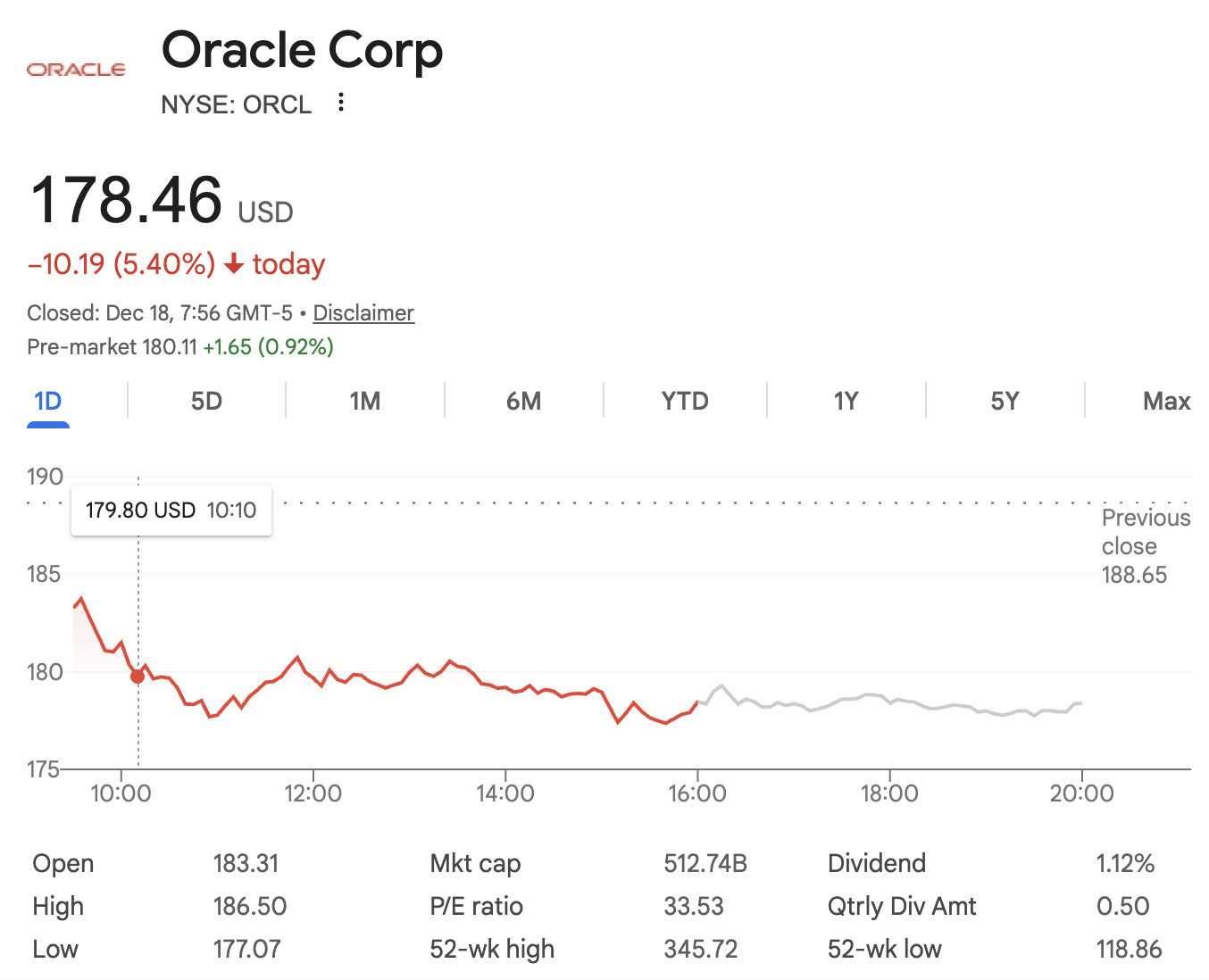
Source: Google Finance
Why Did Oracle’s Data Center Funding Unravel?
Oracle has spent recent quarters racing to expand its cloud business, building out massive new data centers to secure deals with top clients like Meta Platforms, Nvidia, and especially OpenAI. Historically, Oracle worked with private equity funds like Blue Owl Capital to finance these capital-intensive infrastructure projects.
But the Blue Owl deal fell apart for several reasons:
-
Rising Financial Risk: Oracle’s ballooning debt—up 30% year-over-year to over $105 billion—made lenders more wary.
-
Harsher Lending Terms: Market sentiment shifted, with creditors demanding stricter terms than for larger rivals like Amazon or Microsoft.
-
Project Execution Fears: Local legal disputes and potential delays at the Michigan site raised red flags.
-
Private Credit Pullback: Blue Owl’s move signals that even the most aggressive lenders are getting cautious about funding AI infrastructure, threatening the entire investment cycle.
How Did the Market React? The Stock Suffered
The market’s response was swift and brutal. On the day news of Blue Owl’s withdrawal broke, Oracle’s stock plummeted nearly 10%, wiping out around $69 billion in value. Since its highs in late 2024, Oracle shares have slid over 40%, with December alone bringing a 15% dive.
Investors had already been on edge after the company’s latest earnings missed Wall Street forecasts. Despite strong cloud order numbers, Oracle reported negative free cash flow (a rare event for a tech giant), raised its capital expenditure targets by $15 billion, and acknowledged its debt burden would likely exceed $290 billion by 2028.
The Double-Edged Sword of Growth: Can Oracle Turn Orders into Real Profits?
Oracle talks up its $523 billion backlog—leftover performance obligations from cloud and infrastructure deals, up more than five-fold in just one year. But investors now want to see those contracts actually show up as recurring revenue.
Oracle is betting the farm on the idea that AI-fueled demand (from OpenAI, Meta, and others) will fill its new data centers and turn those investments into sustained, high-margin growth. Critics worry the company may be too dependent on a handful of huge clients, that debt costs could spiral further if interest rates stay high, and that execution risk remains high if projects like Michigan stall.
Meanwhile, Oracle’s leadership—especially founder Larry Ellison—pledges to maintain an “investment grade” credit rating and emphasizes a “chip neutral” strategy, buying from Nvidia, AMD, and others to stay flexible in the changing AI landscape.
Oracle Stock Price Forecast: Should You Buy, Hold, or Sell?
So what’s next for Oracle stock?
-
Analyst Consensus: Most major Wall Street firms rate Oracle as a “Buy,” but nearly all are watching debt and execution risk closely. The range of price targets has widened.
-
12-Month Price Targets:
-
Most optimistic: $310–$320 (if Oracle delivers on cloud revenue and stabilizes funding)
-
Conservative median: $200–$230 (accounts for ongoing risk and slower revenue conversion)
-
Bear scenario: $160–$180 (if more project delays and financing issues arise)
-
Key Triggers:
-
Can Oracle secure alternative financing for Michigan and other data centers?
-
How quickly do massive backlog orders turn into operating cash flow?
-
Will new tech sector headwinds or AI market shifts cause further demand volatility?
What Should Investors Watch for Now?
In the months ahead, the fate of Oracle’s AI “supercenter” strategy will hang on several factors:
-
Speed of new financing deals: Oracle is reportedly in talks with big US banks for a $38 billion funding package, aiming to plug the gap left by Blue Owl.
-
Actual data center progress: Any more construction or regulatory hiccups could fuel pessimism.
-
Cloud revenue growth: Investors want to see steady sequential jumps in realized cloud revenue—not just backlog.
-
Health of key partnerships: Any wavering by OpenAI, Meta, or other anchor clients could hit sentiment hard.
Final Thoughts: Oracle at a Crossroads
Oracle’s AI ambitions have never been bigger—or riskier. The company’s future valuation now hinges on whether it can turn bold promises and historic backlogs into real, recurring profit, all while managing its swollen debt. The December 2025 data center shock is a wake-up call for investors: this is a high-reward, high-risk moment for Oracle stock.
For investors, it’s time to watch each quarter’s financials, partnership news, and funding developments closely. The next chapters for Oracle—and its share price—are likely to be anything but dull.
Disclaimer: The opinions expressed in this article are for informational purposes only. This article does not constitute an endorsement of any of the products and services discussed or investment, financial, or trading advice. Qualified professionals should be consulted prior to making financial decisions.