U.S. July PCE Inflation Rises 3.7% Year Over Year: Sticky Core Prices Keep Markets Focused on Fed Signals
The latest U.S. Personal Consumption Expenditures (PCE) Price Index for July indicates that inflationary pressures have not fully subsided. The headline PCE Price Index rose 0.2% month over month and 3.7% year over year. The annual reading came in slightly above market expectations and remained well above the Federal Reserve’s 2% inflation target.
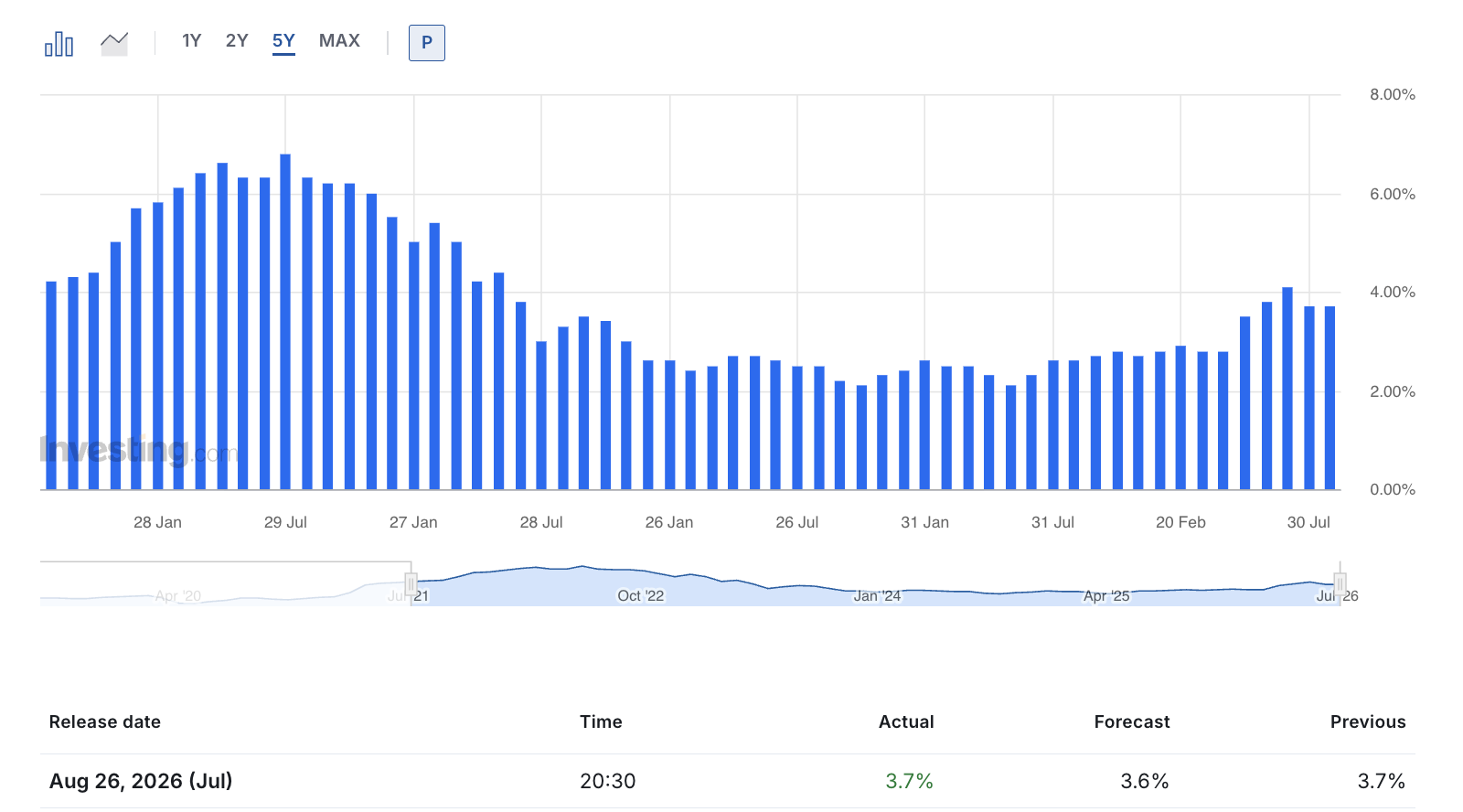
Meanwhile, core PCE, which excludes food and energy prices, increased 0.2% month over month and 3.3% year over year, broadly in line with market expectations. Since core PCE filters out short-term volatility in food and energy prices, it has long been regarded as one of the Fed’s key gauges for assessing medium- to long-term inflation trends. As a result, while the latest report does not point to a major resurgence in inflation, it is also not strong enough to suggest that the inflation problem has been fully resolved.
Headline Inflation Rebounds as Services Remain the Main Source of Pressure
Headline PCE increased by 0.2% in July, rebounding from a 0.1% monthly decline in June. Looking at the components, goods prices fell 0.1% from the previous month, largely due to lower gasoline and other energy-related prices. Weaker prices for furniture and durable household goods also helped offset some goods inflation.
However, services prices rose 0.3% during the month and remained the primary driver of overall inflation. Financial services and insurance recorded relatively larger price increases, while housing costs continued to rise. This suggests that U.S. inflation is no longer merely a story of goods or energy prices. The stickiness of services inflation could continue to slow the pace of overall disinflation.
Markets are also monitoring “supercore” services inflation, which generally excludes housing and energy. Although the year-over-year pace of this measure has moderated, rising costs for portfolio management, investment advisory services, and related categories continue to support core services inflation. When financial markets perform strongly and assets under management expand, higher fees for related financial services may also be reflected indirectly in PCE data.
Nominal Consumer Spending Rises, but Real Spending Stalls
Beyond inflation data, changes in consumer spending momentum are also worth watching.
Nominal personal consumption expenditures increased 0.2% month over month in July, suggesting continued growth on the surface. However, after adjusting for inflation, real consumer spending was broadly flat, indicating that U.S. consumers’ purchasing power and spending momentum are starting to cool.
By category, real spending on core goods declined, while services spending posted modest growth. This suggests consumers are becoming more cautious about discretionary purchases. At the same time, both personal income and inflation-adjusted disposable income increased, while the saving rate rose to 3%, reaching a multi-month high. This indicates that households are increasing savings and reducing non-essential spending amid elevated prices and interest rates.
In addition, earlier retail promotion schedules, rising oil prices, and the gradual fading of previous tax refunds or fiscal support may affect consumer spending in the coming months. A sustained slowdown in consumption could help ease demand-driven inflation. However, if services prices remain elevated, the Fed may still face a difficult policy trade-off.
Divergence Between PCE and CPI Adds Complexity to Fed Decisions
Recent CPI data had offered some signs of easing inflation, but PCE readings have remained relatively firmer. This highlights the differences between the two indicators in terms of weighting methodology and the composition of their consumption baskets.
Compared with CPI, PCE adjusts category weights based on actual consumer spending behavior. As a result, it may better capture substitution effects and changes in overall household spending patterns. This is one reason why the Fed generally places greater emphasis on PCE, particularly core PCE.
With headline PCE up 3.7% year over year and core PCE up 3.3%, inflation has eased from its peak but remains meaningfully above the Fed’s 2% target. For policymakers, easing policy too early could risk reigniting inflation. At the same time, keeping interest rates elevated for too long could place greater pressure on consumer spending, the housing market, and business investment.
Markets Focus on Fed Commentary and Interest Rate Expectations
Following the PCE release, discussions around the future path of interest rates have intensified once again. With headline inflation slightly above expectations and services inflation still sticky, investors will closely monitor upcoming remarks from Fed officials and their assessment of inflation, employment, and economic growth.
Key questions for the market include:
-
Whether the Fed believes the current disinflation trend is sufficient to justify a policy shift;
-
Whether core services inflation can decline further in the coming months;
-
Whether weaker consumer spending will place meaningful pressure on economic growth;
-
Whether the Fed is more likely to maintain higher rates for longer or preserve room for further policy adjustments at its next meeting.
As inflation data, bond yields, the U.S. dollar, and Fed policy expectations continue to shift rapidly, market volatility may remain elevated. For traders, periods surrounding major economic releases and central bank speeches are often when equity indices, foreign exchange, gold, and U.S. Treasury-related markets experience more pronounced price movements.
Conclusion: Inflation Risks Remain as Markets Enter a Data-Dependent Phase
The core message from the latest PCE report is clear: U.S. inflation is improving, but it has not yet fallen to a level that would allow the Fed to become fully comfortable. Goods price pressures have eased, and consumer spending momentum is showing signs of slowing, but services inflation and core PCE remain elevated, leaving the policy outlook uncertain.
Going forward, markets will continue to monitor employment reports, CPI, PCE, retail sales, and comments from Fed officials. Rather than simply betting on rate hikes or cuts, traders may be better served by focusing on real-time market reactions in the U.S. dollar, U.S. equity indices, gold, and interest-rate products following key data releases, while maintaining a clear risk management plan.
Capture Opportunities From Macroeconomic Volatility With Bitget CFD Trading
PCE, CPI, nonfarm payrolls, and Fed interest-rate decisions can all trigger rapid moves across global markets. If you are looking to track price movements in U.S. equity indices, gold, forex, and other markets, you can explore CFD-related products and tools on Bitget and identify potential long or short opportunities based on your own trading strategy.
However, CFDs are leveraged products. While leverage may amplify potential returns, it can also magnify losses. Before trading, make sure you fully understand the product mechanics, margin requirements, and liquidation risks, and trade carefully according to your own risk tolerance.
Disclaimer
Bitget trading tutorials are for educational purposes only and do not constitute financial advice. Strategies and examples are for reference only and may not reflect actual market conditions.
CFD trading involves significant risk, including the potential loss of capital. Past performance does not guarantee future results. Please conduct your own research and understand the risks involved. Bitget is not responsible for users’ trading decisions.