How Does Bitget Verify Reserves? PoR, Custody and Counterparty Risk Explained
For institutions, choosing a crypto trading venue is not only about liquidity, fees, or API performance. Knowing where assets are held, how reserves can be verified, and how custody exposure can be managed is equally important. As institutional capital moves further into crypto and tokenized markets, reserve transparency is becoming part of the basic infrastructure expected from a major exchange.
Bitget has built several layers around this requirement. Its framework combines monthly Proof of Reserves, Merkle-tree verification, publicly disclosed reserve information, a separate Protection Fund, and institutional off-exchange custody solutions. For tokenized equities, Reality rTokens add another verification layer through daily independent reserve attestations. The result is a model designed to give institutions more ways to verify assets, control custody, and manage counterparty exposure rather than relying on trust alone.
Key Takeaways
-
Bitget's latest Proof of Reserves report, published on August 27, 2026, showed a total reserve ratio of 122%. It marked Bitget's 45th consecutive monthly PoR update since the program began in December 2022.
-
Bitget maintains at least 1:1 reserves for reported user assets and publishes reserve information monthly.
-
Users can independently verify that their balances were included in a reserve snapshot using Bitget's Merkle-tree system and open-source MerkleValidator tool.
-
Bitget maintains a separate Protection Fund backed by 5,500 BTC. Its July 2026 average valuation was approximately $351 million.
-
Institutions can separate custody from execution through integrations including Fireblocks Off Exchange, Copper ClearLoop, Cactus Custody, Bitfire PrimeMirror, and OSL MirrorEX.
-
With Fireblocks Off Exchange, institutional collateral can remain in an external Collateral Vault Account while the institution trades on Bitget, reducing the amount of capital that needs to sit directly on the exchange.
-
Reality rTokens have their own reserve-verification framework. Since August 5, 2026, The Network Firm has prepared daily reserve attestation reports covering Reality's tokenized-stock ecosystem.
-
For institutions, the strongest approach is not to look at PoR in isolation. Bitget combines reserve transparency with custody separation, collateral controls, and additional asset-protection infrastructure.
How Does Bitget Verify Its Reserves?
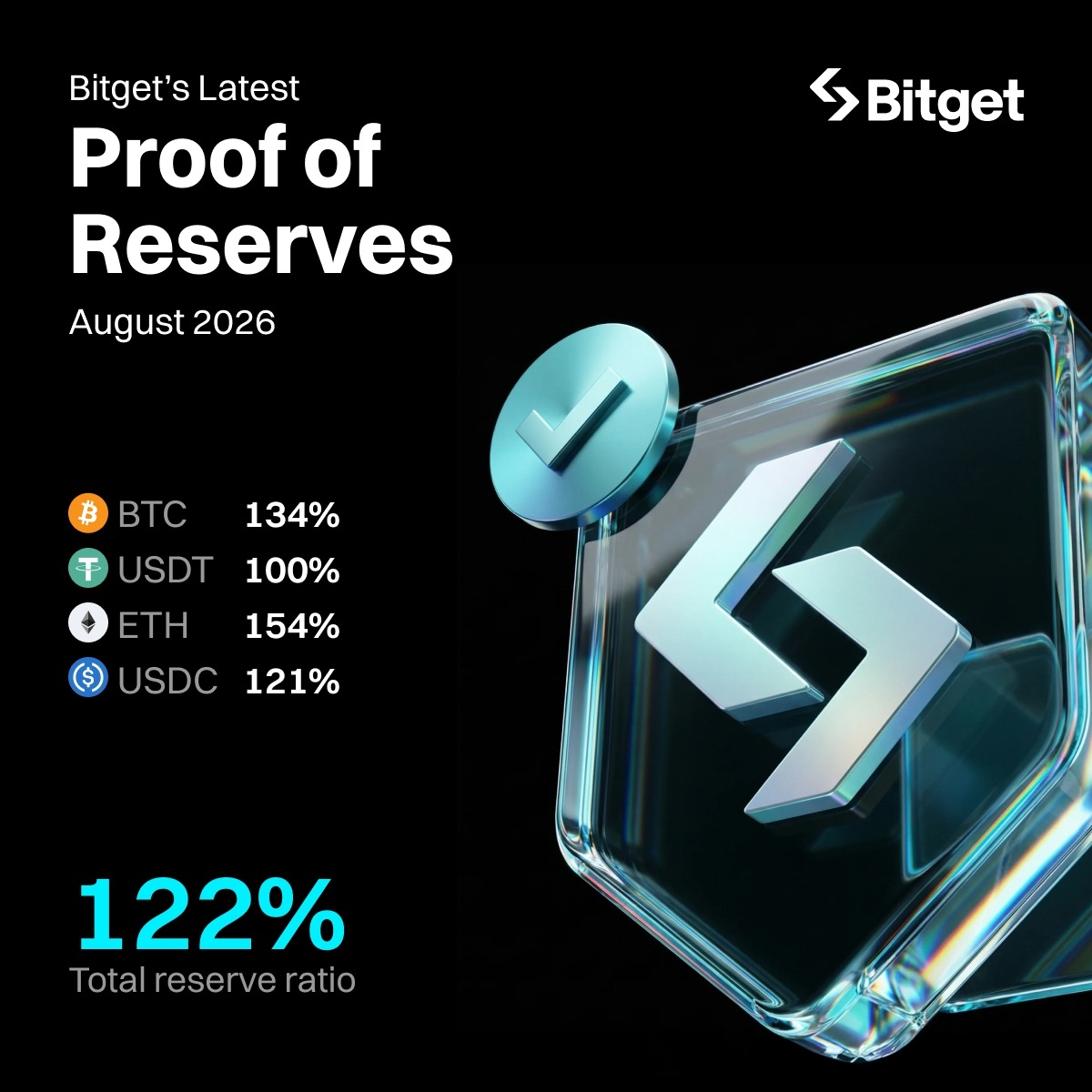
Bitget uses Proof of Reserves, or PoR, to demonstrate that the platform maintains assets sufficient to cover reported customer balances.
👉To view the latest Bitget Proof of Reserves, visit HERE.
The basic calculation is straightforward:
Reserve Ratio = Platform Assets ÷ User Assets
A reserve ratio of 100% means platform reserves equal the reported user assets covered by the calculation. A ratio above 100% indicates that reported platform assets exceed those customer balances.
Bitget introduced its PoR program in December 2022 and updates the information every month. On August 27, 2026, Bitget published its 45th consecutive report, with a total reserve ratio of 122%.
The latest August snapshot reported user holdings of:
| Asset | Reported User Holdings |
| BTC | 26,811 BTC |
| ETH | 123,688 ETH |
| USDT | 1,453,506,874 USDT |
| USDC | 109,685,432 USDC |
| Total reserve ratio | 122% |
Reserves remained above the 1:1 benchmark across all tracked assets in the August report.
For institutions, the value is not simply the 122% headline figure. The consistency of the reporting matters as well. Instead of publishing a one-off reserve snapshot, Bitget has maintained monthly PoR reporting for nearly four years, giving risk teams a historical series they can continue to monitor.
That creates a stronger transparency framework: institutions can look not only at whether reserves exceed customer balances today, but also at whether Bitget continues publishing and maintaining coverage over time.
How Does Bitget's Merkle Tree Verification Work?
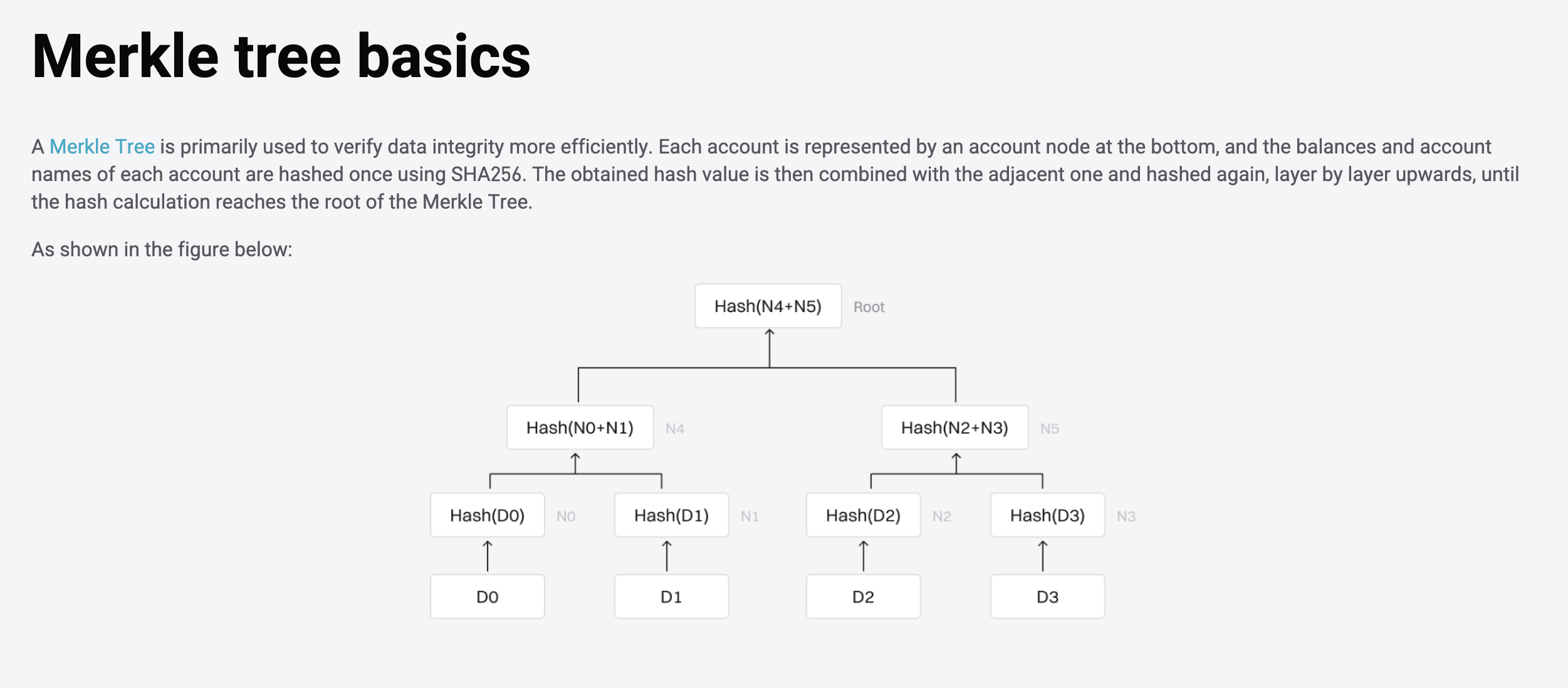
Publishing a reserve ratio is one layer of transparency. Bitget goes further by allowing users to verify cryptographically that their own balances were included in the reported user-asset snapshot.
Bitget uses a Merkle tree, a cryptographic data structure that organizes user asset information into hashed leaf nodes. Each user's balance information is represented through an encrypted identifier, nonce, and asset balances. Those leaf hashes are progressively combined until they produce a single Merkle root.
If underlying information changes, the corresponding hashes change as well. This makes the structure useful for checking the integrity of the dataset while preserving user privacy.
How Users Can Verify Their Bitget Assets
Bitget allows users to:
-
Open Asset Overview > Proof of Assets.
-
View the relevant asset snapshot.
-
Download their Merkle-tree verification data.
-
Use Bitget's open-source MerkleValidator tool.
-
Compare their calculated path with the published Merkle root.
If the calculated root matches, the user's balance is confirmed as part of that PoR dataset. Bitget also publishes the verification tool's code, so technically sophisticated users and institutions can review the methodology or build their own verification process.
For an institutional risk or treasury team, this is an important distinction. Bitget does not simply publish a reserve percentage and ask clients to accept it. Individual users can independently verify that their own assets were included in the underlying liability snapshot.
That makes PoR more useful as an operational monitoring tool rather than only a marketing statistic.
What Does Bitget Proof of Reserves Mean for Institutions?
For institutions, Bitget PoR provides a transparent way to monitor one of the most basic questions in exchange due diligence:
Are reported customer assets backed by corresponding platform reserves?
Bitget's framework addresses this through several components working together:
| Verification Layer | What It Provides |
| Monthly PoR | Regular reserve coverage reporting |
| Reserve ratio | Comparison between reported platform and user assets |
| Merkle tree | Cryptographic representation of customer balances |
| MerkleValidator | Independent user-level balance verification |
| Published reserve information | Greater visibility into platform asset coverage |
| Historical monthly reports | Ability to monitor reserve coverage over time |
For professional firms, these layers can form part of a broader exchange due-diligence process alongside internal risk limits, legal review, custody arrangements, and settlement controls.
PoR is particularly valuable because it makes reserve coverage observable and repeatable. An institution does not need to evaluate Bitget based only on reputation or trading activity. It can review the latest reserve ratio, verify its own balance inclusion, and monitor updates month after month.
That is the larger institutional value of Bitget's approach: reserve transparency becomes something clients can independently check rather than something they simply have to trust.
Bitget Protection Fund Adds Another Layer of Asset Protection
Bitget's Protection Fund is separate from Proof of Reserves.
PoR is designed to demonstrate reserve coverage. The Protection Fund provides an additional financial protection layer for eligible circumstances involving user assets.
Bitget launched the fund in 2022 with a commitment to maintain its valuation above $300 million. The fund currently holds 5,500 BTC. In July 2026, its latest reported monthly figures were:
-
Average value: approximately $351 million
-
Monthly high: approximately $365.9 million
-
Monthly low: approximately $329.8 million
-
BTC holdings: 5,500 BTC
The fund remained above Bitget's original $300 million commitment throughout the month.
The important point for institutional users is that the Protection Fund does not replace PoR. It sits alongside it.
Bitget therefore approaches asset protection through two distinct layers:
-
Proof of Reserves: demonstrates that reported customer assets are backed by reserves.
-
Protection Fund: maintains a separate pool of assets designed to provide additional protection in qualifying circumstances.
For institutions evaluating exchange infrastructure, having both layers creates a broader protection framework than reserve disclosure alone.
How Can Institutions Reduce Counterparty Exposure With Off-Exchange Custody?
For large institutional portfolios, verifying exchange reserves is only one side of counterparty-risk management. Another strategy is simply to reduce how much capital needs to sit directly on an exchange in the first place.
Bitget supports this through institutional fund custody and off-exchange settlement.
The basic workflow is:
-
The institution secures assets with a third-party custodian.
-
Funds are locked in the custodial environment.
-
The value is mapped to the institution's Bitget trading account.
-
The institution trades through Bitget.
-
The custodian and Bitget settle the required net amount.
This separates asset custody from trade execution.
Bitget currently integrates with several institutional custody providers:
| Custody Solution | Institutional Function |
| Fireblocks Off Exchange | Collateral Vault Account and off-exchange trading |
| Copper ClearLoop | MPC custody with mirrored trading balances |
| Cactus Custody Oasis | Separation of custody and execution |
| Bitfire PrimeMirror | Mirrored third-party custody |
| OSL MirrorEX | Trading and settlement while assets remain with OSL Custody |
For institutional treasury teams, the advantage is straightforward. They can access Bitget's liquidity and execution infrastructure without necessarily placing their entire trading portfolio into ordinary exchange custody.
This gives professional clients more flexibility to design their own custody model while still participating in Bitget markets.
Fireblocks and Copper Bring Institutional Custody Closer to Traditional Prime Infrastructure
Two integrations are particularly important for institutions: Fireblocks Off Exchange and Copper ClearLoop.
Fireblocks Off Exchange: Trade While Retaining Control of Assets

Bitget announced its Fireblocks Off Exchange integration on June 17, 2026.
Instead of transferring collateral into a conventional exchange wallet, institutions can place assets inside an MPC-based Collateral Vault Account, or CVA. Client assets remain in the external vault while Bitget receives on-chain visibility needed to verify that the trading account is sufficiently collateralized.
The structure allows institutions to:
-
retain control of collateral on-chain;
-
separate asset custody from execution;
-
access Bitget liquidity;
-
reduce repeated transfers between custodian and exchange;
-
use real-time on-chain settlement;
-
improve operational and capital efficiency.
For an institution managing substantial balances, this can materially change the custody model. Rather than moving the full asset base onto an exchange before trading, capital can remain inside dedicated custody infrastructure while Bitget handles execution.
That is a strong institutional feature because risk controls do not have to come at the expense of market access.
Copper ClearLoop: Mirrored Balances and Off-Exchange Settlement

Bitget also supports Copper ClearLoop, which allows institutions to hold assets within Copper's MPC custody environment while assigning corresponding balances for trading on Bitget.
Trades can then be settled between the two environments rather than requiring every transaction to begin with an on-chain transfer into the exchange.
Copper's ClearLoop structure also uses a dedicated omnibus account subject to an English-law trust framework, designed to provide additional insolvency protection for participating assets.
For professional traders, the model offers a combination of:
third-party custody + Bitget execution + automated settlement + improved capital utilization.
This is where Bitget's institutional risk framework becomes particularly compelling. Instead of treating exchange custody as the only route to liquidity, Bitget allows institutions to build a more flexible separation between where assets are held and where trades are executed.
How Are Bitget rToken Reserves Verified?
Institutions trading Bitget rToken should understand that rToken reserve verification is separate from Bitget's general exchange Proof of Reserves.
Bitget's platform PoR covers the relationship between reported exchange reserves and user balances.
Reality rToken has another layer designed specifically to verify the real-world securities backing the tokenized assets.
On August 5, 2026, Reality expanded its work with The Network Firm from daily reserve data to independently prepared daily PoR attestation reports covering its portfolio of more than 500 tokenized stocks and exchange-traded products.

👉To view the latest Reality Proof of Reserves, visit HERE.
Each issued rToken is designed to be backed 1:1 by the corresponding underlying security. The underlying U.S. stocks and ETFs are custodied through Alpaca Securities LLC, a FINRA-registered and SIPC-covered broker-dealer. The Network Firm performs agreed-upon procedures intended to compare issued rTokens with the corresponding securities held in custody.
For institutions, the verification structure can therefore be understood as:
| Question | Verification Layer |
| Are reported assets on Bitget backed by exchange reserves? | Bitget monthly Proof of Reserves |
| Was my Bitget balance included in the snapshot? | Merkle-tree verification |
| Is an rToken matched to an underlying security? | Reality daily attestation framework |
| Where are the underlying stocks and ETFs held? | Alpaca Securities |
| Can trading collateral remain outside ordinary exchange custody? | Fireblocks, Copper and other custody integrations |
| Is there an additional financial protection layer? | Bitget Protection Fund |
The frequency is another key advantage. Bitget publishes general platform PoR monthly, while Reality's rToken attestation layer is updated daily.
For institutions expanding into tokenized equities, that creates a more transparent bridge between on-chain assets and the traditional securities sitting behind them.
What Should Institutions Know About Counterparty Risk on Bitget?
Institutional counterparty-risk management is not about relying on a single number. The strongest framework combines verification, custody control, exposure management, and operational infrastructure.
Bitget gives professional firms tools across each of these areas.
Reserve Coverage
Institutions can monitor Bitget's monthly PoR and reserve ratio. As of August 27, 2026, the reported total reserve ratio stood at 122%.
Balance Verification
Institutions can use the Merkle-tree system and MerkleValidator to confirm that their own balances were included in the PoR dataset.
Custody Control
Professional clients can choose third-party custody structures rather than keeping all capital under conventional exchange custody.
Concentration Management
Fireblocks, Copper, Cactus Custody, Bitfire, and OSL integrations give institutions more options for separating custody and execution, which can help firms design more diversified treasury arrangements.
Settlement Infrastructure
Off-exchange settlement can reduce the need for frequent deposits and withdrawals while allowing institutions to continue accessing Bitget markets.
Product-Level Transparency
Reality provides a separate daily attestation framework for rTokens, adding another verification layer for institutions trading tokenized U.S. equities.
Additional Asset Protection
The 5,500 BTC Protection Fund provides an additional financial buffer alongside the reserve framework.
The result is a more complete institutional structure:
Verify reserves → verify your balance → choose your custody model → trade through Bitget → settle efficiently → monitor continuously.
Counterparty exposure is something professional firms actively manage rather than simply remove. Bitget's advantage is that it gives institutions multiple tools for controlling that exposure at different stages of the trading lifecycle.
Why Bitget's Reserve and Custody Framework Stands Out for Institutions
For institutions, trust becomes much stronger when it can be backed by data, cryptography, custody controls, and repeatable verification.
Bitget has built its institutional framework around those principles.
Its monthly PoR provides visibility into reserve coverage. The Merkle tree lets institutions verify their own inclusion. The Protection Fund adds another asset-protection layer. Third-party custody integrations allow professional firms to separate custody from execution. And Reality's daily rToken attestations extend reserve transparency into tokenized U.S. equities.
The pieces reinforce one another:
-
122% latest total reserve ratio
-
45 consecutive monthly PoR reports
-
Open-source Merkle verification
-
5,500 BTC Protection Fund
-
Fireblocks Off Exchange
-
Copper ClearLoop
-
Cactus Custody
-
Bitfire PrimeMirror
-
OSL MirrorEX
-
Daily independent rToken attestations
-
Regulated underlying rToken custody through Alpaca Securities
For institutional traders, this means Bitget's proposition extends far beyond publishing a reserve percentage. The platform is building an infrastructure where reserves can be checked, custody can be structured externally, trading capital can remain efficient, and tokenized assets can be independently monitored.
That is a much stronger model for institutional participation than asking clients to rely on a single custody or verification layer.
Conclusion
Institutional trust in digital-asset markets increasingly depends on one thing: verifiability. Firms want to know that reserves exist, that their own balances are included, that assets can be held under appropriate custody structures, and that trading access does not require sacrificing capital control.
Bitget has built a multi-layered answer. Monthly Proof of Reserves and Merkle-tree verification create transparency at the exchange level. The Protection Fund adds another financial safeguard. Fireblocks, Copper, Cactus Custody, Bitfire, and OSL give institutions greater control over how trading assets are custodied and settled, while Reality's daily rToken attestations extend transparency into tokenized equities.
For institutions, Bitget's strength is not simply saying that assets are protected. It is giving professional clients the tools to verify reserves, structure custody, monitor backing, and manage exposure themselves. In institutional markets, that shift from trust to verification is what makes the difference.
FAQs
1. What is Bitget's latest Proof of Reserves ratio?
Bitget's latest Proof of Reserves report was published on August 27, 2026, with a 122% total reserve ratio. It was the platform's 45th consecutive monthly PoR update since December 2022.
2. Can users independently verify their assets on Bitget?
Yes. Bitget uses a Merkle-tree verification system and provides an open-source MerkleValidator tool. Users can download their verification data and confirm that their balances were included in the corresponding reserve snapshot.
3. How does Bitget help institutions manage counterparty risk?
Bitget combines monthly PoR, Merkle verification, a separate Protection Fund, and institutional off-exchange custody integrations. Institutions can use solutions including Fireblocks Off Exchange and Copper ClearLoop to keep assets in third-party custody while accessing Bitget's trading infrastructure.
4. What is the Bitget Protection Fund?
The Protection Fund is a separate asset-protection mechanism established by Bitget. It currently holds 5,500 BTC, and its latest July 2026 report showed an average monthly value of approximately $351 million.
5. How are Bitget rTokens backed and verified?
rTokens are backed 1:1 by their corresponding underlying securities, which are held through Alpaca Securities. Since August 5, 2026, The Network Firm has prepared daily independent reserve attestation reports intended to compare issued rTokens with the corresponding securities held in custody.
Disclaimer: This article is for informational and educational purposes only and does not constitute financial, investment, legal, or tax advice. Proof of Reserves, custody solutions, the Protection Fund, and reserve attestations help improve transparency and risk management but do not eliminate all risks. Institutions should review Bitget's latest terms, disclosures, and custody arrangements before trading or depositing assets.