Escalating Unrest in France: Trading Ideas for EUR and FRA40 Volatility | How Markets May Price Political and Fiscal Risks Six Months Before the Election
Public anger on the streets of France is becoming a new variable that European markets can no longer ignore.
On October 17, France saw its most serious large-scale unrest since the 2018 “Yellow Vest” movement. The demonstrations initially centered on the rising cost of living, but quickly brought together students dissatisfied with education resources, households pressured by fuel costs and inflation, farmers, labor unions, and resurgent Yellow Vest supporters.
France’s Interior Ministry estimated that around 550,000 people took to the streets that day, while organizers put the figure at 800,000. Clashes, arson, looting, and attacks on government buildings were reported in multiple locations. Paris, Marseille, Lyon, Limoges, Bordeaux, and other cities were affected, with police carrying out mass arrests.
For markets, this is more than a social event. It is a risk signal emerging from the intersection of fiscal pressure, energy costs, austerity budgeting, and political uncertainty ahead of the presidential election. Over the coming months, the euro and France’s benchmark equity index, FRA40—linked to the CAC 40—may become increasingly sensitive to political headlines, polling shifts, sovereign yield spreads, and broader risk sentiment.
From “The Cost of Living Is Too High” to a Political Crisis: What Is the Market Worried About?
The core slogan of the protests is la vie chère, meaning “life is too expensive” or “the cost of living is too high.”
On the surface, protesters are calling attention to inadequate school funding, teacher shortages, rising fuel prices, higher agricultural costs, and declining purchasing power. At a deeper level, however, the unrest reflects broader anxiety within French society over the government’s fiscal path and the country’s economic outlook.
1. Rising Energy and Fuel Costs
Against a backdrop of conflict in the Middle East and shipping risks in the Strait of Hormuz, uncertainty surrounding crude oil transportation, insurance, and supply has increased. Oil prices briefly rose above US$100 per barrel, and French households have felt the impact most directly through higher prices at fuel stations and rising daily expenses.
Higher oil prices not only reduce consumers’ disposable income, but also raise costs for logistics, agriculture, manufacturing, and retail. For an economy such as France’s, which depends heavily on domestic demand and services, this can pressure both corporate earnings and consumer confidence.
2. Austerity Budgets and Fiscal Credibility Concerns
The government is under pressure to pursue an austerity budget, yet there is a clear contradiction between reducing spending and improving public services. Students are demanding more resources for schools, public-sector workers and unions oppose budget cuts, and the government must still demonstrate to markets and the European Union that it can control deficits and debt.
This leaves France facing a classic policy dilemma:
-
If fiscal spending is increased: Social pressure may ease temporarily, but budget deficits and sovereign debt risks could worsen.
-
If austerity is maintained: Fiscal discipline may be preserved, but public discontent, strikes, and political polarization could intensify.
What matters most to markets is not the number of protesters on any single day, but whether demonstrations continue to grow and eventually force the government to loosen fiscal discipline or enter a political deadlock earlier than expected.
3. Six Months Before the Election: Political Risk Premiums May Rise
With roughly six months remaining before the first round of the 2027 French presidential election, street clashes can easily become part of competing electoral narratives.
The government is emphasizing “order” and a crackdown on violence. The left is criticizing austerity measures and insufficient public services. Meanwhile, the far-right National Rally may benefit from public concerns about security, anti-government sentiment, and the rising cost of living.
As election uncertainty increases, markets typically begin reassessing:
-
France’s future fiscal policy;
-
The direction of labor-market and pension reforms;
-
The degree of fiscal coordination with the European Union;
-
Energy, defense, and industrial policy;
-
Foreign investors’ risk appetite toward French assets.
These factors may translate into volatility in French sovereign bond yields, French-German yield spreads, the euro, and FRA40.
EUR Trading Watch: Where Do the Risks to EUR/USD Come From?
A single event in France is usually not enough to determine the euro’s broader trend. However, when French political turmoil coincides with weak eurozone growth, rising energy prices, and changing expectations for European Central Bank policy, EUR/USD volatility may increase.
Scenarios That Could Weigh on the Euro
If markets believe the unrest in France is escalating into a prolonged political crisis, the euro could come under pressure, particularly under the following conditions:
1. Protests continue and develop into cross-sector strikes
Disruptions to transportation, energy, education, public services, and retail could further weaken economic activity.
2. The government is forced to revise its austerity budget
If fiscal deficit-control targets are called into question, risk premiums on French sovereign bonds may widen.
3. French-German sovereign yield spreads widen
The gap between French and German 10-year government bond yields is an important market indicator of French political and fiscal risk. A sustained widening of the spread is often negative for euro sentiment.
4. Risk aversion rises and the U.S. dollar strengthens
If markets are also dealing with geopolitical risks or a global equity-market pullback, safe-haven demand for the U.S. dollar may put pressure on EUR/USD.
Scenarios That Could Support the Euro
However, the euro is not guaranteed to decline. EUR/USD could also rebound if the following factors emerge:
-
Protest activity moderates and the government restores order quickly;
-
The French government presents a fiscal plan that markets consider credible;
-
Eurozone economic data exceeds expectations;
-
U.S. economic data weakens, raising expectations for Federal Reserve rate cuts;
-
The ECB maintains a relatively hawkish stance, supporting euro interest-rate differentials.
Therefore, when trading EUR/USD, traders should avoid chasing moves based solely on French news headlines. It is important to monitor the U.S. Dollar Index, U.S.-Europe rate expectations, French-German yield spreads, and risk sentiment in European equity markets.
FRA40 Trading Watch: French Equities Become More Sensitive During Political Volatility
FRA40 is a popular CFD index product tracking major listed companies in France. Its constituents are highly international in nature and include luxury goods, banking, energy, industrials, aerospace, and consumer businesses. As a result, FRA40 is influenced by domestic political risks in France, but also by the global economic cycle, the U.S. dollar, oil prices, and Chinese consumer demand.
However, when unrest affects major cities such as Paris, Lyon, and Marseille—and disrupts retail, tourism, and luxury-shopping districts—FRA40 may face a higher short-term risk discount.
Potential Bearish Factors for FRA40
Pressure on Consumer and Retail Sentiment
Large demonstrations and damage to stores may temporarily affect retail, tourism, hospitality, and premium-consumption activity. If violence persists, companies may face higher security, insurance, and operating costs.
Banks and Financial Stocks Are Sensitive to Sovereign Yield Spreads
French bank stocks are generally sensitive to sovereign bond markets, economic growth, and credit risk. If French bond yields rise and spreads against German bonds widen, financial stocks could weigh on FRA40 performance.
Political Uncertainty Can Depress Valuations
Markets dislike risks that cannot be easily priced. When investors cannot assess future government policy on fiscal spending, taxation, labor, or industry, they often demand a higher risk premium, which can lower price-to-earnings valuations.
FRA40 Volatility Trading Ideas: Three Scenario Frameworks
The following is an event-driven and technically confirmed trading framework:
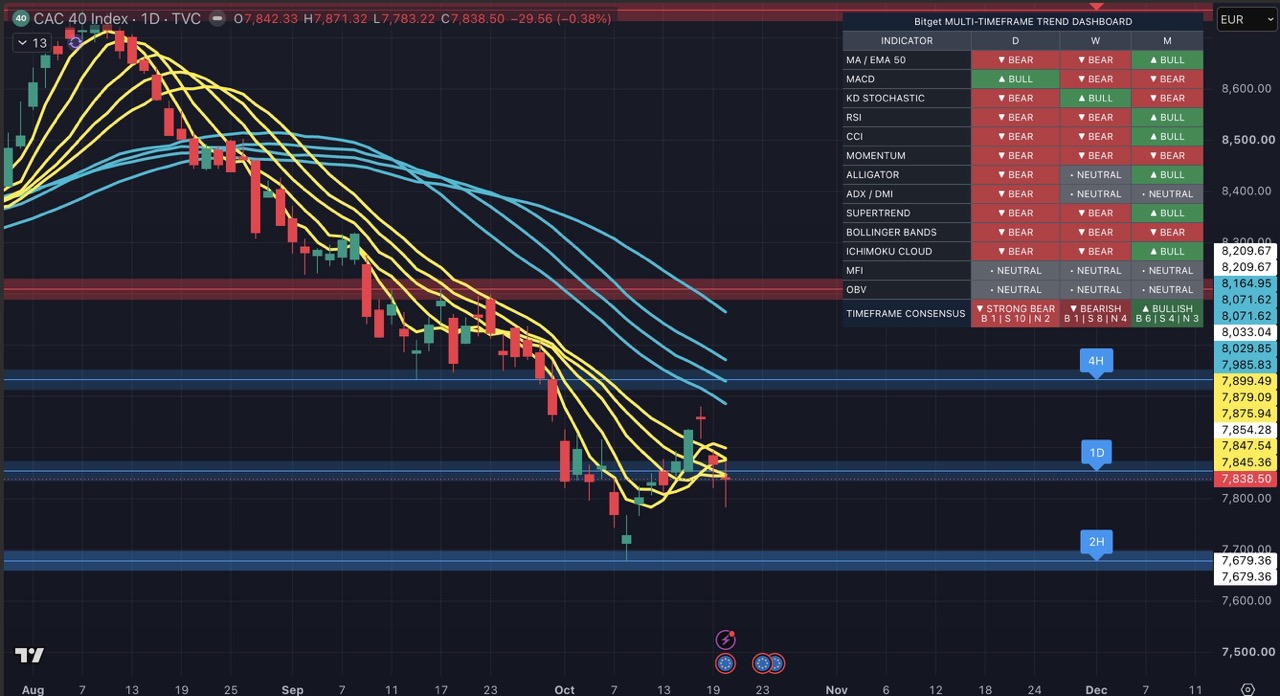
Scenario 1: Unrest Escalates and FRA40 Breaks Below Key Support
If weekend protests extend into the working week, or if news emerges of nationwide strikes, blocked budget legislation, or selling pressure in French government bonds, FRA40 may experience a gap lower or an accelerated decline.
Key factors to watch include:
-
Whether the opening price breaks below the previous trading day’s low;
-
Whether price breaks key support with increased volume;
-
Whether European bank stocks weaken at the same time;
-
Whether the French-German 10-year yield spread widens;
-
Whether EUR/USD is also under pressure.
In this scenario, traders may wish to avoid blindly chasing a sharp selloff. Instead, they can wait for confirmation signals—such as a weak rebound, former support turning into resistance, or a failed retest after a breakdown—before assessing trend-following opportunities.
Scenario 2: Negative News Is Priced In and a Headline-Driven Rebound Emerges
If the government announces stabilization measures, protest participation is lower than expected, or markets believe political risks are temporarily contained, FRA40 may see a “sell the rumor, buy the fact” rebound.
Key factors to watch include:
-
Whether the index holds above its prior low or a major round-number level;
-
Whether intraday price action forms a long lower wick alongside recovering volume;
-
Whether major European equity indices rebound in tandem;
-
Whether volatility declines and bank and luxury stocks stop falling;
-
Whether EUR/USD begins to strengthen.
This type of market environment is typically characterized by sharp volatility and fast reversals. It may therefore be more suitable for smaller position sizes and clearly defined stop-loss levels, rather than aggressive directional bets before the situation becomes clearer.
Scenario 3: Range-Bound Volatility While Waiting for the Next Political Catalyst
If markets do not see further escalation but also receive no policy signal strong enough to resolve the risk, FRA40 may consolidate within a high-volatility range.
For short-term traders, key areas of focus may include:
-
Upcoming protest dates in Paris and across France;
-
Whether unions call for cross-sector strikes;
-
Progress on France’s budget legislation and parliamentary votes;
-
Changes in polling support for far-right and left-wing political blocs;
-
French sovereign debt auctions and comments from credit-rating agencies;
-
ECB officials’ remarks, inflation data, and PMI releases.
In a range-bound market, rather than attempting to predict the final direction, traders may find it more effective to wait for clearer breakout signals near support and resistance levels.
What Data Should Traders Track When Trading the Euro and FRA40?
If French political risk becomes a core market theme, the following indicators may be worth adding to a daily watchlist:
| Item to Monitor | Potential Market Implication |
| French-German 10-year sovereign yield spread | A widening spread usually suggests markets are pricing in greater French political and fiscal risk |
| EUR/USD | Reflects eurozone risk appetite and safe-haven demand for the U.S. dollar |
| Performance gap between FRA40 and DAX40 | If FRA40 significantly underperforms German equities, it may signal rising France-specific risk |
| European bank stocks | Sensitive to interest rates, sovereign bonds, and the economic outlook |
| Brent crude oil price | Rising oil prices may intensify cost-of-living and inflation pressures in France |
| VIX and European volatility indicators | Can help assess whether markets are shifting into risk-off mode |
| French opinion polls and budget progress | Can influence medium-term political risk premiums |
Conclusion: Street Risk in France Could Become Europe’s Next Source of Volatility
The unrest in France during October is not merely a public-order issue. It reflects the tensions between rising living costs, pressure on public services, energy uncertainty, fiscal austerity, and electoral politics.
In the short term, markets may be most sensitive to whether protests spread, whether strikes broaden, and whether the government can maintain fiscal credibility. Over the medium term, shifts in public opinion ahead of the 2027 presidential election could leave French assets carrying a higher political risk premium.
For CFD traders, events like these often create larger price swings—but higher volatility also means higher risk. When trading products such as EUR/USD, EUR/JPY, and FRA40, avoid entering positions based solely on news-driven sentiment. Risk should be managed through stop-loss orders, position sizing, and cross-market confirmation.
Want to follow real-time opportunities arising from French political risks, euro movements, and FRA40 volatility? Visit the Bitget CFD trading platform to monitor popular markets such as EUR/USD and FRA40, combining live market data, technical analysis, and disciplined risk management to build your own trading strategy.
All trading education provided by Bitget is for educational purposes only and should not be considered financial advice. The strategies and examples shared are for reference only and may not reflect actual market conditions. CFD trading involves significant risk, including the potential loss of capital. Past performance does not guarantee future results. Please conduct thorough research and ensure that you understand the risks involved. Bitget is not responsible for any trading decisions made by users.