Written by: Dave
Summary
HYPE has implemented a strong buyback mechanism (so far about $1.3 billion, accounting for about 46% of all token buybacks in 2025) and enjoys solid revenue support. Almost all researchers are very optimistic about this token, but today I want to play the contrarian: several structural and macro factors make HYPE a less "sweet" deal.
1. Buybacks VS Unlocks
Buybacks have always been the main mechanism supporting the price of HYPE, and many KOLs have mentioned this. However, future token unlocks should not be ignored either.
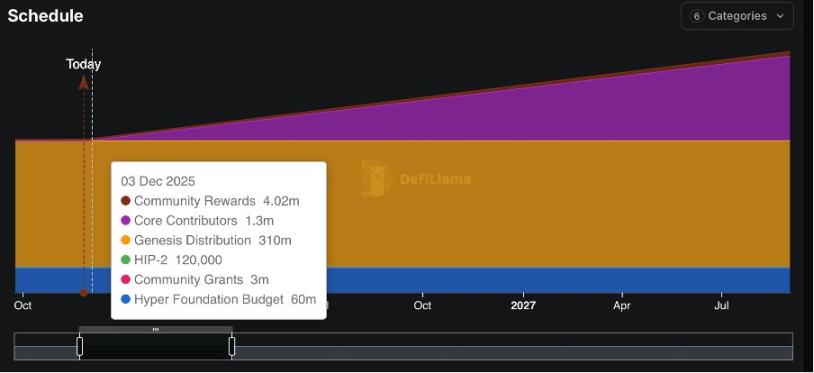
Starting from 2025-11-29, 373 million HYPE tokens will be unlocked (about 37% of total supply), approximately 215,000 HYPE per day, with an unlocking period of 24 months. At the current price, this will create a potential supply pressure of about $200 million per month.
In comparison, the total buyback amount for 2025 is $644.64 million, averaging about $65.5 million per month, with buyback funds coming from 97% of trading fees. Daily buybacks can only cover 25-30% of the daily unlocked amount. Even if revenue continues to grow strongly, the buyback capacity will struggle to absorb such a scale of unlocks, inevitably leading to price compression.
2. Market Cycle Risk & Valuation Fragility
Currently, almost all valuations of HYPE (including the widely cited P/E, which is actually calculated on a ttm basis) are based on strong data from the past few months, i.e., a bull market. But as someone who has experienced the 2022 bear market, I believe macro cycle factors are key variables that must be considered. At least in the foreseeable future, the probability of a bear market is no less than that of a bull market, and core assumptions and indicators are all challenged.
2.1 Current Overview
Current revenue indicators are indeed very strong:
-
· Annualized revenue: $1.2 billion
-
· Fully Diluted Valuation (FDV): $31.6 billion
-
· Circulating supply: $20 billion (data source: Defillama)
-
· TTM PE is about 16.67
· Compound monthly revenue growth from 2024-12 to 2025-08 is +11.8%
These figures seem attractive compared to most US stock companies, but that's also where the problem lies—in the upcoming bear market, HYPE may face a more severe Davis Double Kill situation than other projects.
2.2 Bear Market Scenario and Davis Double Kill
Backtesting shows that the correlation coefficient between perpetual contract trading volume and BTC price is > 0.8 (across cycles).
-
· 2022 bear market: Perpetual contract trading volume fell 70% compared to the 2021 peak.
-
· Revenue dependence: 91% comes from trading fees, making it highly susceptible to trading volume shocks.
-
· Withdrawal delay: HLP vault requires 4 days lock-in, centralized exchange withdrawals require 24-48 hours
This is a classic Davis Double Kill structure: crypto asset prices fall → trading volume & fees drop, while valuation multiples contract → forming a vicious cycle.
The valuation of $HYPE is mostly based on the performance of the past year's bull market. However, in the Web3 sector, revenue is highly cyclical. We should also adjust our basic assumptions accordingly.

Unlike US stocks, where the S&P has shown almost smooth growth since 2008, the cryptocurrency market still exhibits boom-bust cycles. Although macro market factors are indeed difficult to quantify, the ability to grasp these cycles is precisely what distinguishes excellent traders from top traders in the crypto space.
2.3 Crypto-native Indicators
We know that even in traditional finance, P/E is not the only indicator; there are also EV/EBITDA, P/FCF, ROIC, etc. For HYPE, some other important indicators also need to be considered, including:
-
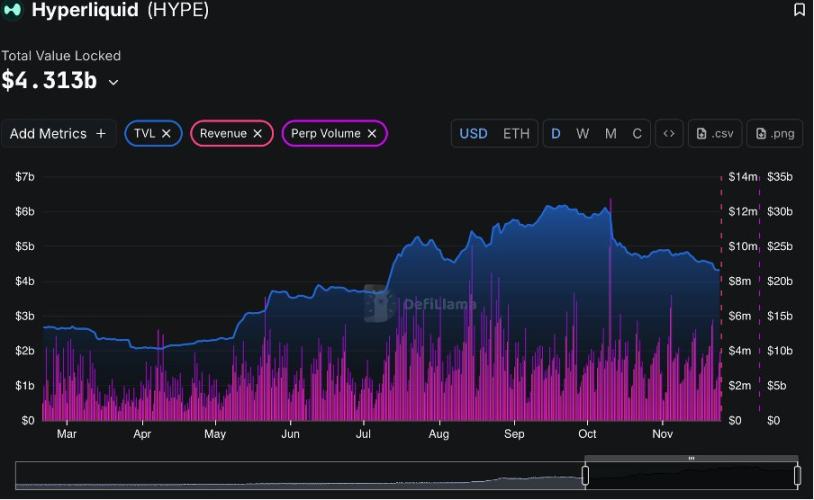
TVL: $4.3 billion, but showing a clear downward trend from the 2025.09 peak of $6.1 billion.
-
P/TVL: 2.0 (Solana 1.5).
Market share: Market share has dropped from the 80% peak to 70%, credit to the dark horse Aster. Of course, there are also lighter edgex and a bunch of others.
3. Is Dave an idiot for FUDing HYPE? Not necessarily
Although I currently do not support investing in HYPE, my bearish stance only applies to the mid-term perspective. If we look at a 2-5 year long-term investment cycle, HYPE is definitely worth investing in. This needs no further explanation.
A complete investment decision depends on multiple factors, including position size, drawdown tolerance, investment goals, etc.
All projects are under pressure in a bear market, so what is the way out?
Prediction markets may currently offer a higher cost-performance ratio. @a16z research says the correlation between prediction markets and the broader market is only 0.2-0.4, compared to >0.8 for $HYPE.
Moreover, 2026 will see many high-profile events, such as the World Cup (the last for many veterans like Messi and Ronaldo), the US midterm elections, the Winter Olympics, the League of Legends World Championship, and many game, movie, and anime releases such as GTA6. It is foreseeable that it will be a big year for betting. A considerable amount of off-market funds may flow into this sector, potentially even impacting the Nasdaq. So, in the mid-term, if you go with the trend, prediction market projects are worth paying attention to.





