

Alliant Energy Corporation
Huling na-update noong 2026-06-30 05:09 EST. Ang impormasyon sa presyo ng stock ay nagmumula sa TradingView at sumasalamin sa real-time market prices.
LNT stock price change
LNT key data

Bitget ushers in the Stocks 2.0 era:
Isang bagong paraan ng trade stocks — anumang oras, kahit saan, 24/7.
I-access ang likididad sa Wall Street, mga payout ng dibidendo, at suporta sa margin ng futures.
Learn moreAlliant Energy Corporation overview
LNT Pulse
Daily updates on LNT stock prices, fund flows, and market news, generated by AI and reviewed by our team of analysts. Always DYOR.
LNT Stock Price Forecast
According to technical indicators for LNT stock, the price is likely to fluctuate within the range of 85.63–88.51 USD over the next week. Market analysts predict that the price of LNT stock will likely fluctuate within the range of 72.17–112.90 USD over the next months.
Batay sa mga pagtataya ng presyo sa loob ng 1 taon mula sa 71 mga analista, ang pinakamataas na pagtatantya ay 121.14 USD, habang ang pinakamababang pagtatantya ay 58.90 USD.
Trending stocks
Trade spot stocks on Bitget
Trade stock perps on Bitget
Tungkol kay Bitget
Latest LNT stock news
Ilalabas ng Edison International ang Q4 Earnings: Ano ang Inaasahan?
Ang hangganan ng AI ay kuryente! Matapos ang pinakamalaking pagsasanib ng public utility sa kasaysayan ng US stock market, ang bagong "nagtitinda ng pala" ng AI data center—mga stock ng kuryente, ay nasa sentro ng atensyon
Ilalabas ng Edison International ang Q4 Earnings: Ano ang Inaasahan?
Ang hangganan ng AI ay kuryente! Matapos ang pinakamalaking pagsasanib ng public utility sa kasaysayan ng US stock market, ang bagong "nagtitinda ng pala" ng AI data center—mga stock ng kuryente, ay nasa sentro ng atensyon
LNT competitors


Mga bagong uso sa industriya ng stock at estratehiya sa pangangalakal ng stock ng Bitget
Ang stock tokenization ay umuusbong bilang isang pangunahing kalakaran sa interseksyon ng tradisyonal na pananalapi at merkado ng cryptocurrency. Sa pamamagitan ng pagdadala ng mga asset tulad ng mga stock sa blockchain at pagpapagana ng 24/7 na pandaigdigang trading, pinahuhusay nito ang accessibility, kahusayan, at transparency para sa mga mamumuhunan.
Itinuturing ng Bitget ang suporta sa pangangalakal ng stock bilang isang mahalagang estratehikong direksyon para sa pagbuo ng platform. Kasalukuyang sinusuportahan ng platform ang pangangalakal ng mga stock token at stock perps, at naitatag na ang sarili bilang isang pangunahing manlalaro sa larangang ito.
Ang mga pangunahing bentahe ng mga stock perps ng Bitget ay nakasalalay sa kanilang inobasyon at disenyo na nakatuon sa gumagamit:
1. Una sa mundo: Ang unang tokenized stock index perps sa industriya, na nakaangkla sa maraming pinagmumulan ng presyo para sa mas malawak na transparency at seguridad.
2. Mataas na leverage: Sinusuportahan ang hanggang 25x na leverage, na nagpapakinabang sa kahusayan ng kapital at mga potensyal na kita.
3. Mga sari-saring pinagbabatayang asset: Sinasaklaw ang daan-daang sikat na stock, na sumusuporta sa malawak na hanay ng mga estratehiya sa trading.
4. Low transaction fees: Ang mga bayarin ay may limitasyon sa 0.06%, na binabawasan ang mga gastos para sa mga trader na madalas makipagtransaksyon.
5. Mekanismo ng pagkalkula ng indeks: Batay sa mga presyo ng USDT ng mga tokenized asset mula sa iba't ibang issuer (hal., xStocks, Ondo). Ang mga timbang ay regular na kinakalkula muli o tuwing may nagaganap na mga pangunahing kaganapan sa merkado upang matiyak na ang index ay nananatiling nakahanay sa mga kondisyon ng merkado.
Sa unang bahagi ng Disyembre 2025, ang Bitget ay nakapagtala ng mahigit $18 bilyon sa trading volume sa merkado ng stock perps, na ginagawa itong isa sa mga pinakasikat na plataporma para sa mga stock token at stock perps. Sa pagtatapos ng 2026, ang pinagsama-samang trading volume ng Bitget sa merkado ng stock perps ay inaasahang lalampas sa $100 bilyon.
Magpatuloy sa pagbabasa upang matuto nang higit pa tungkol sa mga asset na sinusuportahan para sa pangangalakal sa Bitget, pati na rin ang detalyadong impormasyon tungkol sa mga stock token at stock perps ng Bitget.



Key differences between Bitget and traditional brokers
What are the key advantages of Bitget Stocks 2.0?
1. Access real U.S. stock market depth with fast, low-latency trading.
2. Mga stock na pangkalakal na sinusuportahan ng 1:1 ng mga totoong pinagbabatayang asset, na may mga dibidendo na direktang kinikredito sa iyong account.
3. Use your stock assets across Bitget's margin and yield ecosystem.
How do I start stock trading on Bitget?
1. Gumawa ng account at kumpletuhin ang pag-verify ng pagkakakilanlan.
2. Magdeposito ng USDT sa iyong spot account.
3. Go to the stock trading section.
4. Maglagay ng mga kalakalan at pamahalaan ang iyong mga posisyon.
Mga artikulong may kaugnayan sa mga stock token at stock perps
As a leading crypto exchange, Bitget offers a diverse range of derivative products, including classic crypto perpetual futures (like BTCUSDT and ETHUSDT) and innovative stock perps—USDT-margined perpetual futures tracking tokenized U.S. stock indices (such as TSLA, NVDA, AAPL).
Parehong uri ng produkto ang sumusuporta sa leverage, hedge mode (long/short), at USDT settlement. Ang mga ito rin ay mga perpetual futures na walang expiration, gamit ang mekanismo ng funding rate upang mapanatili ang mga presyo na nakaangkla sa spot price ng mga pinagbabatayang asset. Gayunpaman, malaki ang pagkakaiba ng mga ito sa mga tuntunin ng mga katangian ng pinagbabatayan na asset, volatility, profile ng panganib, at pangkalahatang karanasan sa trading. Binibigyang-daan ka ng mga stock perps na palakasin ang mga kita gamit ang leverage habang sinusuportahan ng medyo matatag na mga pundamental na batayan at pangangasiwa ng regulasyon sa stock market ng US. Kung ikukumpara sa mga purong crypto futures, mas hindi sila madaling kapitan ng matinding pagbabago-bago ng presyo (tulad ng mga biglaang pag-crash), kaya mas madaling pamahalaan ang pangkalahatang panganib. Dahil dito, isa silang mainam na pagpipilian para sa mga mangangalakal na gustong pagsamahin ang katatagan ng tradisyonal na pananalapi at ang kakayahang umangkop ng crypto.
Core advantages of Bitget stock perps over crypto futures
Pinagsasama ng mga stock perps ang mga tradisyonal na pinansyal na asset at mga crypto derivatives, na nag-aalok ng malinaw na mga bentahe sa maraming dimensyon. Ang mga ito ay partikular na angkop para sa mga gumagamit na may katamtamang risk appetite o mga mamumuhunan na naghahanap ng iba't ibang uri ng ari-arian palayo sa mataas na pabagu-bago ng crypto.
| Dimension |
Bitget stock perps (U.S. stocks, perpetual futures) |
Bitget crypto futures (crypto like BTC/ETH, perpetual futures) |
Why stock perps have the edge |
| Underlying volatility |
Mababa hanggang katamtaman (pang-araw-araw na galaw na 1–5%, paminsan-minsan ay mas mataas para sa mga pangalang tulad ng NVDA) |
Napakataas (BTC daily moves na 5–15%; maaari itong lumagpas sa 20% sa matinding mga kondisyon) |
Mas kaunting flash crash ang mga stock ng US at mas hinihimok ng mga fundamentals, na nagbabawas sa panganib ng black-swan liquidation. |
| Flash crashes/extreme moves |
Mas mababang panganib (mas matatag ang mga presyo dahil sa mga regulated na merkado at multi-source index aggregation) |
Mas mataas na panganib (ang mga desentralisadong pamilihan ay mahina sa malalaking order at manipulasyon) |
Gumagamit ang mga stock perps ng composite index mula sa maraming tokenized sources para sa mas patas na pagtuklas ng presyo, na ginagawang mas malamang ang mga flash crash kumpara sa crypto. |
| Leverage |
Up to 100x on popular stocks, 10–25x on indices |
Up to 125x (for major crypto like BTC) |
Pinapalakas ng katamtamang leverage ang kita habang kinokontrol ang labis na panganib, kaya mas angkop ito para sa patuloy na lumalawak na mga posisyon. |
| Funding rate / holding cost |
Karaniwang mas mababa (depende sa long/short ratio), matatag sa ilang partikular na panahon |
Lubos na pabago-bago (ang mga may hawak ng long position ay kadalasang nagbabayad ng mataas na bayarin sa mga bull market) |
Mas mahuhulaang gastos para sa pangmatagalang paghawak ng mga posisyon, na binabawasan ang panganib ng paghina ng kita dahil sa mga bayarin sa pagpopondo. |
| Transaction fees |
Napakababa (maaaring 0% ang maker fees, ang taker fees ay kasingbaba ng 0.0065%, na may maraming limited-time perks) |
Standard sa 0.02% para sa mga order ng tagagawa at 0.06% para sa mga order ng taker |
Ang mas mababang gastos sa transaksyon ay nangangahulugan na maaari kang magbukas ng mas malalaking posisyon o mag-trade nang mas madalas gamit ang parehong kapital. |
| Pangkalahatang antas ng panganib |
Medyo mas mababa (sinusuportahan ng mga pundamental na stock at mas mababang volatility) |
Mas mataas (hinihimok ng purong haka-haka at mataas na pabagu-bago) |
Bagama't pinapataas ng leverage ang kita, mas mababa ang posibilidad ng likidasyon, kaya angkop ito para sa mga estratehiyang katamtaman hanggang pangmatagalan. |
| Pag-iba-iba at pag-iingat |
Madaling pagsamahin sa mga crypto portfolio upang mabawasan ang single-asset risk |
Mataas ang kaugnayan (karamihan sa mga crypto ay gumagalaw sa BTC) |
Nagbibigay ng direktang pagkakalantad sa tradisyonal na pananalapi, na nagbibigay-daan sa tunay na pag-iba-iba ng mga asset. |
| Target users |
Mga gumagamit ng crypto na may katamtamang gana sa panganib na gusto ang pagkakalantad sa stock ng US ngunit ayaw sa mataas na pabagu-bagong pananaw |
Mga purong manlalaro ng crypto na may mataas na risk tolerance na naghahangad ng pinakamataas na kita |
Isang mas madaling puntahan at matatag na tulay patungo sa mga tradisyunal na pamilihan, na nagpapababa ng posibilidad na mawala ng mga bagong mangangalakal ang kanilang buong puhunan. |
Sa buod, pinapanatili ng mga stock perps ng ang kakayahang umangkop sa crypto trading (leverage, USDT settlement, hedge mode) habang makabuluhang binabawasan ang pabagu-bago at matinding panganib. Nagsisilbi silang mainam na tulay para sa mga gumagamit ng crypto na naghahangad na mag-level up sa tradisyonal na pananalapi.
Trading stock perps vs. crypto futures: Use cases
Ipagpalagay natin na ang isang user ay may 1000 USDT at gumagamit ng 10x leverage sa Bitget, na naglalayong hawakan ang posisyon sa loob ng isang linggo. Ang pinasimpleng halimbawang ito (hindi kasama ang mga bayarin/mga rate ng pagpopondo bilang paglalarawan) ay nagpapakita ng potensyal na pagkakaiba sa kinalabasan at mga panganib.
Scenario 1: Going long on a tech stock (NVDA)
-
Mga stock perps: Ipagpalagay na NVDA ay tumaas ng 8% sa loob ng isang linggo (isang tipikal na paggalaw pagkatapos ng kita). Sa 10x na leverage, ang kita ay humigit-kumulang 80%. Ang 1000 USDT ay nagiging 1800 USDT. Banayad ang volatility na halos walang flash crash, na nag-aalok ng kapanatagan ng loob at napakababang panganib ng likidasyon.
-
Crypto futures: Ipagpalagay na ang BTC ay tataas ng 8% sa parehong bullish na kapaligiran. Ang teoretikal na kita ay 80% din na may 10x na leverage. However, BTC often experiences drawdowns of 10–15%. Ang posisyon ay madaling ma-liquidate o bahagyang ma-liquidate sa kalagitnaan, na posibleng magdulot sa iyo ng pagkawala ng prinsipal kahit na tama ang pangwakas na direksyon.
Scenario 2: Extreme market volatility (negative news)
-
Mga taong gumagawa ng stock: Bumagsak ang merkado ng 4% sa isang araw dahil sa mga komento ng Fed. Sa 10x na leverage, ang pagkalugi ay 40%, na nag-iiwan ng 600 USDT na balanse. Bihirang bumaba ng mahigit 10% ang mga stock ng US sa isang araw at may posibilidad na makabawi, na may mas kaunting sunod-sunod na likidasyon.
-
Crypto futures: Sa parehong 10x na leverage, ang 10% na flash crash (karaniwan sa crypto) ay magreresulta sa 100% na pagkalugi, na siyang magbubura sa account.
Ipinapakita ng mga halimbawang ito na pinapayagan ng mga stock perps ang leverage na palakasin ang mga kita nang hindi pinapalakas ang panganib ng pagkawasak. Ito ay lalong mahalaga sa panahon ng earnings season o macro events, na nagbibigay-daan sa iyong makuha ang mga alpha asset sa US stock markets habang iniiwasan ang brutal washouts na tipikal sa crypto.
Who are Bitget stock perps best suited for?
1. Bullish o bearish ang mga mamumuhunan sa mga stock ng US na walang tradisyonal na account Maaari kang makipagkalakalan ng mga direksyon sa paggalaw sa mga sikat na stock tulad ng Apple, Tesla, Nvidia, at Coinbase nang direkta gamit ang USDT sa iyong crypto wallet, nang hindi na kailangang harapin ang abala ng mga tradisyunal na brokerage account, cross-border transfer, at mga paghihigpit sa heograpiya.
2. Mga katutubo ng crypto na pamilyar sa mga crypto futures at 24/7 na merkado Ang interface ng pangangalakal, mga uri ng order (limit, merkado, at kondisyonal na mga order), pagsasaayos ng leverage, pamamahala ng posisyon, at mekanismo ng pagpopondo ay halos kapareho ng BTC/USDT o ETH/USDT perpetual futures. Para sa mga batikang crypto trader, wala talagang learning curve, at ang oras ng kalakalan ay isang malaking pag-upgrade mula sa tradisyonal na oras ng merkado.
3. Mga agresibo/ispekulatibong mangangalakal na naghahanap ng mataas na leverage: Dahil ang leverage ay higit na lumalagpas sa 2–4x margin na iniaalok ng mga tradisyunal na stock broker, perpekto ito para sa paggamit ng mas maliit na kapital upang makuha ang malalaking rally (tulad ng sa Tesla o Nvidia) o para sa pagkuha ng malalaking short position sa mga overvalued na tech name. Tandaan na nagpapahiwatig din ito ng napakataas na panganib at angkop lamang para sa mga gumagamit na may mataas na kakayahang tumanggap ng panganib.
4. Mga hybrid trader na aktibo sa parehong crypto at stocks Ang isang Bitget account at isang pool ng USDT capital ay nagbibigay-daan sa iyong walang putol na magpalipat-lipat sa pagitan ng crypto futures at stock perps. Pinapakinabangan nito ang kahusayan ng kapital at bilis ng operasyon, lalo na para sa mga madalas na nagbabalanse o naghahanap ng mga cross-market hedge.
5. Mga propesyonal o semi-propesyonal na mangangalakal na naghahanap ng low-barrier, 24/7 na access: Kabilang dito ang mga naghahanap upang i-hedge ang mga crypto portfolio, mag-speculate sa mga tech stock/indeks, o magpatakbo ng grid/quantitative bots. Sinusuportahan ng platform ang mga TradingView chart, API, at mga propesyonal na tool tulad ng mga TP/SL order.
Conclusion
Kung ikaw ay isang beterano sa crypto na sawa na sa mga high-volatility blowouts ngunit gusto mo pa ring lumahok sa paglago ng mga nangungunang pandaigdigang kumpanya (tulad ng Apple, Tesla, Nvidia), ang mga stock perps ng Bitget ay isang mahusay na pagpipilian. Pinagsasama nila ang pinakamahusay sa parehong mundo—leverage, 24/7 na access, at mababang hadlang, habang makabuluhang binabawasan ang emosyong FOMO na partikular sa crypto.
Ang pangangalakal ay may kasamang malaking panganib. Magsimula sa maliliit na halaga, gumamit ng mababang leverage, palaging magtakda ng TP/SL, at mag-trade nang responsable. Subukan mo lang ito sa Bitget!
Panimula
Bilang isang nangungunang platform sa kalakalan ng cryptocurrency, kamakailan ay inilunsad ng Bitget ang 25 USDT-M U.S stock perpetual futures, na sumusuporta ng hanggang 25x na leverage. Ang makabagong produktong ito ay nagbibigay-daan sa mga gumagamit na samantalahin ang mga pagkakataon sa pamumuhunan sa U.S. stock na may USDT settlement, nang hindi direktang hawak ang mga pangunahing stock assets. Kung ikukumpara sa tradisyonal na U.S. stock futures, ang Bitget U.S. stock futures ay nag-aalok ng malinaw na mga bentahe sa leverage, mga bayarin sa transaksyon, at mga oras ng kalakalan. Ipinaliwanag ng artikulong ito ang kahulugan, mga katangian, sinusuportahang mga asset, gabay sa kalakalan, pamamahala ng panganib, at mga konsiderasyon para sa Bitget U.S. stock futures upang matulungan ang mga gumagamit na maunawaan at makipagkalakalan nang ligtas.
Ano ang stock futures?
Ang stock futures ay makabagong walang hanggan na index ng futures para sa mga stock assets na ipinakilala ng Bitget. Ang mga pangunahing asset nito ay tokenized stock indices na umiikot na sa merkado. Bawat index ay naglalaman ng hindi bababa sa isang tokenized stock, na maaaring nagmula sa iba't ibang mga issuer. Itinatakda at inilalathala ng Bitget ang mga timbang batay sa mga bahagi ng kalakalan sa merkado at likwididad. Halimbawa, ang index price ng NVDA/USDT perpetual futures ay maaaring isang composite index ng NVDA RWA tokenized stocks na inisyu ng xStock, ONDO, at iba pa.
Idinadagdag o inaalis ng Bitget ang mga token o mga pamilihan ng kalakalan batay sa mga salik tulad ng aktibidad sa merkado at dami ng kalakalan, na ina-update ang mga pinagmulan ng index. Ginagawa nitong mas transparent at matatag ang mga presyo ng futures. Sa halip na subaybayan ang mga pangunahing stock assets nang direkta, nagsisilbi silang sukatan ng mga presyo ng tokenized stock.
Tradisyonal na futures at Bitget U.S. stock futures
Ang Bitget U.S. stock futures ay mas mahusay kaysa sa tradisyonal na U.S. stock futures sa ilang aspeto. Narito ang mga pangunahing paghahambing:
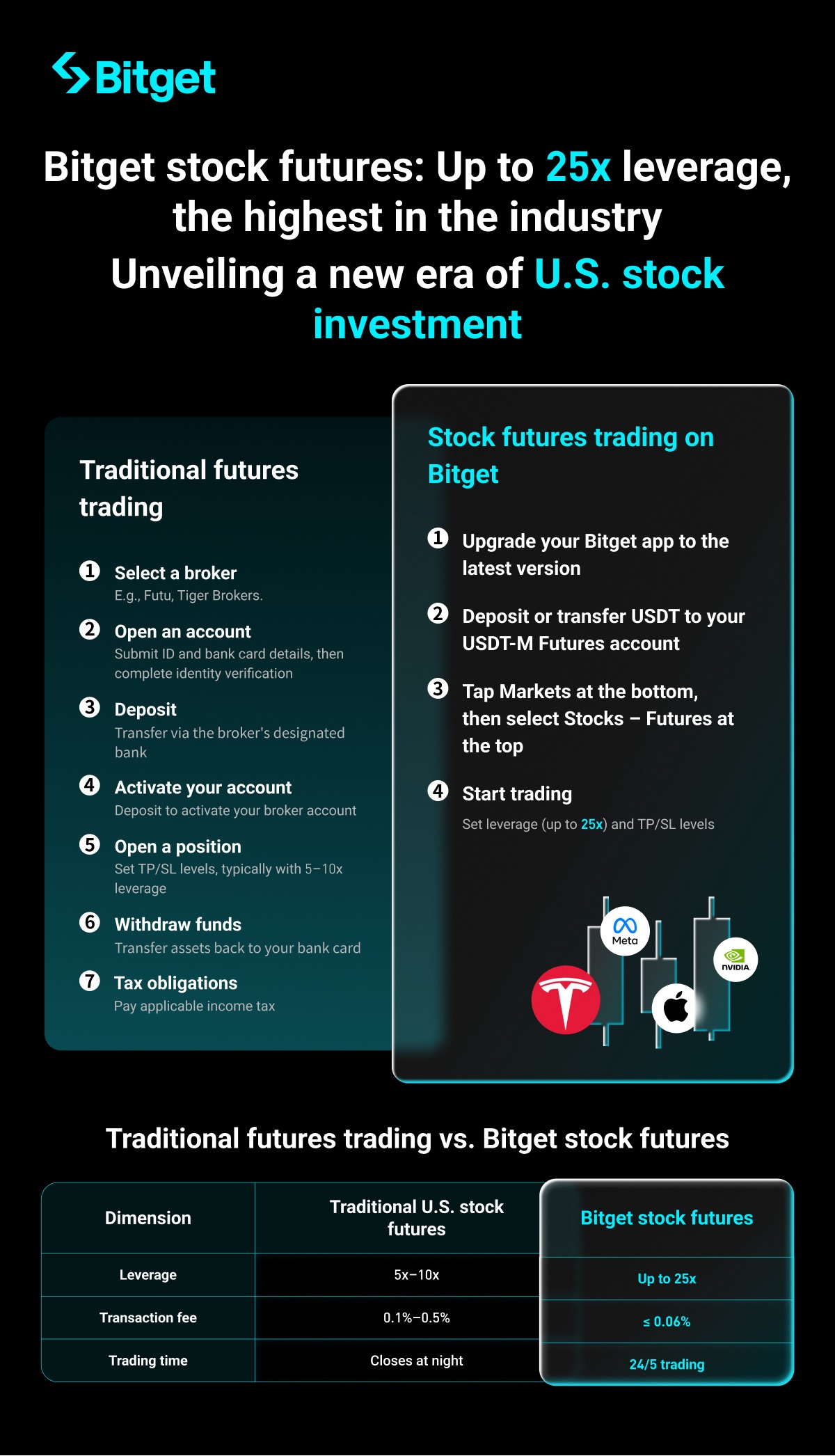
Mga pagkakaiba sa pagitan ng Bitget U.S. stock futures at mga karaniwang USDT-M perpetual futures
Ang Bitget U.S. stock futures ay dinisenyo upang maging iba sa mga karaniwang USDT perpetual futures. Narito ang mga pangunahing paghahambing:
| Feature |
Stock futures |
Regular USDT perpetual futures |
| Trading period |
24/5 (UTC-4: mula 12:00 AM Lunes hanggang 12:00 AM Sabado). Ang mga posibleng pagsususpinde ay iaanunsyo nang maaga.
|
24/7 |
| Settlement currency |
USDT |
USDT |
| Quote currency |
USDT |
USDT |
| Underlying asset |
Composite index ng mga tokenized asset na inisyu sa maraming platform (multi-token index) |
Isang itinalagang token |
| Mode ng position |
Isolated margin mode lamang |
Nakahiwalay na margin, cross margin, at pinag-isang trading account |
| Max leverage |
25x |
125x |
| Index price |
Composite index ng mga presyo ng token mula sa mga merkado tulad ng xStock at ONDO |
Spot market price of the designated token |
| Mark price |
Standard method |
Standard method |
| Open interest (OI) limits |
Parehong nalalapat ang mga limitasyon sa OI ng indibidwal at sa buong platform |
Individual OI limits only |
| Funding rate |
4h |
Every 1h, 2h, 4h, or 8h |
Mga kalamangan ng Bitget U.S stock futures
Ang mga pangunahing bentahe ng Bitget US stock futures ay nakasalalay sa kanilang inobasyon at madaling gamitin na disenyo:
1. World's first: Ang unang tokenized stock index futures sa industriya, na nakabatay sa maraming pinagkukunan ng presyo para sa mas malaking transparency at seguridad.
2. High leverage: Sumusuporta ng hanggang 25x na leverage upang mapalaki ang potensyal na kita at mapabuti ang kahusayan ng kapital.
3. Iba't ibang mga underlying assets: Saklaw ang higit sa 20 tanyag na US stocks upang suportahan ang iba't ibang mga estratehiya sa pangangalakal.
4. Mga mababang bayarin sa transaksyon: Rate ng bayad sa transaksyon na hindi mas mataas sa 0.06%, na nagpapababa ng gastos para sa mga mangangalakal na may mataas na dalas.
5. Index calculation: Batay sa mga presyo ng USDT ng tokenized assets mula sa iba't ibang mga issuer (hal. xStock, ONDO), ang mga timbang ay muling kinakalkula nang regular o tuwing may mga pangunahing kaganapan, na tinitiyak na ang index ay sumusunod sa mga pagbabago sa merkado.
Index rebalancing
● Regular rebalancing: Ang mga bahagi ng index at ang kanilang mga timbang ay muling kinakalkula araw-araw sa 16:01:00 AM (UTC+8).
● Special adjustment: Kung ang mga bahagi ay nakakaranas ng makabuluhang mga pagbabago (tulad ng delisting, kakulangan sa likwididad, o labis na pagkasumpungin), sila ay aalisin, ang mga timbang ay muling kinakalkula, at isang kapalit na bahagi ay gagamitin.
● Hard fork/airdrop/adjustments: Walang kinakailangang ayusin para sa mga fork na hindi bumubuo ng mga bagong token. Kung may mga bagong token na nabuo, sila ay isasama sa orihinal na timbang. Kung hindi sila nakakatugon sa mga pamantayan, sila ay aalisin sa susunod na rebalanse. Para sa mga token splits o merges, ang orihinal na bahagi ay papalitan ng bagong token, at ang timbang ay iaangkop nang naaayon.
Mga detalye ng sinusuportahang U.S. stock futures sa Bitget
Sa kasalukuyan, sinusuportahan ng Bitget ang 25 trending U.S stock USDT-M perpetual futures, na naka-grupo ayon sa kumpanya:
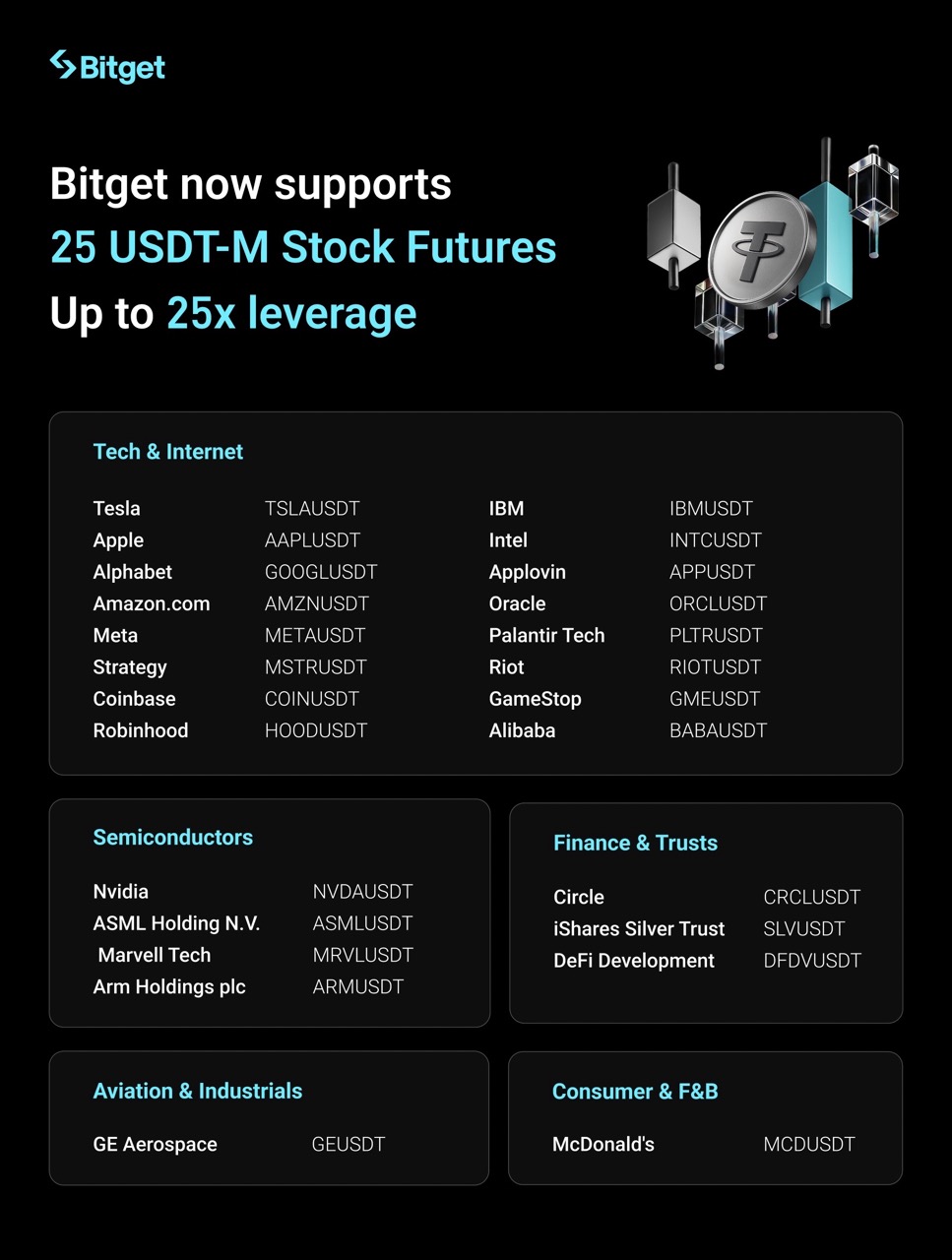
Paano ko maipagpapalit ang U.S stock futures sa Bitget?
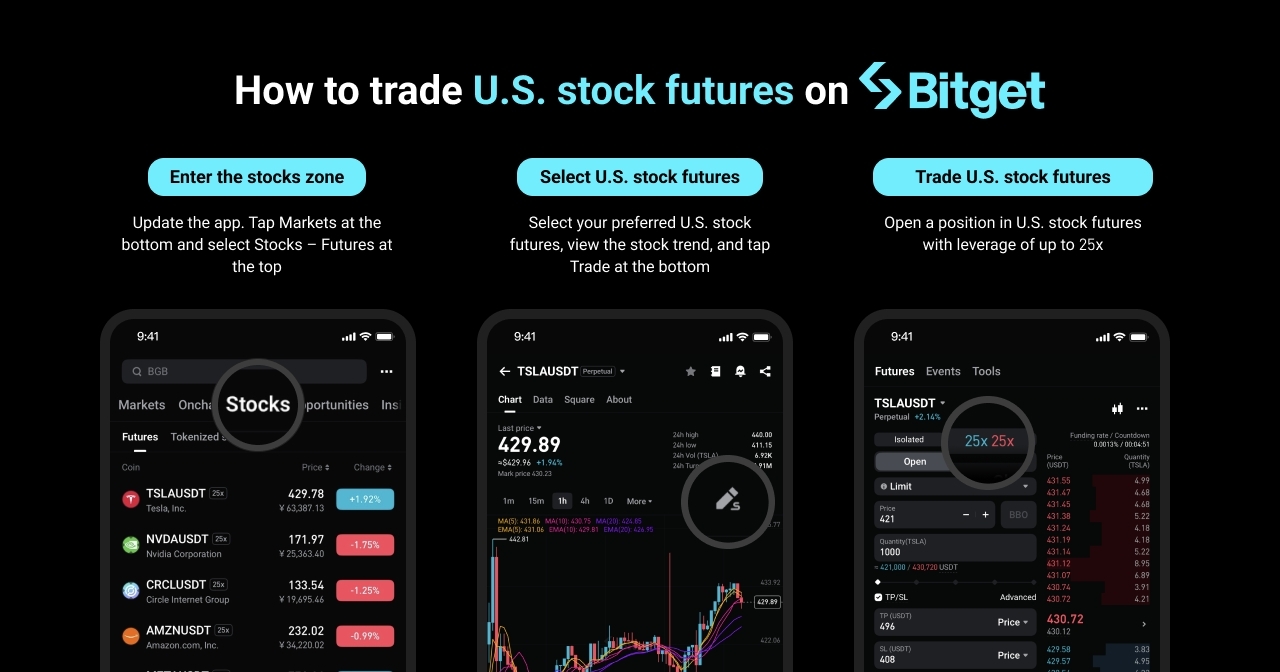
1. I-upgrade ang app: Tiyakin na ginagamit mo ang pinakabagong bersyon ng Bitget App o bisitahin ang opisyal na website.
2. Deposit/transfer: Ideposito o ilipat ang USDT sa iyong USDT-M futures account.
3. Ipasok ang pahina ng kalakalan: I-tap ang Markets sa ibaba, piliin ang Stocks - Futures sa itaas. Maghanap ayon sa ticker o mag-browse sa ilalim ng mga kategorya ng stock.
4. Start trading: Itakda ang leverage (hanggang 25x), TP/SL, at iba pa. Sinusuportahan ang web, app, at API trading, ngunit hindi ang pinagsamang mode ng trading account. Dapat kang lumipat sa single-asset mode.
5. During trading suspension: Maaari mong kanselahin ang mga umiiral na order ngunit hindi ka makakapaglagay ng mga bagong order. Ang mga bayarin sa pagpopondo ay hindi maaayos; ang mark price ay hindi maa-update, at ang mga posisyon ay hindi maliliquidate.
Mga oras ng kalakalan at mga holiday
● Regular trading hours: Available ang kalakalan 24 na oras sa isang araw, limang araw sa isang linggo, mula Lunes 4:00 AM hanggang Sabado 4:00 AM (UTC+8).
● Suspension: Ang kalakalan ay ititigil sa mga pampublikong holiday kapag sarado ang mga pamilihan sa pananalapi. Ang mga pangunahing petsa ng pagsasara para sa 2025 ay ang mga sumusunod:
| Petsa |
Week |
Festival name |
Trading schedule |
| Enero 1, 2025 |
Miyerkules |
Araw ng Bagong Taon |
Sarado buong araw |
| Enero 20, 2025 |
Lunes |
Martin Luther King Jr. Day |
Sarado buong araw |
| Pebrero 17, 2025 |
Lunes |
President's Day |
Sarado buong araw |
| Abril 18, 2025 |
Biyernes |
Good Friday |
Sarado buong araw |
| Mayo 26, 2025 |
Lunes |
Memorial Day |
Sarado buong araw |
| Hunyo 19, 2025 |
Huwebes |
Juneteenth |
Sarado buong araw |
| Hulyo 4, 2025 |
Biyernes |
Araw ng Kalayaan |
Sarado buong araw |
| Setyembre 1, 2025 |
Lunes |
Araw ng Paggawa |
Sarado buong araw |
| Nobyembre 27, 2025 |
Huwebes |
Thanksgiving Day |
Sarado buong araw |
| Disyembre 25, 2025 |
Huwebes |
Christmas |
Sarado buong araw |
● Early closures: Maagang magsasara ang merkado sa 1:00 AM (UTC+8) sa Hulyo 3, 2025 (araw bago ang Araw ng Kalayaan), Nobyembre 28, 2025 (araw pagkatapos ng Thanksgiving), at Disyembre 24, 2025 (araw bago ang Pasko).
● Tandaan: Ang presyo ng pagbubukas ay maaaring magkaiba nang malaki mula sa presyo ng pagsasara ng nakaraang araw. Mangyaring suriin ang mga panganib kung hawak mo ang mga posisyon sa magdamag.
Pamamahala ng panganib at mga paalala
Liquidation mechanism
● Katulad ng regular na isolated margin futures, ang panganib ay tinutukoy ng liquidation price o position margin ratio.
● Sa panahon ng suspensyon, ang mga posisyon ay hindi ililiquidate. Gayunpaman, kung mayroong agwat sa presyo pagkatapos magpatuloy ang kalakalan, maaaring magresulta ito sa liquidation. Inirerekomenda na magdagdag ng karagdagang margin bago magbukas ang merkado.
Insurance fund
● Ang ADL ay naka-enable sa default para sa bawat pares ng futures trading, na may 50,000 USDT na ipinasok bilang paunang pondo ng panganib.
● ADL trigger: Na-trigger kapag ang equity ng insurance fund ay bumaba sa 0.
General risk warning
● Ang U.S. stock perpetual futures ay maaaring makaranas ng mataas na volatility. Ang pangangalakal na may mataas na leverage ay maaaring makabuluhang tumaas ang iyong pagkakalantad sa panganib. Maingat na pamahalaan ang iyong mga posisyon.
● Ang produktong ito ay hindi isang seguridad at hindi kumakatawan sa pagmamay-ari ng underlying stock. Walang mga dibidendo, interes, o karapatan sa pagboto na nalalapat.
● Hindi sakop ng insurance o garantiya ng gobyerno. Ang Bitget ay hindi ang nag-isyu o namamahagi.
● Ang mga digital na asset ay lubos na pabagu-bago. Inirerekomenda na mamuhunan lamang ng kung ano ang kaya mong mawala. Hindi ginagarantiyahan ng nakaraang pagganap ang mga resulta sa future. Ang Bitget ay hindi mananagot para sa anumang pagkalugi.
● Dapat kang palaging humingi ng independiyenteng payo sa pananalapi at kumonsulta sa Mga Tuntunin ng Paggamit at Kasunduan sa Serbisyo ng Kontrata ng Bitget.
● Maaaring isaayos ng Bitget ang mga parameter gaya ng leverage at margin ratio batay sa mga kondisyon ng market. Sumangguni sa mga pinakabagong opisyal na anunsyo.
Patuloy na pagbutihin ng Bitget ang mga produkto upang magbigay ng propesyonal at secure na mga serbisyo sa kalakalan. Para sa karagdagang tulong, bisitahin ang Bitget Help Center o makipag-ugnayan sa serbisyo sa customer. Salamat sa iyong suporta!
Risk warning:
Ang mga stock token (ang "Produkto") ay batay sa isang basket ng mga tokenized na indeks ng stock na umiikot na sa merkado. Gayunpaman, ang Produkto ay hindi isang seguridad at hindi kumakatawan sa aktwal na pagmamay-ari ng pinagbabatayan na mga stock, mga kaukulang stock token, o mga indeks. Hindi ka binibigyan ng karapatan ng Produkto sa anumang mga dibidendo, interes, mga karapatan sa pagboto, mga karapatan ng shareholder, o mga pag-aalok ng karapatan (kabilang ang ngunit hindi limitado sa mga share split, spin-off, o mga karapatan sa subscription) na nauugnay sa pinagbabatayan na mga stock, kaukulang stock token, o mga indeks. Ang produktong ito ay hindi sinusuportahan, nakaseguro, naaprubahan, o ginagarantiyahan ng anumang gobyerno o institusyon. Ang Bitget ay hindi ang issuer o ang distributor ng pinagbabatayan na mga stock, kaukulang stock token, o mga indeks.
Ang mga presyo ng digital asset ay lubhang pabagu-bago at maaaring sumailalim sa mga makabuluhang pagbabago. Ang mga namumuhunan ay dapat lamang mag-invest ng mga pondo na kaya nilang mawala. Maaaring magbago ang halaga ng iyong puhunan, at walang garantiya na makamit ang mga layunin sa pananalapi o mabawi ang iyong prinsipal. Pinapayuhan anng mga mamumuhunan na humingi ng independiyenteng payo sa pananalapi at maingat na tasahin ang kanilang sariling karanasan sa pananalapi at mga pangyayari. Hindi ginagarantiyahan ng nakaraang pagganap ang mga resulta sa future. Walang pananagutan ang Bitget para sa anumang potensyal na pagkalugi. Wala sa artikulong ito ang dapat ipakahulugan bilang payo sa pananalapi. Para sa karagdagang impormasyon, sumangguni sa aming Terms of Use at Futures Service Agreement.
Risk warning
Sa isang Bitget account lang, maaari kang mag-trade ng mga stock at cryptocurrencies nang sabay.
Join now!FAQ
What is the stock price of Alliant Energy Corporation?
What is the stock ticker of Alliant Energy Corporation?
What is the stock forecast of LNT?
What is the market cap of Alliant Energy Corporation?
Ano ang P/E ratio (TTM)?
Ang P/E ratio (TTM) ay nangangahulugang price-to-earnings ratio (labindalawang buwan pagkatapos ng pagtatapos). Ito ay isang makasaysayang sukatan ng pagpapahalaga na kinakalkula gamit ang kita bawat bahagi (EPS) ng isang kumpanya sa pinakahuling labindalawang magkakasunod na buwan, na sumasalamin sa nakaraang kakayahang kumita ng kumpanya.
Sinusukat ng P/E ratio ang ugnayan sa pagitan ng presyo ng isang stock at kakayahang kumita ng isang kumpanya, at kadalasang ginagamit bilang batayan sa paghuhusga kung ang isang stock ay "mura" o "mahal."
P/E ratio = market price (P) ÷ earnings per share (EPS), or P/E ratio = total market capitalization ÷ net profit attributable to shareholders
Ang interpretasyon ng P/E ratio (TTM) ay dapat palaging isaalang-alang kasama ng iba pang mga salik at pangunahing ginagamit para sa mga paghahambing ng pagpapahalaga sa halip na bilang isang nakapag-iisang tagapagpahiwatig.
- Ang mas mababang P/E ratio (TTM) ay nangangahulugan na ang mga mamumuhunan ay nagbabayad ng mas mababa para sa bawat yunit ng kita. Maaaring ipahiwatig nito na ang stock ay undervalued, o na ang merkado ay may limitadong mga inaasahan para sa paglago ng kumpanya sa hinaharap, tulad ng sa mga industriya na may gulang o mabagal na lumalagong industriya.
- A higher P/E ratio (TTM) means investors are paying more for each unit of earnings. Kadalasang ipinapakita nito ang mga inaasahan ng malakas na paglago ng kita sa hinaharap, na karaniwan sa mga stock ng paglago o teknolohiya, bagama't maaari rin itong magpahiwatig na ang stock ay sobrang pinahahalagahan.
- Paghahambing sa mga kapantay: Paghambingin ang P/E (TTM) ng kumpanya sa average o median na P/E ng ibang mga kumpanya sa parehong industriya. Ang isang mas mataas na P/E ay maaaring mangailangan ng karagdagang pagsusuri upang matukoy kung ang mataas na pagtatasa ng kumpanya ay makatwiran dahil sa mas malakas na mga prospect ng paglago o mga kalamangan sa kompetisyon.
- Paghahambing sa mga makasaysayang antas: Paghambingin ang kasalukuyang P/E (TTM) ng kumpanya sa sarili nitong makasaysayang average (tulad ng sa nakalipas na 5 o 10 taon) upang masuri kung ang kasalukuyang pagtatasa ay nasa pinakamataas o pinakamababa sa kasaysayan.
- Paghahambing sa mas malawak na merkado: Ihambing ang P/E (TTM) ng kumpanya sa mga pangunahing indeks ng merkado (tulad ng S&P 500) upang makita kung paano pinahahalagahan ng merkado ang kumpanya sa pangkalahatan.
Ang mga P/E ratio ay maaaring mag-iba nang malaki sa iba't ibang industriya, at walang iisang "ideal" na antas ng P/E. Ang isang makatwirang saklaw ng P/E ay nakasalalay sa industriya, potensyal ng paglago ng kumpanya, at sa mas malawak na kapaligirang makroekonomiko. Ang mga desisyon sa pamumuhunan ay hindi dapat umasa lamang sa P/E ratio (TTM) kundi dapat ibase sa isang komprehensibong pagsusuri na kinabibilangan ng kalidad ng kumpanya, mga inaasahang paglago, at kalusugan sa pananalapi.
Can I trade stocks on Bitget?
Maaari kang mag-trade ng mga stock sa Bitget, ngunit pangunahin sa pamamagitan ng mga stock token at stock perps, sa halip na direktang bumili o magbenta ng mga tradisyunal na stock.
Ang pamamaraang ito ay sumasalamin sa pananaw ng Bitget bilang isang Universal Exchange (UEX), na idinisenyo upang ikonekta ang mga tradisyunal na pamilihang pinansyal sa mga pamilihan ng cryptocurrency.
Kasalukuyang nag-aalok ang Bitget ng mga sumusunod na format ng trading na may kaugnayan sa stock:
1. Stock tokens (spot)
Kalikasan: Ang mga stock token ay mga digital token na naka-peg sa presyo ng mga partikular na tradisyonal na stock (tulad ng TSLAUSDT at NVDAUSDT) at i-trade sa spot market ng Bitget.
Features: Kapag nagte-trade ka ng mga stock token, bumibili at naghahawak ka ng mga token sa halip na pagmamay-ari ng mga pinagbabatayang tradisyonal na stock.
- Ang presyo ng mga token na ito ay karaniwang sumusunod sa paggalaw ng presyo ng mga stock na nakabatay sa mga ito, tulad ng Tesla o Nvidia.
- Ang bentahe ay maaari kang makilahok sa paggalaw ng presyo ng mga tradisyunal na pinansyal na asset, tulad ng mga stock ng US, gamit ang mga cryptocurrency (halimbawa, USDT), nang hindi nangangailangan ng tradisyonal na brokerage account.
2. Stock perps
Kalikasan: Nag-aalok din ang Bitget ng USDT-margined perpetual futures, karaniwang tinutukoy bilang stock perps, batay sa mga pangunahing blue-chip stock ng US tulad ng Tesla at Meta.
Mga Katangian: Ang mga stock perps ay mga produktong derivative na nagbibigay-daan sa iyong magkaroon ng bullish o bearish na pananaw sa presyo sa hinaharap ng isang pinagbabatayan na stock sa pamamagitan ng margin trading. Karaniwang sinusuportahan ng mga produktong ito ang leverage, tulad ng hanggang 25x.
Hindi ito nagsasangkot ng pagmamay-ari ng pinagbabatayan na stock. Sa halip, ang mga kita at pagkalugi ay inaayos batay sa mga paggalaw ng presyo ng mga futures.
Important note: Kapag nangangalakal ka ng mga stock perps sa Bitget, nakikilahok ka sa mga derivative market sa loob ng cryptocurrency ecosystem. This is fundamentally different from purchasing publicly traded shares through a traditional brokerage, as you do not own equity in the underlying company.
Ang futures trading at ang paggamit ng leverage ay may kasamang mataas na panganib. Siguraduhing lubos mong nauunawaan ang mga panganib bago mag-trade.
Kung nais mong direktang humawak ng equity sa mga tradisyunal na stock at tamasahin ang mga karapatan ng shareholder (tulad ng pagtanggap ng mga dibidendo), dapat kang mag-trade sa pamamagitan ng isang regulated na tradisyonal na securities brokerage o brokerage platform.
Ano ang mga bentahe ng mga stock perps ng Bitget?
Ang mga stock perps ng Bitget—karaniwang mga perpetual futures batay sa mga presyo ng stock token—ay isang makabagong alok na nagbibigay-daan sa mga platform ng cryptocurrency na magbigay ng pagkakalantad sa mga tradisyunal na pamilihan sa pananalapi.
Kung ikukumpara sa tradisyonal na stock o futures trading, nag-aalok ang mga ito ng ilang natatanging bentahe, pangunahin dahil sa imprastraktura ng trading ng platform.
Ang mga stock perps ng Bitget, na karaniwang mga derivatives na may denominasyong USDT, ay nag-aalok ng mga sumusunod na pangunahing bentahe:
1. Trading convenience and global accessibility
- 24/7 trading: Traditional stock markets, such as U.S. equity markets, operate during fixed trading hours. Sa kabaligtaran, ang mga merkado ng mga derivatives ng cryptocurrency ay karaniwang bukas 24/7. Nangangahulugan ito na maaaring mag-trade ang mga mamumuhunan anumang oras, habang sinasamantala ang mga pinakabagong balita o pagbabago-bago ng merkado.
- Mas mababang mga hadlang sa pagpasok at mas mabilis na onboarding: Kung ikukumpara sa mga tradisyunal na brokerage, na kadalasang nangangailangan ng malawak na identity verificatio at mahahabang proseso ng pag-setup ng account, ang Bitget ay karaniwang nag-aalok ng mas mabilis na onboarding ng account. Maaaring mag-trade ang mga gumagamit gamit ang mga cryptocurrency tulad ng USDT, nang hindi nangangailangan ng mga kumplikadong proseso ng pagdeposito at pag-withdraw ng fiat.
- Pandaigdigang aksesibilidad: Maaaring ma-access ng mga gumagamit ang derivatives trading na naka-link sa mga stock na kinikilala sa buong mundo sa pamamagitan ng platform ng Bitget, napapailalim sa mga naaangkop na regulasyon.
2. Kahusayan ng kapital at mataas na leverage
- Mga opsyon na may mataas na leverage: Karaniwang nag-aalok ang mga stock perps ng mas mataas na leverage kaysa sa tradisyonal na stock trading (halimbawa, hanggang 25x). This allows traders to control larger positions with smaller margin requirements, improving capital efficiency.
Note: While high leverage can amplify gains, it also amplifies losses proportionally. - Two-way trading: Madaling makukuha ng mga trader ang parehong long at short na posisyon. Nangangahulugan ito na ang mga trader ay maaaring kumita mula sa market volatility, tumaas man o bumaba ang mga presyo ng stock, basta't ang direksyon ng merkado ay wastong inaasahan.
3. Trading and settlement using cryptocurrency
- USDT margin: Karaniwang ginagamit ng mga stock perps sa Bitget ang USDT (o iba pang stablecoins) bilang margin at settlement currency. Para sa mga gumagamit na mayroon nang cryptocurrency, hindi na kailangang i-convert ang mga asset sa fiat currency, na nagbibigay-daan sa kanila na direktang mag-trade gamit ang mga stablecoin.
- Mahusay na paglilipat ng pondo: Ang mga paglilipat at pagbabayad na nakabatay sa crypto ay karaniwang mas mabilis kaysa sa mga tradisyunal na sistema ng fiat, na nagbibigay-daan sa mas mahusay na pandaigdigang alokasyon ng pondo.
4. Integration
One-stop platform: Pinapayagan ng Bitget ang mga user na mag-trade ng mga spot cryptocurrency, crypto derivatives, at stock perps sa iisang platform, na ginagawang mas madali ang pamamahala ng iba't ibang uri ng asset sa isang lugar.
Bagama't nag-aalok ang mga stock perps ng Bitget ng ilang bentahe, mahalagang maunawaan ang mga kaugnay na panganib.
- Mataas na panganib sa leverage: Ang leveraged trading ay maaaring magresulta sa mabilis na pagkawala ng iyong buong margin.
- No equity ownership: Kapag nag-trade ng stock perps, hindi mo pagmamay-ari ang mga pinagbabatayan na shares. Dahil dito, wala kang karapatan sa mga dibidendo o karapatan sa pagboto.
- Market liquidity risk: Ang mga stock token perps ay maaaring may mas mababang liquidity kaysa sa kanilang mga katapat sa tradisyonal na stock market, lalo na sa labas ng regular na oras ng kalakalan.
Sa buod, ang mga stock perps ng Bitget ay nag-aalok ng mga bentahe tulad ng mas malawak na kakayahang umangkop sa trading, mas mababang mga hadlang sa pagpasok, at mas mataas na kahusayan sa kapital.
What are the trading fees for Bitget stock perps?
Trading fees for Bitget stock perps (USDT-margined perpetual futures) mainly include transaction fees and funding rates.
Transaction fees:
Nag-aalok ang Bitget ng mga promosyon para sa limitadong oras na bayad para sa mga stock perps (lalo na ang stock token futures) paminsan-minsan upang makaakit ng mga trader.
Standard reference rates: Under Bitget's standard futures fee structure, the taker fee is typically around 0.06%, while the maker fee is around 0.02%.
Current promotions for stock perps (important): To promote its stock perps products, Bitget is offering discounted transaction fees during Q4 2025, with taker fees as low as 0.006% and maker fees as low as 0.002%. Mayroon ding promosyon na may limitadong oras na nag-aalok ng zero-fee trading para sa mga spot stock token.
Funding rate:
Ang funding rate ay isang mahalagang mekanismo sa perpetual futures (kabilang ang mga stock perps) na nakakatulong na mapanatiling malapit na nakahanay ang presyo ng futures sa spot price ng pinagbabatayang asset. It is not a fee charged by the platform, but a periodic payment exchanged between long and short traders.
Ang mga rate ng pondo ay pabago-bago at pangunahing hinihimok ng sentimyento ng merkado at mga kawalan ng balanse sa pagitan ng mga long at short na posisyon. Ang mga stock perps sa pangkalahatan ay nakararanas ng mas mababang volatility kaysa sa mga cryptocurrency, kaya ang mga rate ng pagpopondo ay kadalasang medyo mababa sa panahon ng matatag na kondisyon ng merkado. Gayunpaman, sa panahon ng mga kita o malalaking positibo o negatibong balita, ang matinding konsentrasyon ng mga long o short na posisyon—tulad ng sa mga high-growth technology stock tulad ng Tesla o Nvidia—ay maaaring lumikha ng malalaking kawalan ng balanse, na nagiging sanhi ng pagtaas ng mga funding rate sa maikling panahon.
Funding payments are typically settled every 8 hours. Kung isasara mo ang iyong posisyon bago ang oras ng pag-aayos ng pondo, walang bayad sa pondo ang sisingilin o matatanggap.
Funding rates are not fixed. If you hold a position for an extended period, high positive funding rates (for long positions) or high negative funding rates (for short positions) will affect your overall holding costs or potential returns. Para sa kadahilanang ito, mahalagang subaybayan ang rate ng pagpopondo nang real time sa trading interface.
Bakit ang Bitget ang mainam na plataporma para sa pangangalakal ng mga stock perps?
Ipinoposisyon ng Bitget ang sarili bilang nangungunang Universal Exchange (UEX) sa pamamagitan ng pag-ugnay sa pagitan ng tradisyonal na pananalapi (TradFi) at ng crypto ecosystem. Sa huling bahagi ng 2025 at hanggang 2026, ito ay naging isa sa mga unang pangunahing centralized exchange na nag-aalok ng mga tokenized stock perps, na nagpapahintulot sa mga gumagamit na mag-trade ng mga equity derivatives gamit ang mga crypto-native na tool.
Narito kung bakit ang Bitget ay itinuturing na isang mainam na plataporma para sa pangangalakal ng mga stock perps:
1. Unified collateral (USDT-margined)
One of the biggest advantages is the ability to trade U.S. equities—like Tesla (TSLA), NVIDIA (NVDA), and Apple (AAPL)—using USDT as collateral.
- Walang fiat conversion: Hindi mo kailangang lumabas sa crypto ecosystem o mag-convert sa USD para mag-trade ng mga pandaigdigang stock.
- Cross-asset efficiency: You can manage your crypto and stock positions from a single USDT-M Futures account, allowing for easier capital allocation.
2. Mataas na kahusayan sa kapital
Nag-aalok ang Bitget ng mga agresibong opsyon sa leverage na karaniwang hindi makukuha sa mga tradisyunal na platform ng brokerage:
- Hanggang 25x leverage: Bagama't kadalasang nililimitahan ng mga tradisyunal na stock broker ang mga retail trader sa 2x o 4x leverage, pinahihintulutan ng Bitget ang mas mataas na capital efficiency.
- Fractional trading: Maaari kang kumuha ng mga posisyon sa mga mamahaling stock (tulad ng Meta o Amazon) nang hindi kailangan ang buong kapital para sa isang share, salamat sa flexible na pagsukat ng posisyon ng perpetual futures.
Extended trading hours (24/5)
Traditional stock markets are restricted by opening bells and weekend closures. Bitget's stock perps products are designed for the modern global trader:
- Patuloy na pag-access: Karaniwang tumatakbo ang trading ng 24/5 (Lunes hanggang Biyernes, UTC+8), na sumasalamin sa kakayahang umangkop ng mga merkado ng crypto.
- Macro responsiveness: Kung ang isang pangunahing kumpanya ng teknolohiya ay nag-uulat ng mga kita pagkatapos magsara ang New York, ang mga gumagamit ng Bitget ay kadalasang maaaring tumugon agad sa mga paggalaw ng presyo sa pamamagitan ng mga stock token market
4. Competitive fee structure
Binago ng Bitget ang tradisyonal na modelo ng brokerage gamit ang isang mababang gastos na diskarte:
- Low fees: Ang mga bayarin sa transaksyon para sa mga stock perps ay kadalasang nasa o mas mababa sa 0.06%, na lubos na mapagkumpitensya kumpara sa parehong tradisyonal na mga broker at iba pang crypto-TradFi hybrid platform.
- Walang nakatagong komisyon: Hindi tulad ng maraming "zero-fee" broker na kumikita mula sa malawak na spreads (pagbabayad para sa daloy ng order), gumagamit ang Bitget ng transparent na modelo ng pagpopondo at margin.
5. Advanced trading and copy trading
Bitget brings its social trading DNA to the stock market:
- Copy trading para sa mga stock: Maaari mong sundan ang mga elite trader na dalubhasa sa mga equity market, awtomatikong kinokopya ang kanilang mga stock perps trade.
- Mga kagamitang pinapagana ng AI: Kasama sa platform ang mga ahente ng AI na tumutulong sa pagpapatupad ng trade, pamamahala ng peligro, at technical analysis.
Paano mas pinoprotektahan ng Bitget exchange ang mga asset ng gumagamit?
Ang Bitget ay nagtatag ng isang multi-dimensional at transparent na sistema ng depensa upang protektahan ang mga asset ng gumagamit, na partikular na idinisenyo upang matugunan ang mga hamon ng tiwala na likas sa mga centralized exchanges (CEXs).
Narito ang limang pangunahing haligi ng proteksyon ng asset ng Bitget:
Bitget maintains a dedicated Protection Fund, which serves as the last line of defense against hacks or security breaches.
- Massive scale: Sa unang bahagi ng 2026, ang average na halaga ng pondo ay pinanatili sa humigit-kumulang $600 milyon (dating umabot sa mahigit $750 milyon).
- Asset diversification: The fund consists of highly liquid assets such as BTC and USDT, ensuring solvency even during extreme market volatility.
- Pinopondohan ng sarili: Ang pondong ito ay hindi umaasa sa seguro ng ikatlong partido. Ang Bitget mismo ang nagpopondo nito at nangangakong mapanatili ang balanseng higit sa $300 milyon nang hindi bababa sa tatlong taon nang walang pagwi-withdraw.
Upang maipakita na hindi ginagamit ng platform ang pondo ng mga gumagamit sa maling paraan, ginagamit ng Bitget ang arkitektura ng Merkle Tree upang maglathala ng mga regular na ulat ng reserba.
- Mataas na coverage ratio: Ipinapakita ng datos mula Enero 2026 na ang average na reserve ratio para sa mga core asset (BTC, ETH, USDT, USDC) ay umabot sa 163%, na higit na lumampas sa 1:1 benchmark.
- Malayang pag-verify: Maaaring gamitin ng mga user ang mga open-source na tool na ibinibigay ng platform upang i-verify na ang kanilang mga asset ay kasama sa mga reserve snapshot sa pamamagitan ng mga anonymous ID.
3. Cold/hot wallet isolation and multi-sig
Sa pinagbabatayang antas teknikal, gumagamit ang Bitget ng arkitektura ng seguridad na pang-bank grade:
- 95% offline storage: The vast majority of user assets are kept in cold wallets, completely isolated from the internet to prevent remote hacking.
- Maraming lagda (multi-signature): Ang mga kritikal na paglilipat ng pondo ay nangangailangan ng mga lagda mula sa maraming heograpikal na nakakalat at independiyenteng may-ari ng susi, na nag-aalis ng panganib ng iisang punto ng pagkabigo.
4. Mahigpit na mga patakaran sa seguridad sa pag-withdraw
Upang mabawasan ang panganib ng pagnanakaw ng indibidwal na account, nagpatupad ang Bitget ng maraming mekanismo ng proteksyon:
- Lock sa whitelist ng pag-withdraw: Pagkatapos magdagdag ng bagong address sa pag-withdraw, ang account ay papasok sa 24-oras na withdrawal freeze period.
- Kumpirmasyon ng cross-device scan: Isang feature na inilunsad noong 2026 ang nangangailangan na ang anumang pag-withdraw na sinimulan sa web ay kumpirmahin sa pamamagitan ng pag-scan ng QR code sa pamamagitan ng mobile app, na epektibong pumipigil sa mga PC-based na trojan na pakialaman ang mga address.
5. Compliance and international certification
Aktibong niyayakap ng Bitget ang regulasyon at nakakuha ng ilang internasyonal na sertipikasyon sa seguridad ng impormasyon:
- ISO 27001 at ISO 27701: Nakakuha ang Bitget ng dalawahang sertipikasyon para sa Pamamahala ng Seguridad ng Impormasyon at Pamamahala ng Impormasyon sa Pagkapribado, na nagpapakita na ang mga panloob na proseso nito ay nakakatugon sa mga nangungunang pandaigdigang pamantayan sa pagsunod.