StakeStone (STO) Price Prediction 2026, 2027–2030: After a 200% Surge, What’s Next?
In early April 2026, StakeStone (STO) surged by more than 200% in a matter of days, quickly becoming one of the most discussed tokens in the DeFi market. The timing is notable. Liquid staking and restaking have moved to the center of the conversation, attracting both retail and institutional capital looking for higher yields and more efficient use of assets. StakeStone, with its focus on cross-chain liquidity and flexible staking strategies, has benefited directly from this shift.
But sharp price movements rarely tell the full story. Behind the rally lies a mix of narrative momentum, early adoption signals, and speculative inflows. Whether that combination can translate into sustained growth remains uncertain. This article explores StakeStone’s fundamentals, tokenomics, and competitive positioning, and evaluates where STO could be heading between 2026 and 2030 under different market scenarios.
What Is StakeStone (STO)?

StakeStone is a decentralized finance protocol focused on liquid staking and cross-chain liquidity management. Founded in 2023, it allows users to stake assets such as ETH or BTC while receiving liquid tokens that can still be used across DeFi applications. This approach improves capital efficiency by removing the traditional trade-off between earning staking rewards and maintaining liquidity.
The protocol operates within the growing restaking and omnichain DeFi narrative, aiming to optimize yield by dynamically allocating assets across multiple networks and strategies. Its native token, STO, is used for governance, incentives, and ecosystem coordination, with its long-term value closely tied to adoption, total value locked, and the protocol’s ability to generate sustainable returns.
Who Created StakeStone (STO)?
StakeStone was founded by Charles K, a builder in the DeFi space with a background in staking infrastructure and cross-chain liquidity design. While detailed public information about the broader founding team remains relatively limited, the project reflects a strong focus on engineering-driven development, particularly in areas such as liquid staking, yield optimization, and omnichain capital allocation.
Since its launch, StakeStone has positioned itself alongside emerging restaking protocols, gaining attention through ecosystem integrations and alignment with major DeFi trends. Its growth has been supported by early adopters and strategic backers, though, as with many early-stage projects, continued transparency around team structure, governance, and execution will be key to sustaining long-term credibility.
How StakeStone (STO) Works
StakeStone is built to improve capital efficiency in staking by allowing users to earn yield without locking their assets. Instead of traditional staking, where funds remain idle, the protocol issues liquid tokens that can be reused across DeFi while still generating rewards. This design enables users to participate in multiple layers of yield generation at the same time.
Key components of how StakeStone works include:
-
Asset staking and tokenization: Users deposit assets such as ETH or BTC and receive liquid tokens like STONE or SBTC, which represent their staked positions.
-
Liquid staking functionality: These tokens remain usable across DeFi, enabling users to engage in lending, trading, and liquidity provision while continuing to earn staking rewards.
-
Cross-chain liquidity allocation: StakeStone distributes capital across multiple blockchains to capture yield opportunities in different ecosystems.
-
Yield optimization strategies: The protocol dynamically routes liquidity to maximize returns, aligning with the broader restaking and capital efficiency trend.
-
STO token utility: The STO token is used for governance, incentives, and coordinating how liquidity is deployed within the ecosystem.
StakeStone (STO) Recent Price Surge
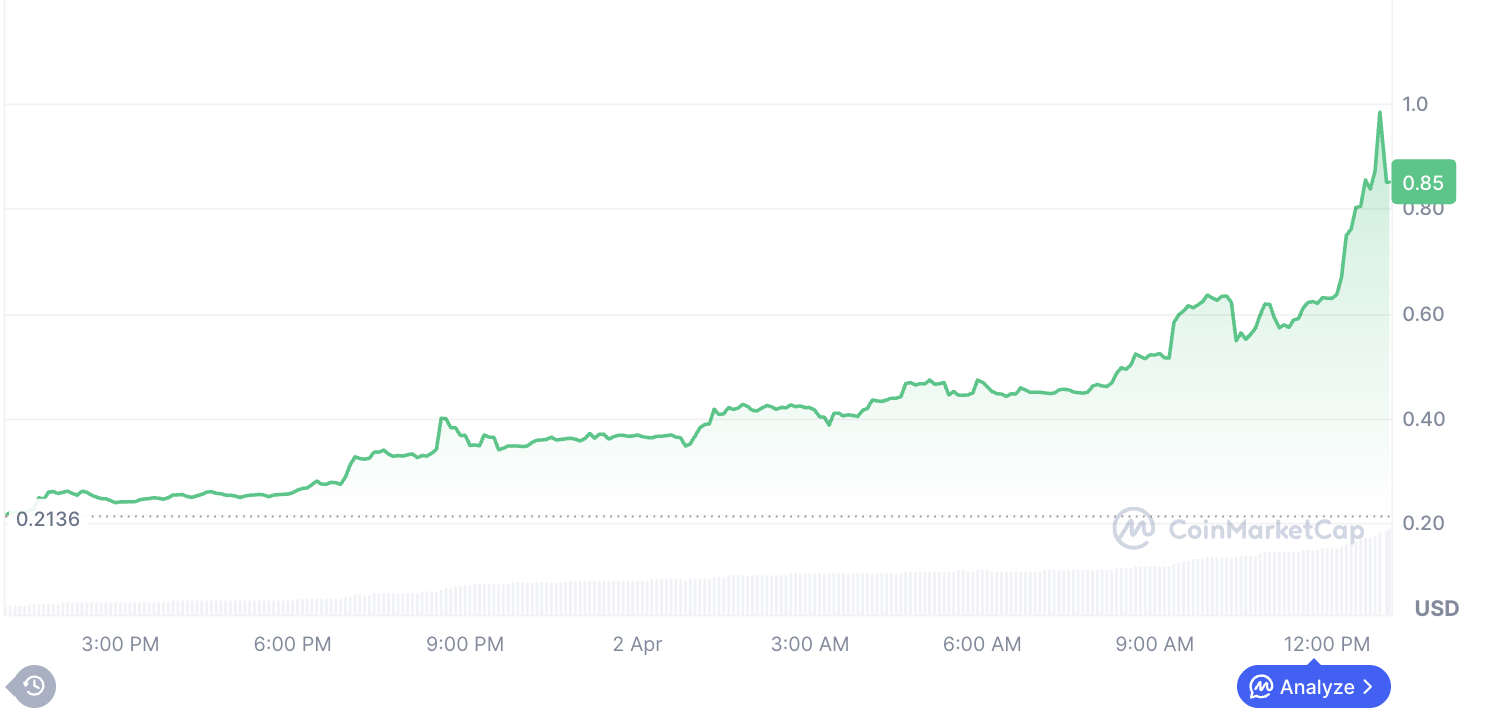
StakeStone (STO) Price
Source: CoinMarketCap
StakeStone (STO) delivered one of the most aggressive rallies in the DeFi sector in early April 2026, with its price surging more than 200% within 24 hours. The token climbed from below $0.30 to reach a new all-time high of $0.9847 on April 2, 2026, before stabilizing slightly lower. At the time of writing, STO is trading around $0.90, reflecting both strong upward momentum and elevated volatility during the move.
The rally was supported by a sharp increase in trading activity, with 24-hour volume reaching levels comparable to its total market capitalization. This kind of volume-to-market-cap ratio is typically associated with short-term speculative flows rather than long-term accumulation. The surge appears to have been driven by a combination of narrative momentum around liquid staking and restaking, increased visibility across exchanges, and heightened social sentiment. At the same time, the speed of the move suggests that price discovery is still in progress, leaving STO vulnerable to rapid corrections as the market digests the rally.
Key Factors Affecting STO Price
Several core factors are likely to shape StakeStone’s price trajectory in the coming years, particularly as the project moves from a narrative-driven phase toward measurable adoption. As with most DeFi tokens, STO’s valuation is closely tied to both internal protocol performance and broader market conditions.
-
Macro market conditions: STO remains highly sensitive to the overall crypto cycle. Bitcoin dominance, liquidity conditions, and risk appetite across altcoins will play a major role in determining whether capital continues flowing into emerging DeFi protocols.
-
Growth of liquid staking and restaking: StakeStone’s success depends heavily on the expansion of these sectors. If restaking continues to gain traction as a core DeFi primitive, STO could benefit from sustained demand.
-
Total value locked (TVL) and adoption: Increasing TVL is a key indicator of real usage. Growth in deposits, integrations, and user activity would support long-term price appreciation.
-
Tokenomics and supply dynamics: With a maximum supply of 1 billion STO, emissions, incentives, and distribution schedules will influence price stability. High unlock pressure or aggressive incentives could weigh on price if not matched by demand.
-
Ecosystem development and partnerships: Integrations with major DeFi platforms, cross-chain expansion, and institutional interest could strengthen StakeStone’s position in a competitive market.
-
Competition within liquid staking: Established players like Lido, Rocket Pool, and newer restaking protocols present strong competition. StakeStone must differentiate itself through yield performance and composability.
Together, these factors will determine whether StakeStone can transition from a high-growth narrative play into a sustainable DeFi protocol with long-term value.
StakeStone (STO) Price Prediction 2026
Looking ahead to 2026, StakeStone (STO) is expected to remain highly sensitive to both market cycles and its ability to convert early momentum into sustained adoption. After reaching a peak near $1 following its April surge, the token enters a phase where consolidation, user growth, and ecosystem expansion will determine its next direction.
-
Bullish scenario ($1.50 – $2.50):
In a strong market environment where Bitcoin maintains upward momentum and DeFi narratives remain dominant, StakeStone could benefit from continued inflows into liquid staking and restaking. If the protocol successfully increases its total value locked, secures major integrations, and demonstrates competitive yields, STO could break above its current highs and trend toward the $2 range. -
Base scenario ($0.80 – $1.40):
Under more balanced conditions, STO may stabilize after its rapid surge and trade within a consolidation range. Moderate adoption, steady TVL growth, and a neutral market environment could support gradual appreciation without explosive upside. In this case, the token would likely fluctuate around the $1 level with periodic volatility. -
Bearish scenario ($0.30 – $0.70):
If market sentiment weakens or the restaking narrative loses traction, STO could retrace a significant portion of its gains. Early-stage tokens often face sharp corrections after parabolic moves, especially if speculative capital exits. Delays in development, declining TVL, or stronger competition could push the price back toward pre-rally levels.
2026 is likely to be a validation year for StakeStone. The project’s ability to transition from hype-driven growth to measurable fundamentals will play a decisive role in determining whether STO sustains its upward trajectory or enters a prolonged consolidation phase.
StakeStone (STO) Price Prediction 2027–2030
The long-term outlook for StakeStone (STO) depends less on short-term momentum and more on whether the protocol can establish itself as a core layer within the evolving DeFi stack. Between 2027 and 2030, the trajectory of STO will likely be shaped by adoption of restaking, cross-chain liquidity demand, and its ability to compete with established players.
-
Bull case ($3.00 – $6.00):
In an environment where DeFi matures and restaking becomes a dominant infrastructure layer, StakeStone could see exponential growth. If the protocol captures meaningful market share, expands across major chains, and maintains strong yield performance, STO could evolve into a top-tier DeFi asset. Sustained TVL growth, institutional participation, and integration into core DeFi primitives could drive the token into the multi-dollar range. -
Base case ($1.20 – $3.00):
A more realistic scenario assumes steady but not dominant growth. StakeStone secures a niche within the liquid staking ecosystem, with moderate adoption and consistent protocol revenue. In this case, STO could gradually appreciate alongside the broader market, benefiting from periodic bull cycles while remaining below the top-tier DeFi leaders in terms of scale. -
Bear case ($0.20 – $1.00):
If the protocol fails to differentiate itself or loses momentum to competitors, long-term performance could weaken significantly. Market saturation, declining yields, regulatory pressure, or technical risks could limit adoption. In this scenario, STO may struggle to maintain its current valuation and could trend downward over time.
By 2030, the key question is whether StakeStone becomes infrastructure or remains a narrative-driven token. Projects that transition into essential components of the DeFi ecosystem tend to capture lasting value. Those that do not often fade as capital rotates to more dominant platforms.
Is StakeStone (STO) a Good Investment?
StakeStone (STO) sits at the intersection of two of the most active narratives in crypto today: liquid staking and restaking. That positioning alone has been enough to attract attention and capital, especially in a market that rewards yield-generating protocols. If the project can convert early traction into sustained total value locked, deeper integrations, and consistent yield performance, it could carve out a meaningful role within the broader DeFi stack.
At the same time, the risks are hard to ignore. The recent rally has been sharp, and the volume profile suggests a large share of the move was driven by short-term trading flows rather than long-term conviction. StakeStone is also entering a competitive arena dominated by established players and well-funded newcomers. For investors, STO may offer upside tied to narrative strength and execution, but it remains a speculative bet. Position sizing and timing will likely matter as much as the fundamentals.
Conclusion
StakeStone’s rapid ascent in early 2026 highlights how quickly capital can rotate toward emerging narratives in crypto. A 200% surge and a push toward the $1 mark in a matter of days placed STO firmly on traders’ radar, but it also underscored how much of the move was driven by momentum rather than fully proven fundamentals. The real test starts now.
For StakeStone, the path forward is less about price and more about traction. Can it grow total value locked? Can it compete with established liquid staking players while carving out a role in the restaking ecosystem? If the answer is yes, STO could evolve from a narrative-driven asset into a more durable part of the DeFi stack. If not, the current rally may prove to be another short-lived cycle. As always in crypto, the difference between hype and staying power is measured over time, not in a single breakout.
Disclaimer: The opinions expressed in this article are for informational purposes only. This article does not constitute an endorsement of any of the products and services discussed or investment, financial, or trading advice. Qualified professionals should be consulted prior to making financial decisions.


- What Is StakeStone (STO)?
- Who Created StakeStone (STO)?
- How StakeStone (STO) Works
- StakeStone (STO) Recent Price Surge
- Key Factors Affecting STO Price
- StakeStone (STO) Price Prediction 2027–2030
- Is StakeStone (STO) a Good Investment?
- Conclusion