How to Use rToken for Leveraged Trading on Bitget During SNDK's Earnings Window
On August 5, 2026, SanDisk (NASDAQ: SNDK) will report its fiscal Q4 and full-year results. The company's previous guidance called for revenue of $7.75B–$8.25B and non-GAAP EPS of $30–$33; Wall Street consensus has since been raised to roughly $8.4B–$8.5B in revenue and about $34.5–$35 in EPS. Market focus is centered on NAND pricing trends, the sustainability of data center/AI storage demand, execution of long-term contracts under the New Business Model (NBM), and forward guidance.
Data shows SNDK's Q3 already demonstrated a strong inflection point—revenue of $5.95B (+251% YoY, +97% QoQ), data center business up +233% QoQ, non-GAAP gross margin rising to 78.4%, and the signing of multiple NBM agreements totaling over $42B in minimum committed revenue. Volatility around the earnings release could be significant, making this an opportune moment for leverage and capital efficiency tools.
Why Choose Bitget rToken? Taking rSNDK as an Example
Bitget rToken is a tokenized U.S. stock product issued by the Reality protocol, named using the format "r + ticker" (e.g., rSNDK corresponds to SNDK). It maps 1:1 to the economic performance of the underlying real stock (price, dividends, stock splits/consolidations, etc.), with the underlying assets held in custody by a licensed broker, and supports USDT trading. Some underlying assets support more flexible trading hours, allowing funds to be turned over instantly.
The core advantage lies in capital efficiency—Bitget's cross-asset unified trading account (UTA) incorporates rToken into a unified margin pool. Holding a single rToken lets you accomplish three things at once:
1. Hold for exposure:Retain economic exposure to SNDK's stock price and dividends.
2. Use directly as margin: Use it as margin for perps/leveraged trading within the unified trading account, allowing you to open positions without selling your holdings.
3. Collateralized lending: Pledge rToken to borrow stablecoins such as USDT, freeing up liquidity for other trades or strategies.
This is the idea behind "one rToken doing the work of three." In a traditional brokerage account, funds are often locked up; within Bitget's UTA, the same asset can simultaneously serve as a holding, margin, and collateral, significantly boosting capital efficiency.
Bitget rToken Spot Liquidity Depth Leads the Market, Enabling Smoother Large Order Execution
In actual trading, liquidity depth directly determines slippage and the execution experience for large orders. Based on a comparison of real-time order book snapshot data collected simultaneously, Bitget's spot market depth for stock tokens significantly outperforms the second-ranked platform in the industry:
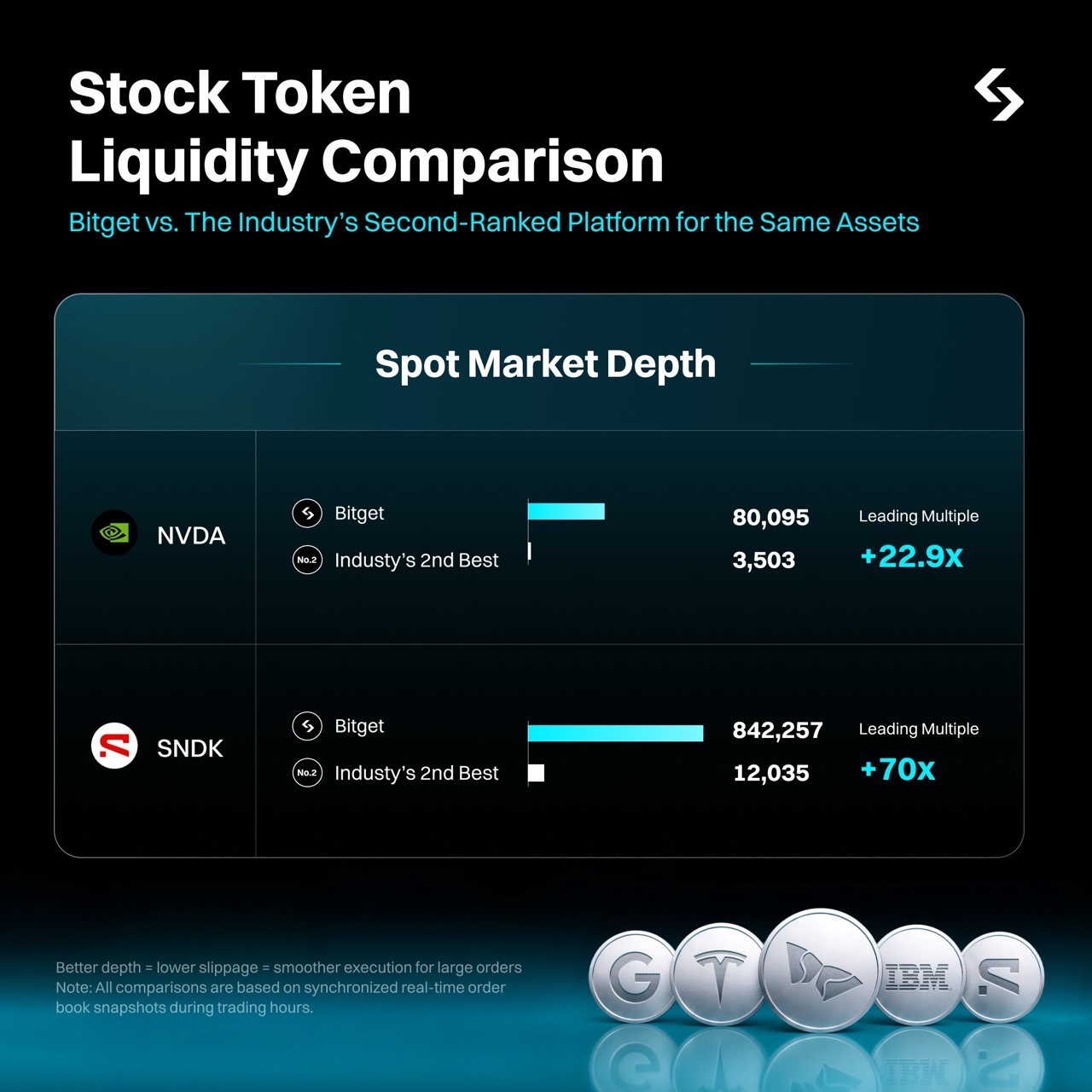
● NVDA: Bitget's spot depth is 80,095, compared to just 3,503 for the industry's second-place platform—roughly 22.9x higher.
● SNDK: Bitget's spot depth is 842,257, compared to just 12,035 for the industry's second-place platform—roughly 70x higher.
Greater depth means lower slippage and smoother execution for large orders. During the potentially sharp volatility window around SNDK's earnings release, traders entering or exiting positions with rSNDK can execute larger-scale trades at costs closer to their expected prices, reducing extra losses caused by insufficient liquidity. Combined with the capital reuse capability of the unified trading account, this depth advantage truly brings the "one rToken doing the work of three" efficiency to life—enabling traders to quickly build or adjust positions while seamlessly converting holdings into margin or loan collateral, further amplifying capital efficiency.
Practical Strategies Around SNDK's Earnings
Sentiment ahead of earnings is typically bullish, leveraged long positions may become crowded, and funding rates tend to rise; after the earnings release, sharp volatility may follow (the options market has previously signaled significant volatility):
● Directional leverage: If you're bullish on a beat (higher guidance, stronger NBM visibility, continued pricing strength), you can buy rSNDK spot directly and use it as margin in the UTA to open additional long perps/futures positions, amplifying your exposure. If bearish, do the opposite. Be mindful of position sizing and liquidation risk.
● Hold without selling + unlock liquidity: Users already holding rSNDK can use it as margin to open other related positions (such as related storage/semiconductor perps), or pledge it to borrow USDT and deploy that capital into other opportunities, all while retaining the original exposure and potential dividends.
● Market-neutral/funding rate strategy: Buy an equivalent amount of rSNDK spot while opening an equivalent-sized short perps position, keeping net exposure close to zero and primarily collecting the funding rate. When longs are crowded ahead of earnings, the funding rate tends to favor the short side. Operating within a unified trading account is smoother, with no need to move funds between multiple accounts.
● Hedging and relative value: Use rSNDK as margin to hedge other AI/storage-related assets, or to trade relative strength.
Execution path: Buy rSNDK/USDT on Bitget spot, then transfer to/enable the unified trading account, set the margin mode, and open perps positions or engage in collateralized lending.
Conclusion
Compared to traditional methods, where funds are locked up in buying stocks and users need additional capital or must sell holdings to add leverage, Bitget rToken + UTA allows the same asset to simultaneously serve as a holding, margin, and collateral—funds can be "reused," lowering opportunity costs.
Behind SNDK's latest results are AI data center-driven storage demand, improving pricing, and long-term contracts, with the market having already priced in some optimistic expectations. The core value of using Bitget rToken isn't about "betting on a direction," but about turning your holdings into an efficiently deployable capital tool—one asset serving exposure, leverage, and liquidity all at once. Volatility is high around earnings, so discipline and risk management matter more than directional calls.


- Why Choose Bitget rToken? Taking rSNDK as an Example
- Bitget rToken Spot Liquidity Depth Leads the Market, Enabling Smoother Large Order Execution
- Practical Strategies Around SNDK's Earnings
- Conclusion