
Google Cloud's Neutral Play to Rewrite Institutional Finance Rules
- Google Cloud launches GCUL, a Layer-1 blockchain for institutional finance, targeting tokenized assets and cross-border settlements. - GCUL uses Python-based smart contracts to lower enterprise adoption barriers and partners with CME Group for 2026 launch. - Positioned as a "credibly neutral" private network, GCUL challenges corporate blockchains like Stripe's Tempo and Circle's Arc. - The platform's success hinges on attracting diverse institutions while maintaining regulatory compliance and perceived n
Google Cloud is accelerating its foray into institutional blockchain infrastructure with the development of the Google Cloud Universal Ledger (GCUL), a Layer-1 (L1) blockchain designed to facilitate tokenized assets, cross-border settlements, and wholesale payments. Announced earlier this year in a joint pilot with CME Group , the project was initially described as a distributed ledger without an explicit classification as an L1. However, in a LinkedIn post by Rich Widmann, Global Head of Strategy for Web3 at Google Cloud, the company has now confirmed GCUL as a Layer-1 blockchain, emphasizing its role as a programmable, high-performance infrastructure tailored for financial institutions .
GCUL is distinguished by its use of Python-based smart contracts, a choice that diverges from the more common Solidity and Rust used in existing blockchain ecosystems. According to Widmann, this approach is intended to lower the barrier for enterprise developers and financial engineers already familiar with Python, a widely used language in data science and machine learning. The platform is also being positioned as a “credibly neutral” infrastructure layer, a contrast to corporate blockchains like Stripe’s Tempo and Circle’s Arc, which are closely tied to their respective payment and stablecoin ecosystems.
Currently, GCUL is operating on a private testnet, with CME Group having completed the first phase of integration and testing. The two partners plan to begin broader trials with market participants later this year, with a target launch date of 2026. CME Group has described the technology as a potential breakthrough for low-cost, 24/7 settlement of collateral, margin, and fees, aligning with broader efforts to modernize financial infrastructure.
Unlike open public blockchains, GCUL is being developed as a private, permissioned network, reflecting the regulatory and compliance demands of institutional finance. This design allows it to offer tailored solutions for banks, exchanges, and fintech firms while maintaining alignment with financial regulations. Widmann emphasized that GCUL’s neutrality is key to its appeal, as it is not controlled by a single entity and can be adopted by any institution without the risk of strengthening a competitor’s ecosystem. This contrasts with corporate-led blockchains, where adoption could entrench existing market power.
Google’s move into institutional blockchain infrastructure places it in direct competition with other major players in the space, including Circle , Stripe, and Ripple. While Circle’s Arc and Stripe’s Tempo are positioned as proprietary solutions tied to their respective payment and stablecoin ecosystems, Google is betting on GCUL’s open infrastructure and scalability to attract a broader range of financial institutions. The company also highlighted its global cloud infrastructure as a key differentiator, enabling GCUL to support billions of users and hundreds of institutions.
Despite its ambitions, GCUL’s neutrality remains a point of debate. While Widmann has argued that the platform is designed to be open and accessible, critics have questioned whether Google can truly claim to be a neutral infrastructure provider given its control over the chain. The platform’s long-term success will depend on its ability to attract a diverse set of institutional users and demonstrate that it can operate without favoring any one participant.
Technical details on GCUL’s architecture remain limited, though Widmann has indicated that more information will be released in the coming months. The platform’s roadmap includes expanding its reach to other technology firms, such as Amazon or Microsoft , which could operate GCUL to better serve their clients. This vision reflects Google’s broader strategy of moving beyond infrastructure hosting and into protocol development, a shift that could significantly impact the future of institutional blockchain adoption.
Source:

Disclaimer: The content of this article solely reflects the author's opinion and does not represent the platform in any capacity. This article is not intended to serve as a reference for making investment decisions.
You may also like
How to truly make a mark in the crypto industry?
You can't live the life you want just by "copying and pasting."

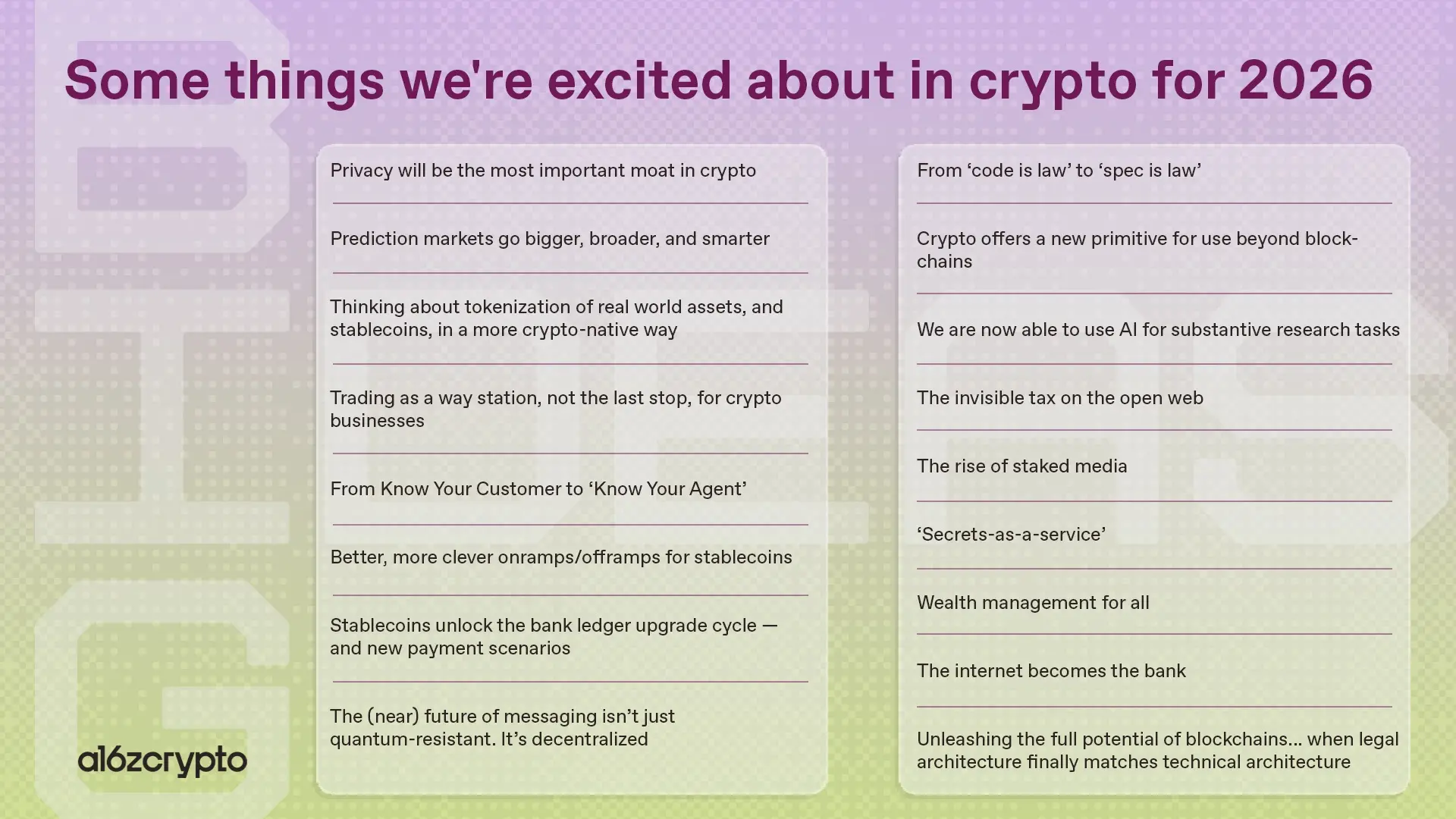
a16z Annual Report: The 17 Most Exciting Web3 Ideas for 2026
Stablecoins will become the infrastructure of Internet finance, AI agents will gain on-chain identity and payment capabilities, and the advancement of privacy technologies, verifiable computation, and compliance frameworks will drive the crypto industry from pure trading speculation towards building decentralized networks with lasting value.
Morning Brief | a16z Crypto releases annual report; crypto startup LI.FI completes $29 million financing; Trump says the rate cut is too small
A summary of important market events on December 11.

Trend Research: The "Blockchain Revolution" is Underway, Remain Bullish on Ethereum
The integration trend in the crypto market and Ethereum's value capture.

Trending news
MoreCrypto prices
More





