
Investors rebalance portfolios as China's AI bargains challenge US focus
- HSBC's Willem Sels highlights China as a key diversification target for investors wary of U.S. market overvaluation and geopolitical risks, citing supply-side reforms and undervalued AI-linked equities. - U.S. Magnificent 7 stocks face scrutiny amid Trump's potential return, prompting global investors to rebalance portfolios toward China's AI infrastructure and automation sectors. - Chinese AI firms like Cambricon Technologies show 112% YTD gains, offering 30-40% valuation discounts compared to U.S. coun
HSBC’s Global Chief Investment Officer, Willem Sels, has flagged China as an emerging focal point for investors seeking to diversify away from U.S. markets amid growing uncertainty driven by geopolitical tensions and the anticipated return of President Donald Trump. In an exclusive interview with Fortune, Sels emphasized that China’s supply-side reforms and relatively cheaper AI-linked equities are drawing capital flows, particularly from global investors looking to balance risk across regions and asset classes.
According to Sels, U.S. markets remain strong, with the S&P 500 rising 15% over the past year and the Federal Reserve expected to begin easing monetary policy. However, concerns about the overvaluation of so-called Magnificent 7 stocks—Alphabet, Amazon , Apple , Meta , Microsoft , Nvidia , and Tesla—and the potential economic implications of Trump’s unconventional foreign policy have prompted a more cautious approach to portfolio concentration.
Sels highlighted the importance of diversification in both asset classes and geography. “When a client comes in the door, the first discussion is about building a global portfolio,” he stated, advising investors to reduce exposure to home markets, particularly if their primary business activity is also based there. This trend has led to a modest shift of capital out of U.S. equities and into other regions, with China emerging as a key beneficiary.
Part of the appeal lies in Beijing’s structural reforms aimed at addressing overcapacity and promoting more sustainable growth. In a recent government meeting, China’s Central Finance and Economic Affairs Commission emphasized the need to regulate disorderly low-price competition and encourage the exit of outdated production capacity. These measures, according to Sels, are expected to improve corporate profitability and earnings growth, reversing a perception among investors that Chinese companies lack pricing power.
Meanwhile, China’s AI sector is gaining traction not only due to structural reforms but also because of its relatively attractive valuations. Sels noted that AI-linked infrastructure stocks in China are outperforming, with the SSE Composite Index up 33.4% year-to-date compared to a 14.9% gain for the S&P 500. While U.S. firms still lead in AI-related capital expenditures—outspending their Chinese counterparts by eight to ten times—they are achieving higher returns on these investments. Despite this, Sels emphasized that investors see value in China’s AI ecosystem, particularly in infrastructure, energy, and automation, which are emerging as areas of significant innovation.
The AI opportunity is further amplified by the presence of undervalued equities in the Chinese market. For example, Cambricon Technologies, a Chinese chipmaker, saw its shares briefly become the country’s most expensive after a 10% one-day surge. While its share price has since retreated, the stock is up 112% for the year. Sels pointed out that similar U.S. counterparts are available at a 30-40% premium, making China an appealing option for investors seeking exposure to the AI boom at a discount.
Despite these developments, Sels cautioned against viewing the U.S. as a fading investment destination. While diversification is increasing, it is not a full withdrawal. “People are adding a little bit to other regions, adding a little bit to other sectors, but they are not fleeing from the U.S.,” he said. Nonetheless, the push to reduce over-reliance on U.S. assets, combined with the attractive fundamentals in China’s AI and infrastructure sectors, is reshaping the global investment landscape.
Source:

Disclaimer: The content of this article solely reflects the author's opinion and does not represent the platform in any capacity. This article is not intended to serve as a reference for making investment decisions.
You may also like
Research Report|In-Depth Analysis and Market Cap of Talus (US)
Five charts to help you understand: Where does the market go after each policy storm?
After this regulatory crackdown, is it a harbinger of an impending downturn, or the beginning of a new cycle where all negative news has been fully priced in? Let’s examine the trajectory after the storm through five key policy milestones.
Mars Morning News | The crypto market rebounds across the board, Bitcoin rises above $94,500; The "CLARITY Act" draft is expected to be released this week
The crypto market has fully rebounded, with bitcoin surpassing $94,500 and US crypto-related stocks rising across the board. The US Congress is advancing the CLARITY Act to regulate cryptocurrencies. The SEC chairman stated that many ICOs are not securities transactions. Whales are holding a large number of profitable ETH long positions. Summary generated by Mars AI. The accuracy and completeness of the content generated by the Mars AI model is still being iteratively updated.

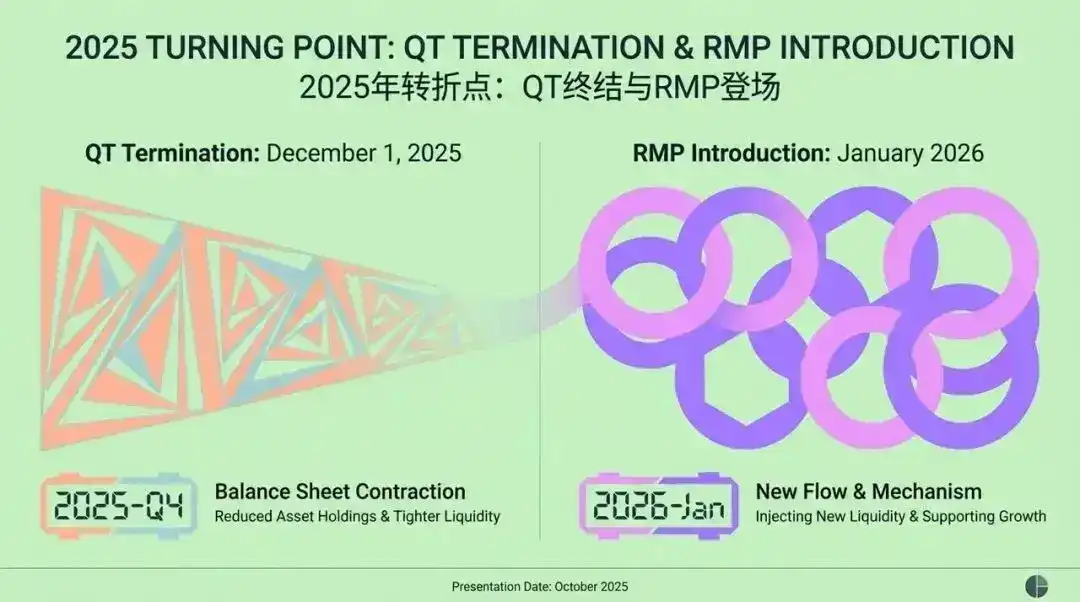
Federal Reserve’s Major Shift: From QT to RMP, How Will the Market Transform by 2026?
The article discusses the background, mechanism, and impact on financial markets of the Federal Reserve's introduction of the Reserve Management Purchases (RMP) strategy after ending Quantitative Tightening (QT) in 2025. RMP is regarded as a technical operation aimed at maintaining liquidity in the financial system, but the market interprets it as a covert easing policy. The article analyzes RMP's potential effects on risk assets, the regulatory framework, and fiscal policy, and provides strategic recommendations for institutional investors. Summary generated by Mars AI This summary was generated by the Mars AI model, and the accuracy and completeness of its content are still in the process of iterative improvement.
Trending news
MoreCrypto prices
More





