
US tech stocks under pressure as AI growth shows signs of cooling

U.S. tech stocks came under pressure on Friday, driven by concerns about the rapid pace of investment in AI and a series of disappointing earnings reports in the semiconductor sector. The Nasdaq Composite fell 1.2%, closing out a week in which the tech-heavy index struggled to maintain recent highs.
Semiconductor sector hit hard
Among the notable tumblers, Marvell Technology plunged nearly 19%, resembling Bitcoin’s early days, after revealing that its data center revenue had failed to meet market expectations.
The stock was downgraded from “buy” to “neutral” by Bank of America in response to these earnings. Meanwhile, Nvidia, whose market capitalization makes it the largest listed semiconductor company globally, dropped 3.3% on Friday.
The company flagged ongoing uncertainty in its sales to China, largely due to U.S. export restrictions impacting its AI chips.
For the week, Nvidia shares fell 2.1%, marking their steepest weekly decline since May. Broader weakness in chipmakers dragged the Philadelphia Semiconductor Index to its lowest point since mid-April.
The S&P 500 also retreated, down 0.6% for its largest single-day drop of the month, though it still managed to finish August up 1.9%. The tech stocks selling is likely attributed to investors taking profits near month-end, especially after a hot August when technology shares led markets to record levels.
Tech stocks overheated and China uncertainties loom
Despite the hundreds of billions of dollars of investment already poured into data centers fueling generative AI projects like ChatGPT, actual revenues in this space remain relatively modest.
According to Morgan Stanley, generative AI products from major cloud providers such as Amazon, Microsoft, and Google brought in about $45 billion last year.
Marvell, a key supplier of custom semiconductors to these companies, has faced additional headwinds, including trade tensions and questions around its growth prospects. Its shares, which had previously surged on the AI hardware boom, have slumped more than 40% since the beginning of 2025.
Nvidia, meanwhile, awaits clarification from the U.S. government regarding a deal to resume H20 chip exports to China, with the administration set to collect a revenue share from those sales.
Chinese authorities have discouraged local firms from buying Nvidia’s technology, ramping up efforts to support domestic alternatives. Cambricon, a leading Chinese AI chipmaker, recently posted record profits and claimed advancements that bring its products closer to Nvidia’s standards, sending its stock price soaring.
Shares in U.S.-based Super Micro Computer, a vital part of Nvidia’s supply chain, fell 5.5% after reporting internal accounting challenges.
Bitcoin price slumps further into the weekend
While tech stocks and AI-linked companies face their own market turbulence, Bitcoin has not been immune to broader risk-off sentiment.
Bitcoin’s price fell below $108,000 on Saturday, heading into the weekend, down nearly 7% for the week and at its lowest point since July.
Selling has accelerated as investors react to persistent uncertainty around U.S. monetary policy, sticky inflation, and weakening labor market data.
Disclaimer: The content of this article solely reflects the author's opinion and does not represent the platform in any capacity. This article is not intended to serve as a reference for making investment decisions.
You may also like
"Validator's Pendle" Pye raises $5 million, enabling SOL staking yields to be tokenized
There are truly no creative bottlenecks in the financialization of Web3.

DiDi has become a digital banking giant in Latin America
DiDi has successfully transformed into a digital banking giant in Latin America by addressing the lack of local financial infrastructure, building an independent payment and credit system, and achieving a leap from a ride-hailing platform to a financial powerhouse. Summary generated by Mars AI. This summary was produced by the Mars AI model, and its accuracy and completeness are still being iteratively improved.

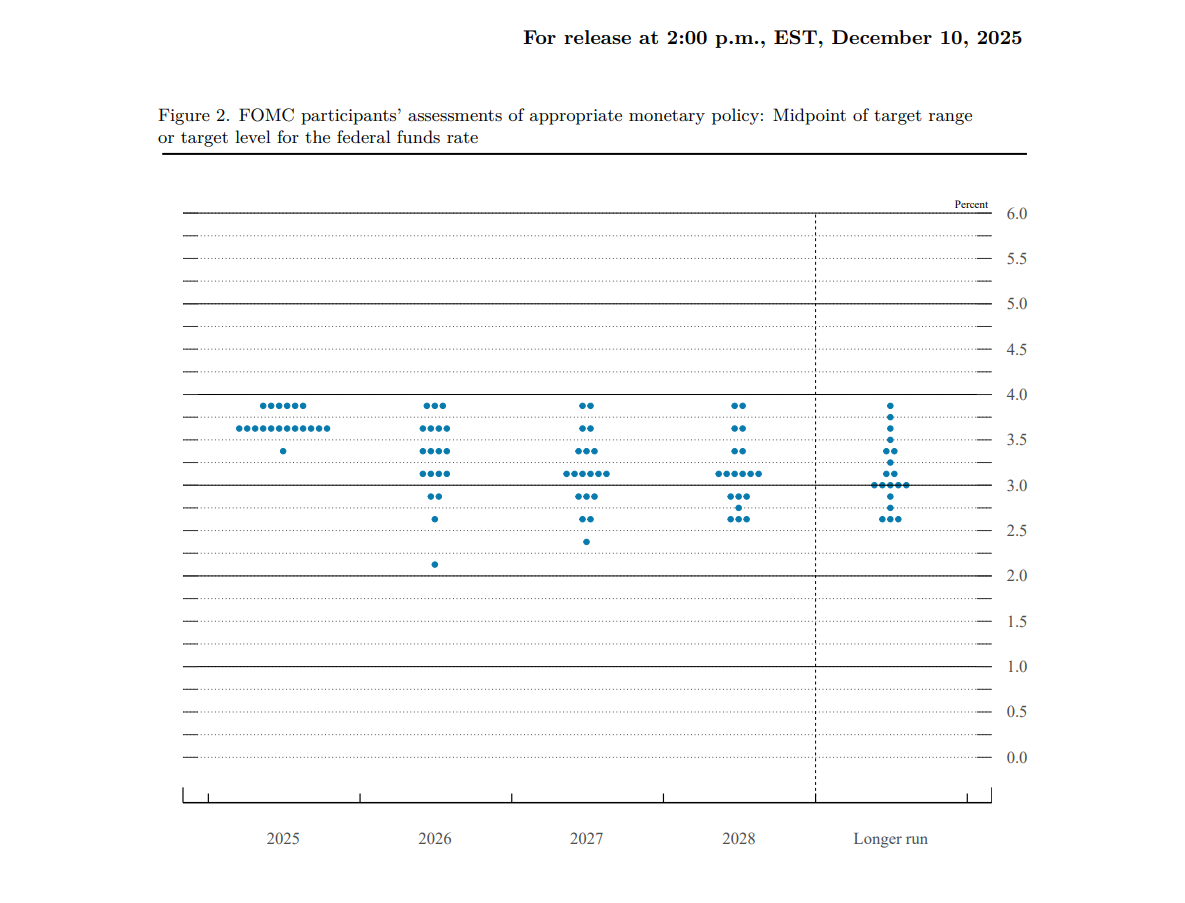
Fed rate cuts in conflict, but Bitcoin's "fragile zone" keeps BTC below $100,000
The Federal Reserve cut interest rates by 25 basis points, but the market interpreted the move as hawkish. Bitcoin is constrained by a structurally fragile range, making it difficult for the price to break through $100,000. Summary generated by Mars AI This summary was generated by the Mars AI model, and the accuracy and completeness of its content are still being iteratively updated.

Full text of the Federal Reserve decision: 25 basis point rate cut, purchase of $4 billion in Treasury bills within 30 days
The Federal Reserve cut interest rates by 25 basis points with a 9-3 vote. Two members supported keeping rates unchanged, while one supported a 50 basis point cut. In addition, the Federal Reserve has restarted bond purchases and will buy $40 billion in Treasury bills within 30 days to maintain adequate reserve supply.
Trending news
MoreCrypto prices
More





