
Ethereum Regains Top Spot in USDT as Tron’s Dominance Slips

After losing its top position to Tron in March, Ethereum has surged back to reclaim its place as the leading network for USDT, with its supply reaching $80 billion. Although both networks maintained high supply levels of roughly $75–$80 billion for most of the year, this reversal signals a key shift in infrastructure preferences.
In brief
- Ethereum’s USDT supply hits $80B, surpassing Tron after months of close competition in the stablecoin market.
- Daily transactions on Ethereum are near 1M, showing strong use of USDT for payments and settlements.
- Institutions favor Ethereum’s DeFi and infrastructure over Tron’s lower fees, boosting its dominance.
- Other chains like BSC, Solana, Polygon, and Arbitrum hold under $10B USDT each, far behind Ethereum and Tron.
Ethereum Reclaims Lead in USDT Transactions
Data from The Block shows Ethereum processing nearly 1 million transactions per day, suggesting that participants are not just holding USDT , but actively using it for payments and settlements.
Earlier in the year, Tron held a clear lead in USDT dominance as Ethereum’s usage declined. Since late April, however, Ethereum has experienced a steady resurgence, eventually overtaking Tron in August.
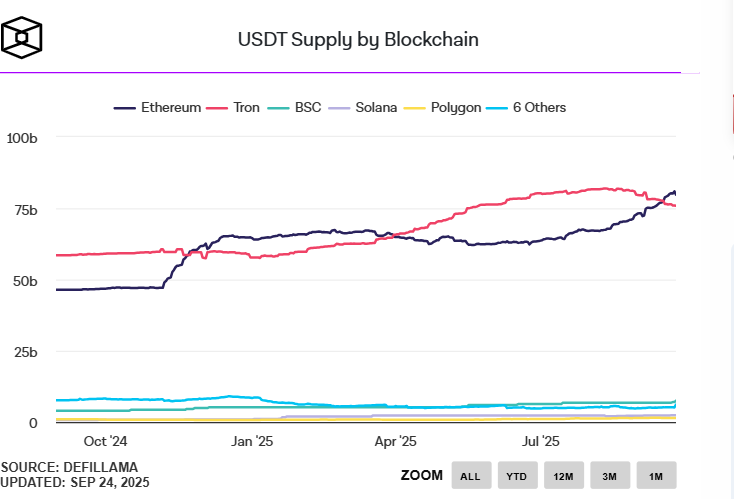
Despite their close competition, the ongoing shift highlights how even small advantages in dominance can influence capital flows.
With each holding less than $10 billion, other chains—including BNB Chain (BSC), Solana, Polygon, and Arbitrum—account for smaller portions of the total supply. Although these networks are seeing healthy growth, their combined share remains a fraction of the total compared to Ethereum and Tron.
Institutions and DeFi Fuel Stablecoin Shift from Tron
Ethereum’s resurgence suggests that users are prioritizing its established DeFi ecosystem and institutional-grade infrastructure over Tron’s lower transaction costs. Experts believe that this flip is also driven by renewed activity in DeFi protocols, as well as institutional adoption through ETFs and corporate treasuries.
This shift comes as mainstream financial institutions increasingly tap into stablecoin payment infrastructure. Firms such as PayPal (with PYUSD) and other major players are integrating stablecoins into their frameworks. Many of these companies are leaning towards Ethereum’s more established institutional presence.
With total USDT supply exceeding $100 billion across chains, the contest between Ethereum and Tron remains central to stablecoin market dynamics. Industry watchers are monitoring whether Ethereum can consolidate its lead or if Tron will reclaim the top spot in the months ahead.
Disclaimer: The content of this article solely reflects the author's opinion and does not represent the platform in any capacity. This article is not intended to serve as a reference for making investment decisions.
You may also like
Helius Labs Expands Solana Developer Power With New History API
Quick Take Summary is AI generated, newsroom reviewed. Helius Labs launched getTransactionsForAddress for Solana developers. The API enables full wallet transaction history queries. It replaces multiple RPC calls with a single efficient request. Faster archival systems improve performance and reduce costs.References X Post Ref
The ZK Atlas Upgrade: Revolutionizing Blockchain Infrastructure Scalability
- ZKsync's 2025 Atlas Upgrade boosts Ethereum L2 scalability to 43,000 TPS with $0.0001 fees via RISC-V zkVM and modular architecture. - Institutions like Deutsche Bank adopt ZKsync for real-time settlements, driving $3.5B TVL in ZK rollups by 2025. - Vitalik Buterin endorses the upgrade as critical for Ethereum's L2 roadmap, with Fusaka set to double throughput by December 2025. - ZK-based platforms now dominate L2 infrastructure, with ZKP market projected to reach $7.59B by 2033 at 60.7% CAGR.
BlackRock Clients Add $52M in Bitcoin and $23M in Ethereum
Bank of America Bitcoin Sees BTC as “Digital Printing Press”
Trending news
MoreCrypto prices
More





