
Vitalik Buterin unveils the missing link to evolve Ethereum

Vitalik Buterin considers the Fusaka upgrade and its PeerDAS technology as a decisive turning point for the future of Ethereum. By revolutionizing blockchain data management, this innovation could well solve the complex equation between scalability and decentralization.

In brief
- Vitalik Buterin states that PeerDAS is the central element of Ethereum’s Fusaka upgrade.
- This technology allows nodes to verify blocks without storing the entire data thanks to erasure coding.
- Ethereum has just reached six blobs per block for the first time, revealing growing demand from rollups.
- Ethereum has just reached six blobs per block for the first time, revealing growing demand from rollups.
PeerDAS, a technical innovation at the heart of Fusaka
Vitalik Buterin has just unveiled an innovation that could transform the Ethereum ecosystem. The co-founder identified PeerDAS (“Peer Data Availability Sampling”) as the key to scaling the network and its sustainability in the face of ever-growing demand.
Concretely, PeerDAS allows nodes to verify the existence of a data block without downloading it entirely. Instead of hosting the whole file, they rely on samples, then recomposed thanks to erasure coding.
This method, already proven in cybersecurity, fragments the data, adds redundancy, and then enables reconstruction even in case of partial loss.
This breakthrough breaks a historic constraint of Ethereum: each node is no longer forced to store all the data to contribute to the network. The result is twofold: increased capacity for transactions and preserved decentralization.
Buterin also highlights the system’s resilience: even if several actors act maliciously, the presence of a single honest validator is enough to guarantee the integrity of the process. An architecture that protects Ethereum from potential attacks while enhancing its processing power.
This evolution couldn’t come at a better time. Since the introduction of “blobs” with the Dencun upgrade, their use has exploded. In August, Ethereum hit a record with six blobs per block.
Layer 2 solutions like Base, Scroll, or Linea already occupy most of this space, generating over $200,000 in fees each week.
In this context, PeerDAS appears as a strategic response. By optimizing data management, it offers the network a way to absorb the growing demand without compromising its stability or decentralization.
Ethereum adopts a progressive strategy facing a long-term challenge
Buterin remains cautious, however. The number of blobs per block will not increase abruptly but in a phased progression. A too rapid scale-up, he warns, could create imbalances and put pressure on certain parts of the network.
The Fusaka schedule reflects this gradual approach: deployment planned for December 3, 2025, preceded by public tests on several networks and accompanied by a security audit with 2 million dollars in rewards to identify possible flaws.
But the challenge goes far beyond layer 2 alone. In the longer term, PeerDAS could also absorb part of the execution data of layer 1, thus freeing nodes from a currently colossal load.
This mechanism would give Ethereum increased capacity to meet growing demand driven by DeFi, stablecoins, and asset tokenization, without sacrificing either the protocol’s neutrality or resilience.
This evolution is part of an ambitious roadmap. After Pectra and before Glamsterdam, Fusaka is not just a technical upgrade. It represents a true strategic building block for Ethereum’s future.
It reflects a clear desire to prepare the network to occupy a central place in global finance, at the very moment when banks, companies, and states increasingly consider blockchain as a critical infrastructure.
Thus, PeerDAS is not a simple technical refinement. It is a direct response to the scalability and neutrality challenges Ethereum faces. By betting on an innovation deployed cautiously but thought over the long term, Buterin seeks to gradually transform the network.
If Fusaka delivers as promised, Ethereum could reach a decisive milestone and confirm its ambition: to become the essential infrastructure for global digital finance.
Disclaimer: The content of this article solely reflects the author's opinion and does not represent the platform in any capacity. This article is not intended to serve as a reference for making investment decisions.
You may also like
How to truly make a mark in the crypto industry?
You can't live the life you want just by "copying and pasting."

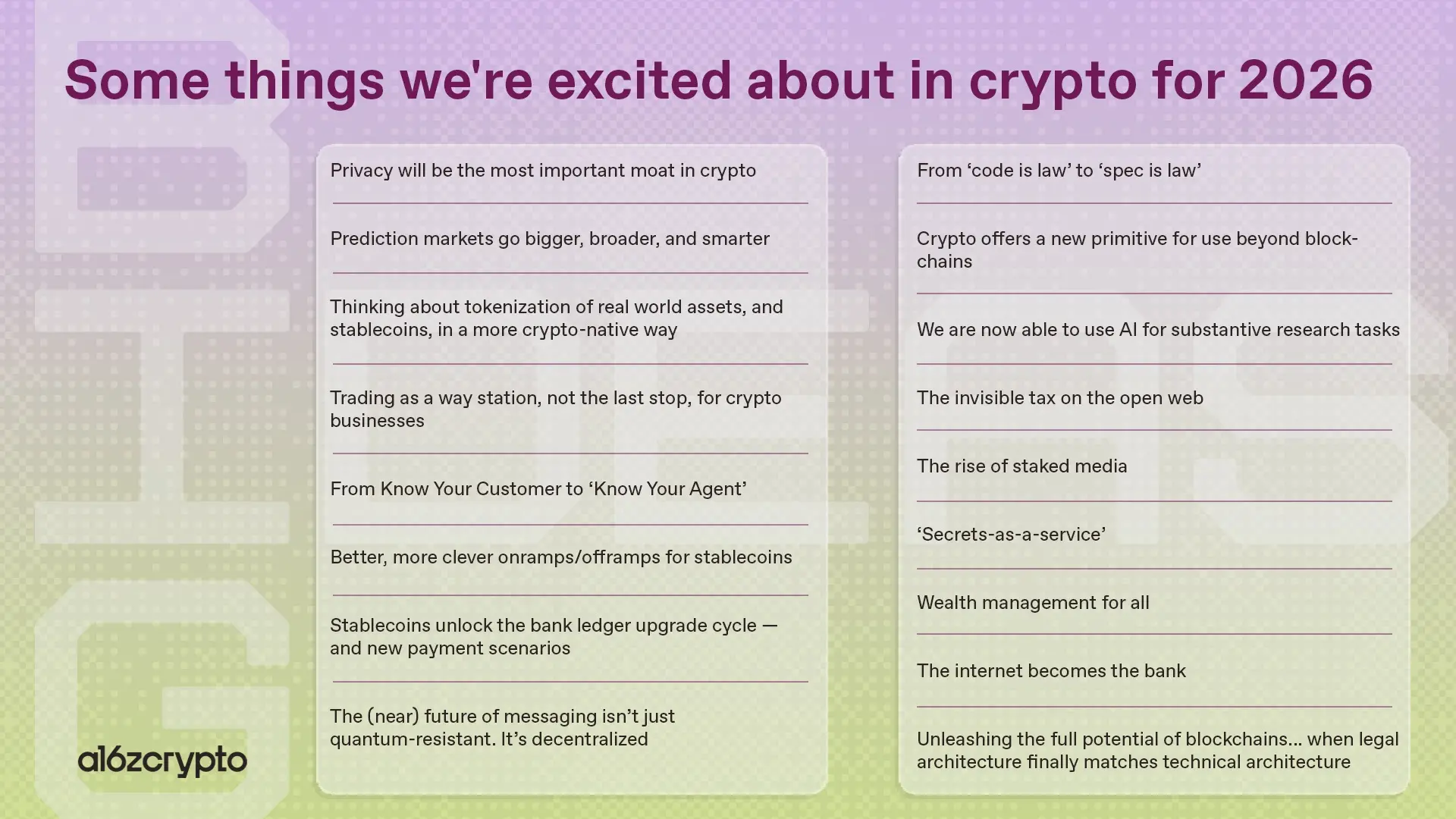
a16z Annual Report: The 17 Most Exciting Web3 Ideas for 2026
Stablecoins will become the infrastructure of Internet finance, AI agents will gain on-chain identity and payment capabilities, and the advancement of privacy technologies, verifiable computation, and compliance frameworks will drive the crypto industry from pure trading speculation towards building decentralized networks with lasting value.
Morning Brief | a16z Crypto releases annual report; crypto startup LI.FI completes $29 million financing; Trump says the rate cut is too small
A summary of important market events on December 11.

Trend Research: The "Blockchain Revolution" is Underway, Remain Bullish on Ethereum
The integration trend in the crypto market and Ethereum's value capture.

Trending news
MoreCrypto prices
More





