
Retail investors pull out while institutions step in as Ethereum's exchange liquidity drops to its lowest point since 2016
- Ethereum's exchange supply fell to 2016 lows (16.3M ETH) in Sep 2025, driven by self-custody shifts, DeFi growth, and institutional accumulation. - Stablecoin inflows ($93.4B USDT) and 5.26M ETH ($21.7B) institutional holdings highlight liquidity shifts toward long-term value. - Whale transfers ($1.19B) and ETF outflows ($33.26M) contrast with $4,100 ETH support, suggesting potential $5,200+ upside if demand persists. - Market divergence shows retail caution vs. institutional confidence, with price traje
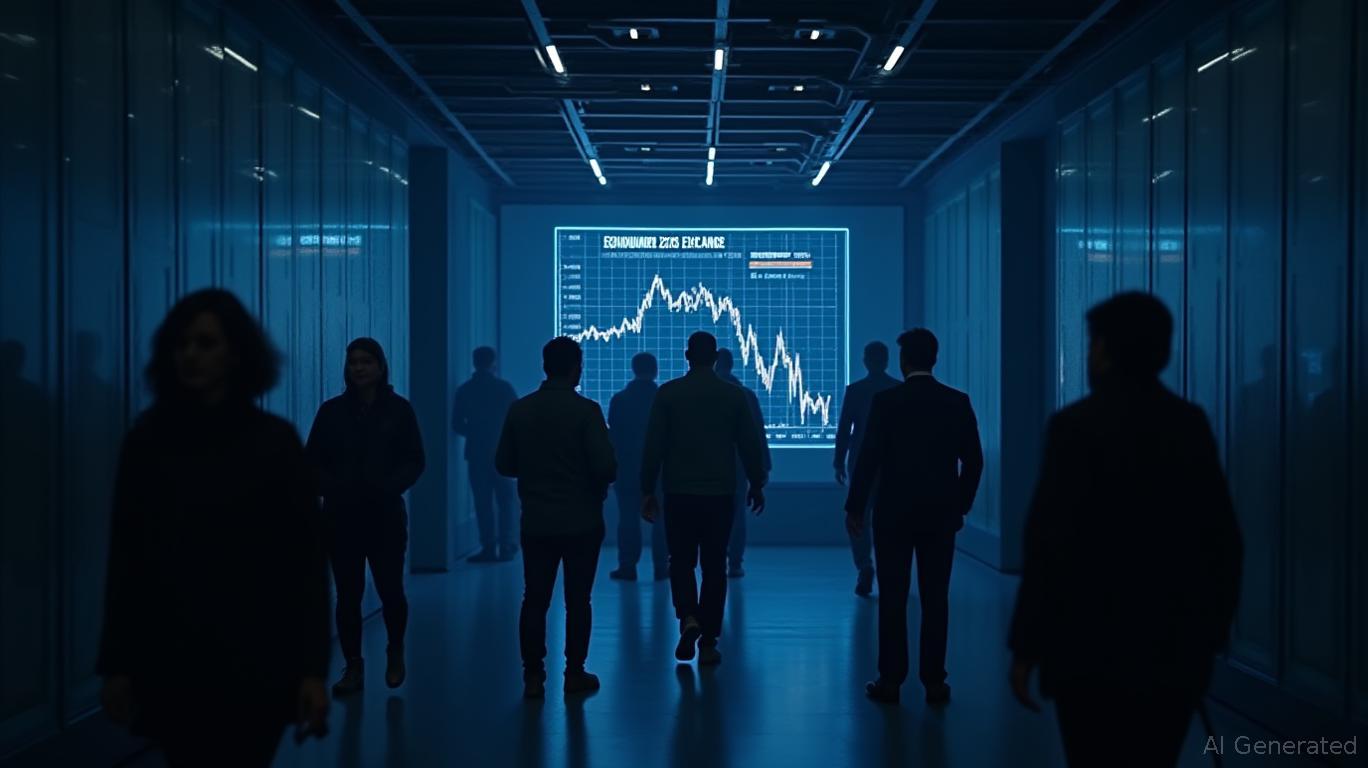
Ethereum’s balance on exchanges has dropped to its lowest point in several years, with the 30-day net outflow exceeding figures last observed at the end of 2023 Is Ethereum Setting Up for a Supply Shock in 2025? [ 1 ]. By September 2025, exchange-held Ethereum reserves have fallen to 16.3 million ETH, a level not seen since 2016 Ethereum Exchange Supply Hits 9-Year Low Amid Institutional Surge [ 2 ]. This sharp decrease in available supply is attributed to a shift toward self-custody, increased DeFi usage, and growing institutional holdings. The Exchange Supply Ratio (ESR), which measures the share of ETH on centralized platforms, has declined to 0.139, a figure that historically points to limited selling pressure and a potentially bullish environment Is Ethereum Setting Up for a Supply Shock in 2025? [ 1 ].
The drop in exchange liquidity is further intensified by a surge in stablecoin inflows into the
Institutional interest has picked up momentum since mid-2024, with organizations like BitMine and other major holders acquiring 5.26 million ETH (valued at $21.7 billion) since April 2025 Ethereum Exchange Supply Hits 9-Year Low Amid Institutional Surge [ 2 ]. More than 2% of all ETH is now either staked or stored in private wallets, further reducing what’s available on exchanges. Experts point out that this accumulation trend reflects growing confidence in Ethereum’s long-term prospects, especially as layer-2 networks and institutional-grade infrastructure continue to evolve Is Ethereum Setting Up for a Supply Shock in 2025? [ 1 ].
Large holders, or whales, are also reinforcing the optimistic outlook. On September 25, 2025, 11 wallets received a total of 295,861 ETH ($1.19 billion) from exchanges such as Kraken and Galaxy Digital OTC. This significant transfer, believed to be driven by institutional investors, suggests strategic moves during periods of market uncertainty. Meanwhile, Ethereum ETFs have shown mixed trends: BlackRock’s ETHA remains dominant but has seen recent withdrawals, while Fidelity’s FETH experienced the largest single-day outflow of $33.26 million Ethereum Exchange Supply Hits 9-Year Low Amid Institutional Surge [ 2 ].
Market participants are increasingly focused on the price outlook. Ethereum is currently trading near $4,100, supported by low selling pressure and a strong support level Is Ethereum Setting Up for a Supply Shock in 2025? [ 1 ]. Analysts believe that if the price breaks above $4,800, it could spark a rally toward the $5,200–$5,500 range, though further gains will depend on continued demand and institutional involvement. Nonetheless, short-term risks remain, including possible profit-taking by large holders and ETF redemptions, which could temporarily limit upward movement Crypto Carnage: $140 Billion Wiped Out as Ethereum Dips Below … [ 4 ].
Looking at the broader market, there’s a notable contrast: while retail investors and ETF outflows suggest caution, major holders are actively accumulating. This split points to a maturing market where experienced investors are focusing on long-term value rather than short-term swings. With exchange liquidity at historic lows and stablecoin inflows on the rise, Ethereum’s price direction will likely depend on the interplay between institutional demand and broader economic factors, such as decisions by the Federal Reserve regarding interest rates.
Disclaimer: The content of this article solely reflects the author's opinion and does not represent the platform in any capacity. This article is not intended to serve as a reference for making investment decisions.
You may also like
Momentum (MMT) Gaining Traction Through Key Alliances and Growing Attention from Institutions
- Momentum (MMT) gains traction in 2025 via strategic partnerships with Sui , Coinbase , and OKX, boosting institutional adoption. - A $10M HashKey Capital funding round and regulatory clarity underpin MMT's cross-chain DEX launch and RWA tokenization efforts. - Ve(3,3) governance and buybacks drive deflationary dynamics, with TVL exceeding $600M and $1.1B daily trading volumes. - Technical indicators signal potential bullish reversal at $0.52–$0.54, despite 70% post-TGE price correction and volatile forec

ALGO Falls by 3.33% Amidst Market Developments and Announced Restructuring Plans
- ALGO drops 3.33% in 24 hours, part of a broader 61.02% annual decline amid volatile market conditions. - Upcoming Swiss rate decisions, U.S. jobless claims, and bond auctions may intensify market uncertainty affecting crypto assets. - Argo Blockchain's approved restructuring plan, including new mining equipment, could indirectly impact ALGO supply/demand dynamics. - Market participants monitor macroeconomic indicators and blockchain sector developments to gauge ALGO's future trajectory.

LUNA Value Increases by 10.29% Over 24 Hours as Network Upgrade and Growing Inflows Drive Momentum
- LUNA surged 10.29% in 24 hours, driven by a network upgrade and rising on-chain inflows. - The terrad v3.6.1 upgrade aims to resolve legacy contract issues and enhance blockchain security ahead of December 18 implementation. - Derivatives open interest in LUNC futures rose to $25.55M, signaling renewed investor confidence linked to the upgrade. - Technical indicators show LUNA trading above 50-week EMA with RSI at 56, suggesting sustained upward momentum. - Analysts project continued gains if the upgrade

KITE Stock Performance After Listing: Understanding Investor Reactions and Institutional Ambiguity in Initial Tech IPO Phases
- KITE's stock plummeted 63% post-IPO despite strong retail occupancy and NOI growth, highlighting market uncertainty in early-stage tech. - Analyst ratings diverged (Buy at $30 vs. Neutral at $24), reflecting skepticism about KITE's ability to compete with AI-driven disruptors. - Institutional positions split sharply, with COHEN & STEERS boosting stakes while JPMorgan/Vanguard cut holdings, revealing sector risk fragmentation. - KITE trades at a 35.17 P/E (vs. 27.1x retail REIT average) but lags high-grow

Trending news
MoreCrypto prices
More





