
Bitcoin’s Fundamental Dilemma: Balancing Spam Prevention and the Threat of Censorship
- Bitcoin developer Luke Dashjr denies proposing a hard fork to create a multisig committee for retroactively altering blockchain data, including removing illicit content like CSAM via ZKPs. - The controversy highlights a divide between Bitcoin Knots (strict spam filters) and Core (permissive approach), with critics warning of censorship risks and regulatory capture. - Market volatility followed, as Bitcoin’s price dropped 2.2% post-leak, though no direct causal link was confirmed, reflecting fears of comp

Bitcoin Developer Faces Backlash Over Alleged Hard Fork Suggestion
Luke Dashjr, who maintains the
This dispute has reignited the ongoing rift between the Bitcoin Knots and Bitcoin Core communities. Knots enforces more rigorous rules to block non-financial data like Ordinals and Runes tokens, whereas Core developers generally allow such data [ 1 ]. The rumored hard fork, if realized, would create a unique process to remove data after confirmation, diverging from Bitcoin’s consensus mechanism, where reorganizations are rare and economically discouraged. Opponents warn that such a change could open the door to forced removals, politically motivated censorship, or regulatory overreach [ 2 ].
Industry responses have been sharply divided. Udi Wertheimer, co-founder of Taproot Wizards and the Ordinals project, dismissed the article as a “hit piece,” stressing that the leaked chats only explored theoretical ideas like ZKPs for filtering spam without splitting the network [ 1 ]. Blockstream CEO Adam Back cautioned that the proposal “bypassed slippery slope concerns” and “went straight to implementing censorship technology” previously criticized as a threat to Bitcoin’s unchangeable nature [ 2 ]. Abra’s founder Bill Barhydt compared the situation to a “second Bitcoin war,” warning that rumors of a hard fork could be used as a “bait-and-switch” by a minority group [ 2 ].
The controversy has also led to market turbulence. Bitcoin’s value dropped 2.2% to $109,000 within a day of the leak, and was down 5.5% over the previous week [ 1 ]. Although no direct cause has been confirmed, the price decline coincided with growing uncertainty. The leaked messages, which mentioned a “buried-state modification” to flag questionable transactions, heightened concerns that Bitcoin’s resistance to censorship—a fundamental aspect of its design—might be at risk [ 2 ].
Dashjr has not released any technical documentation or rollout plan for the supposed mechanism, leaving the discussion based on speculation. The lack of an official proposal has led some to doubt the authenticity of the leak, with The Rage’s reporter L0la L33tz noting the dangers of “destroying Bitcoin over JPEGs” [ 2 ]. Meanwhile, some developers are urging restraint, suggesting that protocol changes should be considered over centuries to prevent destabilizing the network [ 2 ].
This episode highlights the deep philosophical divide over Bitcoin’s governance: should the protocol remain a neutral platform for settlement, or should developers actively block non-monetary uses? Supporters of Dashjr argue that tighter spam controls preserve Bitcoin’s financial purity, while critics see any centralized oversight as fundamentally opposed to its decentralized nature [ 1 ]. As the debate continues, the community is split on whether the proposed hard fork is a necessary step forward or a fundamental threat to Bitcoin’s foundational values.
Disclaimer: The content of this article solely reflects the author's opinion and does not represent the platform in any capacity. This article is not intended to serve as a reference for making investment decisions.
You may also like
PENGU Price Forecast for 2025: Steering Through Regulatory Challenges and Growing Institutional Confidence
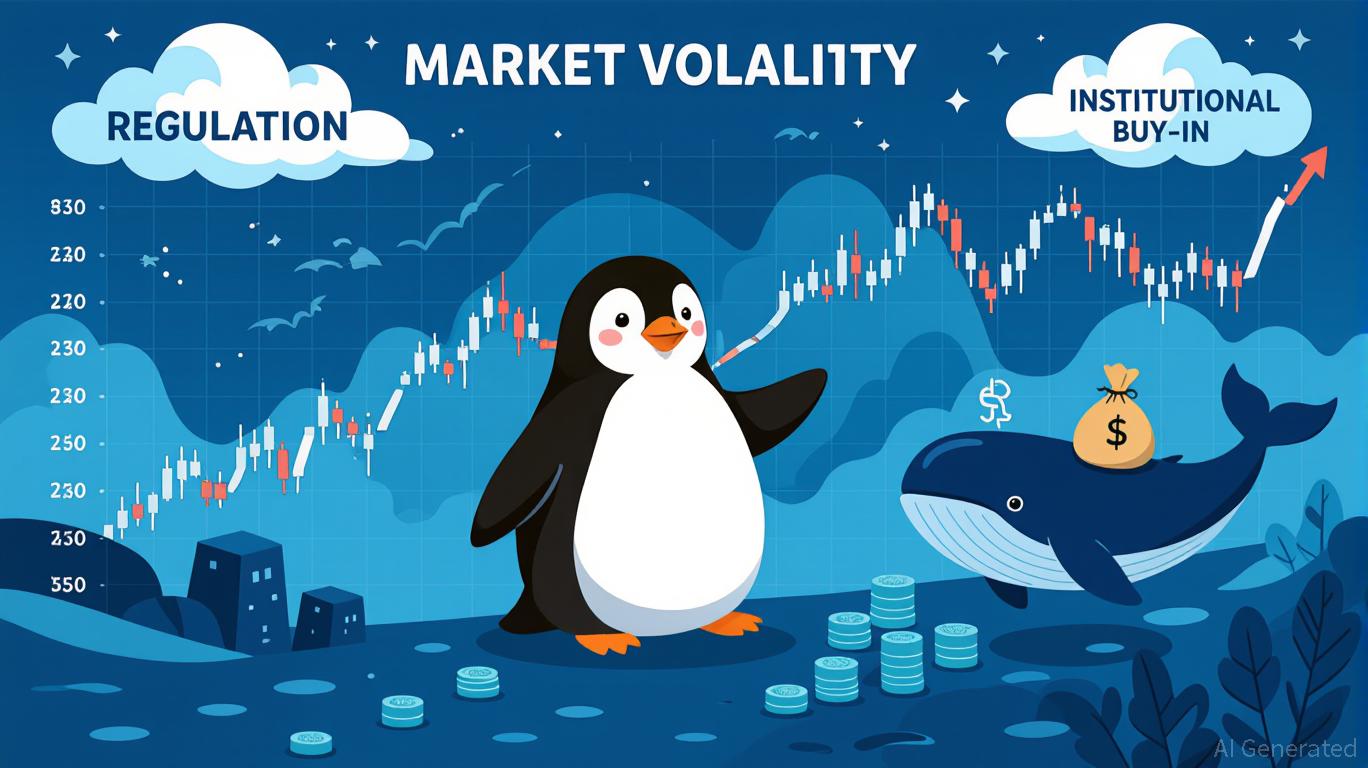
- Pudgy Penguins (PENGU) faces regulatory uncertainty from SEC delays and EU MiCA, causing 30% price drops due to compliance risks. - Institutional interest grows with $273K whale accumulation and rising OBV, contrasting retail fear (Fear & Greed Index at 28). - Ecosystem expansion via Pudgy World and penguSOL, plus Bitso partnership, aims to boost utility but depends on user adoption and regulation. - Expert forecasts diverge: $0.02782 (CoinCodex) vs. $0.068 (CoinDCX), with technical analysis highlighting
PENGU USDT Selling Indicator and What It Means for Stablecoin Approaches
- PENGU/USDT's 2025 collapse triggered $128M liquidity shortfall, exposing systemic risks in algorithmic stablecoins. - Technical indicators (RSI 40.8, bearish MACD) and 52.55% 30-day price drop signal deepening market distrust. - Regulatory frameworks (GENIUS Act, MiCA) and AI-driven risk analytics emerge as critical responses to algorithmic vulnerabilities. - Experts urge hybrid models combining CBDC stability with AI governance to address algorithmic stablecoins' inherent fragility.
Hyperliquid (HYPE) Token: Analyzing the Drivers and Longevity Behind Its Latest Price Rally
- Hyperliquid's HYPE token surged to $42.03 in 2025 from $3.20, driven by product upgrades (HyperEVM, HyperCore) and institutional adoption. - Strategic partnerships with Anchorage Digital and Circle , plus regulatory compliance, boosted credibility and decentralized trading volume (73% market share by 2025). - Bitcoin's $123k high in July 2025 correlated with HYPE's peak, reflecting broader crypto market optimism for low-fee decentralized futures infrastructure. - Sustainability risks include token unlock

The Emergence of Hyperliquid: Transforming DeFi Trading with a Novel Approach
- Hyperliquid dominates 73% of decentralized perpetual futures market with $317.6B 2025 trading volume, driven by institutional-grade infrastructure and on-chain innovations. - Platform's CLOB technology enables precise price discovery and sub-second finality, outperforming AMM-based competitors while maintaining DeFi composability. - HYPE token's deflationary model (97% fee buybacks) and institutional partnerships with Anchorage Digital/Circle accelerate liquidity growth and mainstream adoption. - Cross-c

Trending news
MoreCrypto prices
More





