
Hyperdrive Restores Operations, Compensates Users After $700K Exploit on Hyperliquid

Contents
Toggle- Quick Breakdown
- Exploit and immediate response
- Tracking stolen funds
- Known threat actor involved
- Long-term strategy and risks
Quick Breakdown
- Hyperdrive lost nearly $700K in an exploit targeting its router contract but has since reimbursed users.
- Stolen funds were laundered across Ethereum and BNB Chain, with Tornado Cash involved.
- The exploit highlights ongoing security challenges for the Hyperliquid ecosystem.
Decentralized finance protocol Hyperdrive has resumed full operations and reimbursed users following a $700,000 exploit that targeted two markets on the Hyperliquid blockchain.
Exploit and immediate response
Hyperdrive announced on September 29 that it has restored operations after an exploit drained nearly $700,000 from its Primary and Treasury USDT0 markets. According to the update, all affected accounts have been compensated, and market activity has resumed.
All markets are fully operational and funds have been restored to all impacted accounts.
Summary of Events:
• On Saturday June 27, 2025, around 2200 hours Singapore time, the Hyperdrive team was alerted to certain suspicious activity occurring in the Primary and Treasury USDT0… https://t.co/OiDedFRhOB— Hyperdrive (@hyperdrivedefi) September 29, 2025
The attack, which occurred on September 27, exploited a vulnerability in the protocol’s router contract. The router, which had been granted operator permissions during lending processes, enabled attackers to manipulate collateralized positions and execute arbitrary calls to whitelisted contracts. This resulted in the theft of 672,934 USDT0 and 110,244 thBILL tokens.
Tracking stolen funds
Investigators traced the stolen assets to Ethereum and BNB Chain, where portions were laundered via Tornado Cash. Hyperdrive engaged external auditors and forensic experts to confirm that the vulnerability was patched within hours. Trading was suspended across all markets during remediation and resumed only after funds were restored to users.
Known threat actor involved
The team said the exploit was linked to a known threat actor previously associated with other major DeFi hacks. A detailed post-mortem report is expected in the coming days. Hyperdrive has urged users to rely only on official communication channels to avoid scams.
Long-term strategy and risks
Despite the breach, Hyperdrive reaffirmed its commitment to yield-generating strategies such as tokenizing U.S. Treasury bills in partnership with Theo Network. The project pledged to increase security audits to bolster user trust.
The incident underscores ongoing concerns in the Hyperliquid ecosystem, which has faced recent setbacks, including a $3.6 million rug pull at HyperVault. With only a limited number of validator nodes, the network continues to face scrutiny over centralization and security risks.
Meanwhile, Hyperliquid has launched its first native stablecoin, USDH, following a closely watched governance vote that captured widespread attention across the crypto industry.
Disclaimer: The content of this article solely reflects the author's opinion and does not represent the platform in any capacity. This article is not intended to serve as a reference for making investment decisions.
You may also like
Fed Cuts Rates, Announces $40B T-Bill Program, Crypto Dips
U.S. Marine Policy and Blue Economy Prospects: Key Infrastructure and Geostrategic Roles in Oceanic Commerce
- U.S. oceans policy balances geopolitical strategy, deep-sea tech investments, and UNCLOS ratification challenges to secure maritime influence. - Executive actions accelerate seabed mineral extraction while facing environmental criticism and legal risks from bypassing international seabed authority rules. - Offshore energy partnerships with Australia, Japan, and Saudi Arabia aim to diversify supply chains but face geopolitical tensions in chokepoints like the Red Sea. - Maritime security contracts expand

Aster DEX's On-Chain Momentum: Signaling the Future of DeFi
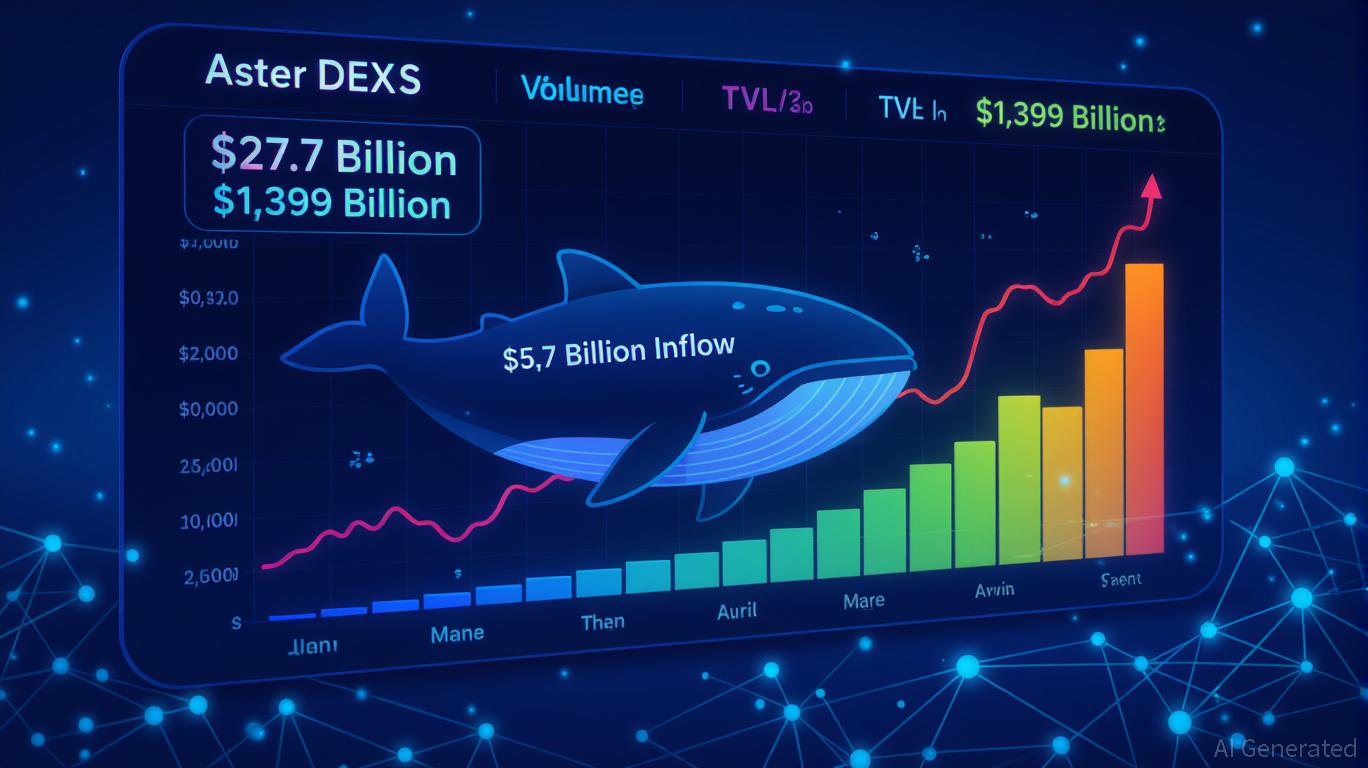
- Aster DEX reported $27.7B daily volume and $1.399B TVL in Q3 2025, outpacing DeFi benchmarks with 2M users. - Institutional whale activity, including CZ's $2M ASTER purchase, drove $5.7B inflows and 800% volume spikes. - Hybrid AMM-CEX model and ZKP privacy tech enabled 40.2% TVL growth, 77% private transactions, and 19.3% perpetual DEX market share. - ASTER's margin trading upgrades and Stage 4 airdrops fueled 30% price surges, while Aster Chain's 2026 launch will integrate privacy-preserving ZKPs. - On
Astar (ASTR) Price Rally: Protocol Enhancements and Ecosystem Growth Drive Long-Term Value
- Astar (ASTR) surged 150% due to protocol upgrades and ecosystem expansion, positioning it as a sustainable value creation case study in blockchain. - Tokenomics 3.0 (fixed 10.5B supply) and Burndrop mechanism created deflationary incentives, supported by Galaxy Digital's $3. 3M OTC investment and Astar's $29.15M buyback. - Cross-chain interoperability with Polkadot/Plaza and Sony's Soneium, plus partnerships with Toyota and Japan Airlines, expanded real-world utility in logistics, identity, and loyalty p

Trending news
MoreCrypto prices
More





