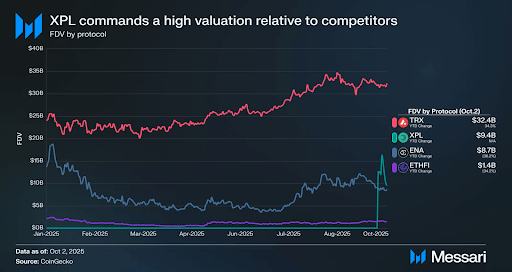
TRX FDV remains strong at approximately $32.4 billion, showing year‑to‑date resilience and investor confidence while XPL and ENA display pronounced volatility and partial recoveries; investors should prioritize project execution, on‑chain metrics, and revenue strategy over short‑term hype when evaluating DeFi valuations.
-
TRX’s steady FDV and YTD gains signal resilience and market trust.
-
XPL’s sharp FDV swings illustrate speculative risk and valuation repricing.
-
ENA and ETHFI show weaker momentum—execution and revenue plans determine long‑term viability.
TRX FDV leads DeFi valuations at $32.4B—read analysis, risks, and next steps for investors. Learn which metrics matter most.
What is driving TRX FDV resilience in 2025?
TRX FDV is driven by sustained on‑chain activity and investor confidence, holding near $32.4 billion through 2025. Strong year‑to‑date performance (around 34.3% growth) and limited downside relative to peers emphasize stability rooted in usage metrics and protocol positioning.
How volatile has XPL been and what caused the swings?
XPL experienced extreme valuation swings in 2025, falling from roughly $18 billion to $3 billion before rebounding to a mid‑year high near $16 billion and settling near $9.4 billion FDV. Market reappraisal of XPL focused on its neobank strategy and perceived proximity to Tether rather than predictable revenue, increasing speculative trading and volatility.
TRX shows resilience with strong FDV while XPL faces volatility and ENA struggles, highlighting execution over hype in the DeFi sector.
- TRX’s steady growth and dominance with a $32.4B FDV underscore its resilience and investor confidence despite market volatility.
- XPL’s sharp swings highlight the risks of speculative hype as its FDV plunged from $18B to $3B before rebounding to $16B.
- ENA’s partial recovery and ETHFI’s weak momentum reveal how execution and strategy, not hype, define long-term DeFi strength.
The DeFi market is witnessing sharp contrasts in valuation trends, sparking investor debate on sustainability and execution. On October 2, 2025, data from CoinGecko revealed that TRX remains the dominant force with a Fully Diluted Valuation (FDV) of $32.4 billion. Meanwhile, XPL, once hailed as a proxy to Tether, finds itself caught in a challenging position as investors reassess its long-term value.
According to analyst Sam on X, “$XPL is caught in a tricky spot. Investors were eager to treat Plasma as a proxy to Tether, but at a $10 billion valuation, the market appears to be overpricing its ability to monetize that alignment.” Sam further stressed that Plasma’s success depends on its neobank strategy, not just chain fees or Tether proximity.
 Source: Sam
TRX demonstrated notable stability throughout 2025. It fluctuated between roughly $20 billion and $35 billion, peaking near $35 billion between January and August. Modest corrections emerged from August onwards, but TRX retained strength above $30 billion, reflecting steady demand and network usage.
Consequently, TRX maintained a lead in the DeFi sector with a 34.3% year‑to‑date increase, separating it from more speculative rivals focused on narrative over execution.
Why did XPL and ENA struggle to maintain valuations?
XPL’s volatility stemmed from rapid changes in market expectations and unclear monetization paths. The token’s FDV collapsed to $3 billion before rebounding; as of early October it traded at about $9.4 billion FDV after a short spike to $16 billion. Market participants shifted from narrative‑driven valuation to revenue and product milestones.
ENA showed a softer but similar trajectory: starting near $12 billion, falling to $3–4 billion, recovering to $10 billion, and stabilizing near $8.7 billion. ENA’s negative performance of roughly 36.2% in 2025 highlights execution challenges despite late‑year recoveries.
ETHFI remains the smallest protocol of those covered, with valuations below $2 billion—standing at about $1.4 billion and reflecting a 34.2% yearly decline. These contrasts underscore that long‑term DeFi strength depends on product delivery and sustainable monetization.
Frequently Asked Questions
How can investors separate hype from sustainable DeFi projects?
Focus on on‑chain metrics, clear monetization plans, roadmap progress, and third‑party audits. Prioritize projects delivering predictable revenue or demonstrable product adoption over speculative narratives.
Is FDV a reliable single metric to value a protocol?
FDV is useful for market perspective but must be combined with TVL, active users, fee revenue, and tokenomics to form a comprehensive valuation view.
Key Takeaways
- TRX strength: Consistent FDV and YTD gains point to resilience rooted in usage metrics.
- XPL risk: Sharp FDV swings highlight speculative exposure tied to narrative shifts.
- Execution matters: ENA and ETHFI show recovery and decline patterns that reward operational execution and revenue clarity.
Conclusion
TRX’s robust FDV and relative stability through 2025 emphasize the value of execution and on‑chain fundamentals in DeFi. XPL and ENA illustrate how quickly valuations can reprice when monetization and strategy lag. Investors should prioritize demonstrable adoption, revenue models, and transparent milestones when evaluating DeFi projects. Stay informed and focus on measurable metrics over short‑term hype.