
How to Understand Hyperliquid's Latest HIP-3 Upgrade in Layman's Terms?

Allow anyone to deploy a perpetual contract market.
Original Author: nairolf
Original Translation: Deep Tide TechFlow
What is HIP-3?
Here is @HyperliquidX's simple explanation of HIP-3.
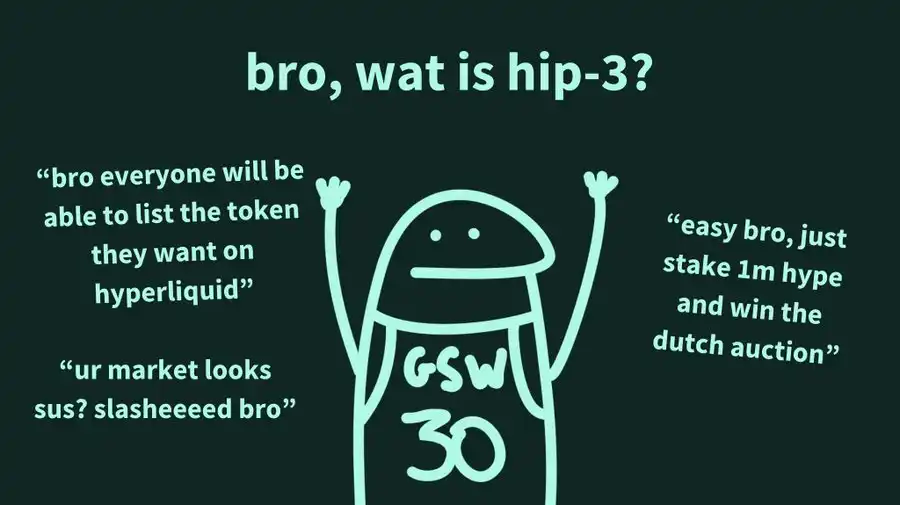
HIP-3 allows developers to deploy a perpetual contract market on HyperCore.
To ensure market quality and protect users, deployers must stake 500,000 HYPE. In case of malicious market behavior, validators have the authority to slash the deployer's stake.
You should already be familiar with HyperCore, right? It includes the state of the order book and the matching engine.
In simple terms, it is the backend of Hyperliquid's exchange.
HIP stands for Hyper Improvement Proposal. Essentially, it outlines how changes are proposed for the protocol.
The primary goal of HIP-3 is to allow anyone to deploy a perpetual contract market.
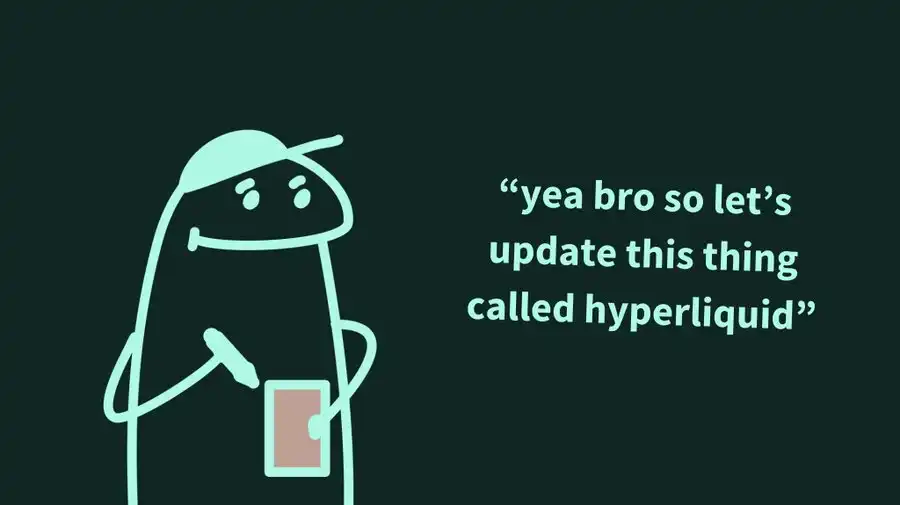
Currently, the process of adding new tokens to a perpetual contract exchange is permissioned.
This means the core team decides which tokens to add based on demand, trading volume, and other criteria.
HIP-3 enables anyone to list their chosen tokens. Yes, quite literally any token.
However, there are some restrictions. Only one token can be listed every 31 hours. Additionally, you need to win the deployment rights through a Dutch Auction (using HYPE).

You must stake 500,000 HYPE and be responsible for setting up the market.
This involves selecting an oracle, defining leverage limits, handling settlement logic, and ensuring everything operates securely.
The 500,000 HYPE serves as a security guarantee and a way for the protocol to protect itself.
If your token market experiences strange manipulation, validators can vote to slash your HYPE.
In simple terms, this HYPE is to ensure that your token listed is legitimate.
As the deployer of the token, you can claim 50% of the total market fees. You can even set an additional custom fee.
In other words, you can earn a portion of the fees from users trading the token you listed.
HIP-3 allows anyone to list a token on the Hyperliquid perpetual contract exchange.
To ensure market security, a 500,000 HYPE stake is required, and in case of suspicious activity, this stake may be slashed.

Disclaimer: The content of this article solely reflects the author's opinion and does not represent the platform in any capacity. This article is not intended to serve as a reference for making investment decisions.
You may also like
The Growing Impact of Artificial Intelligence on Learning and Professional Development
- Global AI in education market to grow from $7.57B in 2025 to $32.27B by 2030 (31.2% CAGR), driven by classroom AI adoption and workforce training. - Asia-Pacific leads growth (35.3% CAGR), with 60% U.S. teachers and 86% global students using AI for personalized learning and content summarization. - Institutions like Farmingdale State College pioneer AI integration through interdisciplinary programs and NSF-funded ethical AI research initiatives. - Strategic partnerships (e.g., IBM-Pearson) and platforms

The Influence of TWT’s Updated Tokenomics on the Dynamics of the Cryptocurrency Market
- TWT/TON's 2025 tokenomics shift from speculative governance to utility-driven ecosystem integration, embedding tokens in platform functions like Trust Premium. - Deflationary mechanisms (88.9B tokens burned) and cross-chain FlexGas systems create scarcity, mitigating oversupply risks while expanding transactional use cases. - Governance reforms prioritize community voting on fees and partnerships, but face challenges from regulatory uncertainty and Solana network dependencies. - Institutional adoption gr

Astar (ASTR) Price Spike: Unraveling the Reasons for Recent Market Fluctuations
- Astar (ASTR) price surged amid Tokenomics 3.0 reforms, institutional capital inflows, and strategic partnerships in November 2025. - Deflationary mechanisms like Burndrop and a $29.15M buyback program reduced circulating supply to 8.24B tokens. - Galaxy Digital's $3. 3M OTC purchase and Coinbase listing roadmap signaled institutional confidence in ASTR's long-term potential. - Partnerships with Sony , Toyota , and Japan Airlines expanded ASTR's real-world utility in logistics and digital identity sectors
The Increasing Importance of STEM Education as a Strategic Asset in a Technology-Focused World Economy
- U.S. STEM education is reshaping curricula and partnerships to meet AI, cybersecurity, and renewable energy demands, driven by $75M investments like Farmingdale State College's expanded Computer Sciences Center. - Public-private collaborations, including NSF AI Education Act and Google/IBM workforce pledges, are accelerating workforce readiness through AI research and micro-credential programs. - STEM-focused universities achieved 11.5% average endowment returns in 2025, but proposed excise taxes threate

Trending news
MoreCrypto prices
More





