
Imminent Explosion? Ether Facing a Historic Shortage

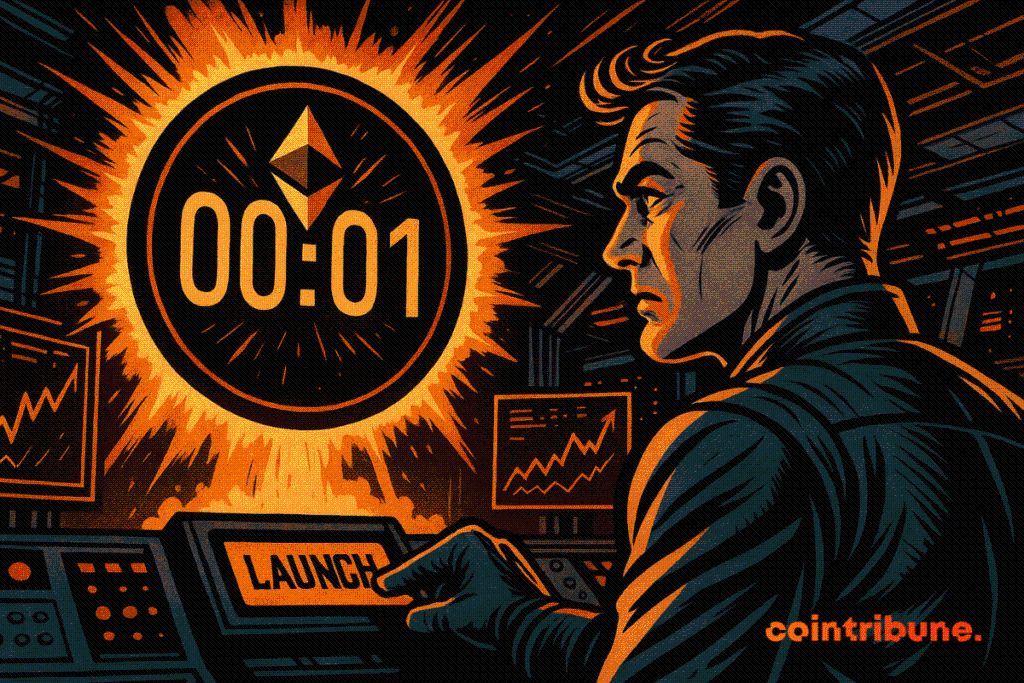
We hear them everywhere, these fiery predictions about Ethereum. According to several analysts, the crypto could explode soon. A surge that is not by chance but due to a well-oiled scarcity mechanism. Three dynamics are crossing right now to make Ethereum a market crypto time bomb. And if the price does not soar now, it would almost be a historic anomaly.
In brief
- 40% of ETH is locked between staking, DATs and ETFs, making the available supply scarce.
- Staking locks 35.7 million ETH with a 40-day exit delay.
- US ETFs already hold 6.84 million ETH despite the absence of authorized staking.
- DATs hold 5.9 million ETH, stored for long-term yields.
Ethereum and the law of emptiness: the 3 brakes on supply
Already in July, SharpLink had bet 6 billion dollars to acquire 1% of the total Ethereum supply . Since then, signals have been accumulating. Crypto Gucci, the analyst, does not mince his words: ” The ETH supply disappears faster than ever“.
And for good reason: the Ethereum supply is melting visibly. Three “supply vacuum” mechanisms are simultaneously active for the first time in a bullish cycle.
First, the DATs (Digital Asset Treasuries), these crypto treasuries with a long-term focus, have amassed 5.9 million ETH. A jackpot of 24 billion dollars, representing 4.9% of the total supply. These actors did not even exist in the previous cycle.
Second, spot ETFs. Since their launch, they have absorbed 6.84 million ether, or 5.6% of the supply. This figure is all the more striking as staking via ETF is not yet authorized in the United States.
Third, native staking. With 35.7 million ETH locked, the majority illiquid for at least 40 days, nearly 30% of the supply escapes the market. In total, 40% of all ethers are no longer exchangeable.
In this context, the price rise seems almost mathematical. ” This time, ETH enters the cycle with a record institutional demand and the lowest liquid amount in its history“, says Crypto Gucci.
The FOMO factor: when States also get involved
And that’s not all. A fourth factor could soon be added: the entry of nation-states into the fray. The Kingdom of Bhutan, for example, has just announced the integration of its national identity system on Ethereum. For now, it holds no ETH. But the idea is gaining ground: to use Ethereum as infrastructure, then as a store of value.
Ryan Sean Adams, co-founder of Bankless, summarizes it this way :
If Ethereum does not manage to turn building on Ethereum into holding ETH as a store of value, it will never realize its cypherpunk dreams.
But not everyone is so enthusiastic. Patrick Cashmore wonders: what if Ethereum prospered… but without ETH? A scenario where the network becomes essential, but only another crypto — bitcoin — is perceived as real money.
For others, like Devansh Mehta, the key lies elsewhere: countries should become network validators. Because owning a few ethers for fees is not enough to guarantee real involvement.
What to remember:
- 40% of the total ETH supply is currently locked;
- US ETFs hold 6.84 million Ethereum;
- Staking alone represents 146 billion dollars;
- ETH shows a price of $4,003 at the time of writing;
- Bhutan is building on Ethereum but does not yet hold any ETH.
The crypto market seems ready for a new chapter. But the story must still turn in favor of ether.
This picture would be incomplete without recalling recent predictions by Arthur Hayes and Tom Lee. Both foresee Ethereum at 10,000 dollars soon. A prophecy that directly resonates with the current market signals.
Disclaimer: The content of this article solely reflects the author's opinion and does not represent the platform in any capacity. This article is not intended to serve as a reference for making investment decisions.
You may also like
PENGU Price Forecast for 2025: Steering Through Regulatory Challenges and Growing Institutional Confidence
- Pudgy Penguins (PENGU) faces regulatory uncertainty from SEC delays and EU MiCA, causing 30% price drops due to compliance risks. - Institutional interest grows with $273K whale accumulation and rising OBV, contrasting retail fear (Fear & Greed Index at 28). - Ecosystem expansion via Pudgy World and penguSOL, plus Bitso partnership, aims to boost utility but depends on user adoption and regulation. - Expert forecasts diverge: $0.02782 (CoinCodex) vs. $0.068 (CoinDCX), with technical analysis highlighting
PENGU USDT Selling Indicator and What It Means for Stablecoin Approaches
- PENGU/USDT's 2025 collapse triggered $128M liquidity shortfall, exposing systemic risks in algorithmic stablecoins. - Technical indicators (RSI 40.8, bearish MACD) and 52.55% 30-day price drop signal deepening market distrust. - Regulatory frameworks (GENIUS Act, MiCA) and AI-driven risk analytics emerge as critical responses to algorithmic vulnerabilities. - Experts urge hybrid models combining CBDC stability with AI governance to address algorithmic stablecoins' inherent fragility.

Hyperliquid (HYPE) Token: Analyzing the Drivers and Longevity Behind Its Latest Price Rally
- Hyperliquid's HYPE token surged to $42.03 in 2025 from $3.20, driven by product upgrades (HyperEVM, HyperCore) and institutional adoption. - Strategic partnerships with Anchorage Digital and Circle , plus regulatory compliance, boosted credibility and decentralized trading volume (73% market share by 2025). - Bitcoin's $123k high in July 2025 correlated with HYPE's peak, reflecting broader crypto market optimism for low-fee decentralized futures infrastructure. - Sustainability risks include token unlock

The Emergence of Hyperliquid: Transforming DeFi Trading with a Novel Approach
- Hyperliquid dominates 73% of decentralized perpetual futures market with $317.6B 2025 trading volume, driven by institutional-grade infrastructure and on-chain innovations. - Platform's CLOB technology enables precise price discovery and sub-second finality, outperforming AMM-based competitors while maintaining DeFi composability. - HYPE token's deflationary model (97% fee buybacks) and institutional partnerships with Anchorage Digital/Circle accelerate liquidity growth and mainstream adoption. - Cross-c

Trending news
MoreCrypto prices
More





