
What Does the Stock–Crypto Investor Divide Signal for the Future?

Retail investors captured about 20% of US stock trading volume in Q3 2025, the second-highest level ever recorded. At the same time, the crypto market is experiencing the opposite trend, with institutional capital dominating as retail participation declines. This divide between equities and digital assets raises important questions about market maturity, volatility, and the future
Retail investors captured about 20% of US stock trading volume in Q3 2025, the second-highest level ever recorded. At the same time, the crypto market is experiencing the opposite trend, with institutional capital dominating as retail participation declines.
This divide between equities and digital assets raises important questions about market maturity, volatility, and the future direction of both asset classes as 2026 approaches.
Stocks Go Retail While Crypto Turns Institutional
The rise in retail investor activity marks a major change in equity market structure. According to data shared by the Kobeissi Letter, individual investors reached their second-highest trading share in history during Q3 2025, nearing the peak of the Q1 2021 meme stock surge.
Before 2020, average retail participation was about 15% for several years. Thus, this makes the current 20% figure quite significant.
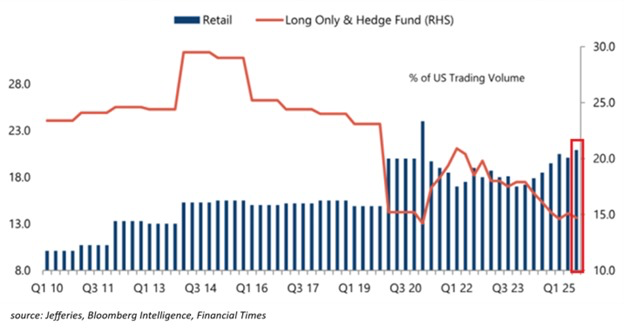 Retail Investors Now Command 20% of US Stock Trading Volume. Source:
X/The Kobeissi Letter
Retail Investors Now Command 20% of US Stock Trading Volume. Source:
X/The Kobeissi Letter
Retail participation has surpassed individual institutional categories. Long-only mutual funds and traditional hedge funds each accounted for about 15% of trading volume last quarter, or half their 2015 share. Furthermore, all fund categories, including quants, together made up just 31% in Q3.
“Retail investors are taking over the market at a historic pace,” The Kobeissi Letter stated.
Meanwhile, the crypto market now shows the reverse of the stock market’s composition. While retail investors fueled past bull runs, 2025 saw a clear shift to institutional dominance. JPMorgan, in its recent note, highlighted that retail participation in the market has fallen. According to the bank,
“Crypto is moving away from resembling a venture capital style ecosystem to a typical tradable macro asset class supported by institutional liquidity rather than retail speculation.”
It is worth noting that the crypto market’s drawdown has reduced demand for exchange-traded funds (ETFs) and put substantial pressure on digital asset treasury (DAT) firms. That said, analysts indicate that buying interest has slowed rather than disappeared.
This dynamic is reflected in the growing gap between retail and institutional behavior. According to CryptoQuant data, institutional Bitcoin holdings continued to expand throughout 2025, while retail investors moved in the opposite direction.
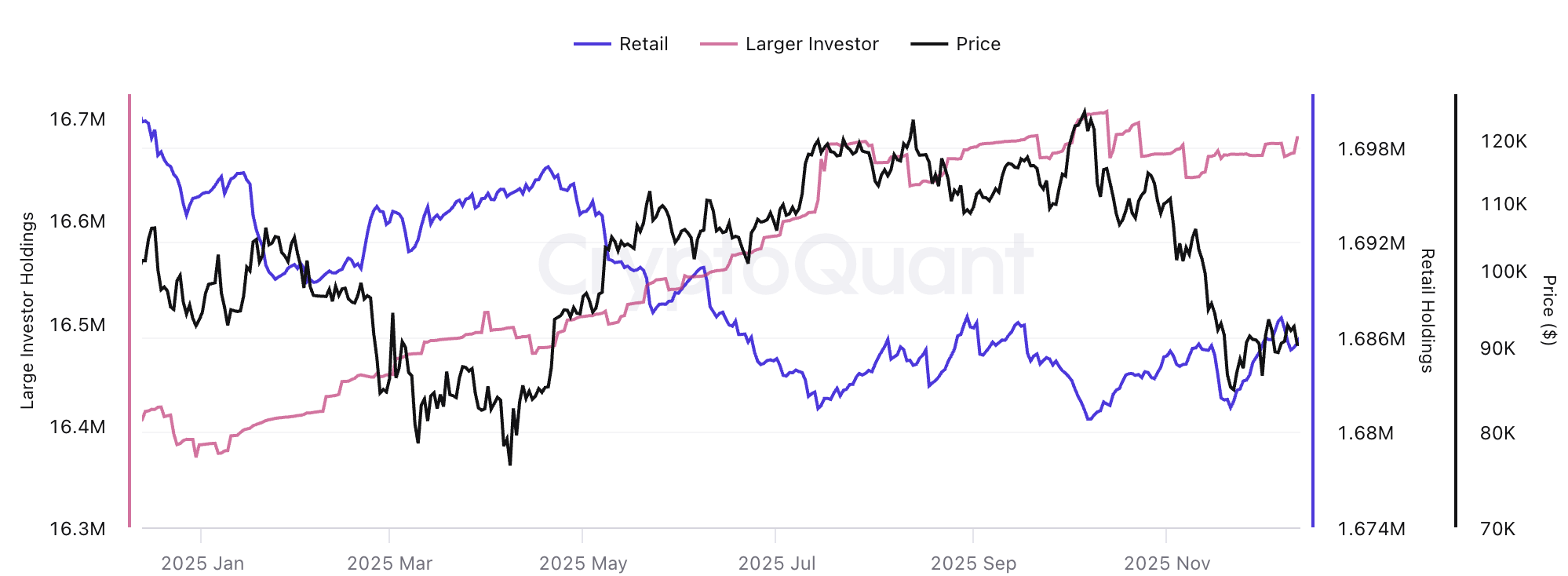 Retail and Large Investor Bitcoin Holdings. Source:
CryptoQuant
Retail and Large Investor Bitcoin Holdings. Source:
CryptoQuant
Why This Contrast Matters
The market changes matter beyond participation rates. High retail activity in stock markets typically reflects a sentiment-driven environment where price action is increasingly influenced by short-term narratives, momentum chasing, and crowd behavior. When individual investors dominate trading, markets tend to become more reactive.
More retail investors changes how markets behave:-More short-term volatility, especially in individual stocks⁰-Options driven moves amplify rallies/ selloffs⁰-Stronger momentum runs, but sharper reversals⁰-Overreactions happen faster due to social media/ news⁰Fundamentals… https://t.co/JKERtgQO2V pic.twitter.com/08LncKN4oN
— Beat The Insider (@BeatTheInsider) December 14, 2025
On the other hand, crypto analysts view institutional dominance as a sign of growing maturity and future stability. More institutional capital means deeper liquidity, more stable pricing, and (in theory) less volatility. Large institutions usually have longer time horizons and better risk management, which could allow for steadier price growth instead of wild swings.
Still, expectations for crypto remain cautious. Barclays projects 2026 as a down year for crypto, noting that in the absence of major catalysts, structural growth appears limited. While the US political climate has become more crypto-friendly this year, Barclays believes this shift has already been priced in by the market.
Thus, the divergence between equities and crypto highlights a structural shift in how risk is being expressed across markets. While rising retail participation is making stock trading more sentiment-driven, crypto’s growing institutional base points to increased maturity but more subdued momentum. Whether these differences are temporary or mark a lasting shift as 2026 nears remains to be seen.
Read the article at BeInCryptoDisclaimer: The content of this article solely reflects the author's opinion and does not represent the platform in any capacity. This article is not intended to serve as a reference for making investment decisions.
You may also like
The Rise of CFTC-Regulated Clean Energy Markets: Opening a New Chapter for Institutional Investors
- CFTC's 2025 approval of REsurety's CleanTrade as a SEF marks a landmark shift in clean energy markets by introducing standardized, transparent trading for VPPAs and RECs. - The platform attracted $16B in notional value within two months, enabling rapid institutional-grade transactions that previously took months to negotiate. - By addressing liquidity gaps and enabling precise risk modeling, CleanTrade is accelerating capital flows into decarbonization while bridging ESG investment gaps for institutional

The Increasing Overlap Between Health and Financial Wellbeing in Managing Personal Finances
- Global wellness economy to hit $9 trillion by 2028, driven by holistic well-being trends. - Millennials/Gen Z prioritize wellness as lifestyle, with 55% spending over $100/month on health. - Employers integrate financial wellness into health programs to reduce burnout and boost productivity. - Investors target wellness-driven SaaS, healthcare tech , and financial literacy platforms for holistic solutions.

Revealing the Value of Green Gold: The Transformative Impact of Institutional-Grade Platforms on Clean Energy Markets
- Clean energy markets hit $35.42B in 2025 but face VPPA/PPA liquidity gaps as U.S. policy rollbacks raise costs by 11.8% YoY. - REsurety's CleanTrade platform digitizes PPA trading, unlocking $16B in liquidity via CFTC-approved SEF infrastructure within two months. - Strategic S&P Global partnership standardizes PPA/REC valuations, addressing institutional investors' risk management gaps in green energy markets. - While global PPA markets grow at 14.6% CAGR to $9.5B by 2035, U.S. policy uncertainty remain

Paradex rolls out Privacy Perps with enhanced end-to-end data privacy

Trending news
MoreCrypto prices
More





