
A New Perspective on the Four-Year Crypto Cycle: I Asked Seven Industry Veterans What Stage We Are In Now

Original | Odaily (@OdailyChina)
Author | Dingdang (@XiaMiPP)

In the eighteen years since the birth of bitcoin, the "four-year cycle" theory has almost become a cornerstone of faith in the cryptocurrency market. Bitcoin halving, supply contraction, price increases, and the relay of altcoin seasons—this narrative not only explains the historical cycles of bull and bear markets, but also profoundly influences investors' position management, project teams' fundraising pace, and even the entire industry's understanding of "time."
However, after the halving in April 2024, bitcoin only rose from $60,000 to a historical high of $126,000, a much smaller increase than in previous cycles, with altcoins remaining weak. Macro liquidity and policy variables have instead become more sensitive market anchors. Especially after the large-scale entry of spot ETFs, institutional funds, and traditional financial instruments, one question is being repeatedly discussed:
Does the four-year cycle in the crypto market still exist?
To this end, we specially invited seven senior practitioners in the crypto field for a dialogue that spans optimism and caution, bull and bear market predictions. They are:
- Jason|Founder of NDV Fund: Previously responsible for China investments at Joe Tsai's (founder of Alibaba) family office, involved in both primary and secondary markets. His investment style combines the rigor of primary markets with the liquidity of secondary markets. The first phase of his fund achieved an absolute return of about 275% in 23 months, has fully exited, and as an open-ended fund, all investors made profits.
- Ye Su|Founding Partner of ArkStream Capital: Over the past eight years, has invested in more than a hundred companies and projects, including Aave, Filecoin, Ethena, etc., as a trend-following institutional investor.
- Jack Yi|Founder of Liquid Capital: Focuses on real-time positions and trading strategies, paying attention to the allocation value of mainstream assets, stablecoins, and exchange ecosystems at different cycle stages.
- James|Founder of DFG: Currently manages over $1.1 billions in assets, early investor in LedgerX, Ledger, Coinlist, Circle, etc., and also an early investor and supporter of protocols such as bitcoin, ethereum, solana, uniswap, etc.
- Joanna Liang|Founding Partner of Jsquare Fund: A post-90s entrepreneur and investor, currently managing over $200 million in assets, and specifically operates a $50 million LP fund; has invested in several star projects including Pudgy Penguins, Circle, Amber Group, Render Network, etc.
- Bruce|Founder of Maitong MSX: With a mining background, judges the long-term profit space and risk boundaries of the crypto market from mining costs, cycle returns, and industry maturity.
- CryptoPainter|Crypto Data Analyst: Uses on-chain data and technical indicators as main tools, combined with historical cycle characteristics, to quantitatively judge market stages and trend inflection points.
1. What exactly is the "four-year cycle" we are talking about?
Before discussing whether the cycle is "invalid," we first need to clarify a prerequisite question:
What exactly do we mean by the "four-year cycle"?
According to the general consensus of the interviewees, the traditional four-year cycle is mainly driven by bitcoin's block reward halving, which occurs approximately every four years. Halving means a decrease in new supply, changes in miner behavior, and long-term support for the price center. This is the core and most mathematically grounded part of the "four-year cycle" narrative.
However, some guests have incorporated the crypto cycle into a broader financial framework. Jason, founder of NDV, believes that the four-year cycle is actually a dual-driven model of political cycle + liquidity cycle, not just a simple halving code rule. The so-called four years actually highly coincide with the US election cycle and the global central banks' liquidity release rhythm. In the past, everyone only looked at halving, thinking it was the only variable, because the number of new bitcoins added in each cycle was significant. But now, with the approval of spot ETFs, bitcoin has entered the macro asset sequence, and the expansion speed of the Federal Reserve's balance sheet and the growth of global M2 are the real core factors defining the cycle. So in his view, the four-year cycle is essentially the cycle of fiat liquidity. Simply thinking about the supply-side impact mathematically, BTC will only add 600,000 coins this cycle (2024-2028), which is too small compared to the approximately 19 million already issued, and the less than $6 billion in new selling pressure can easily be absorbed by Wall Street.
2. Law, or self-fulfilling narrative?
When a concept is repeatedly verified and widely disseminated, it often evolves from a "law" to a "consensus," and further into a narrative. And narrative itself can in turn influence market behavior. Therefore, an unavoidable question is: Is the four-year cycle an objectively existing economic law, or a market narrative that is collectively believed and thus continuously self-fulfilling?
Regarding the causes of the four-year cycle, our interviewees' views are basically consistent, believing that it is the result of both objective mechanisms and market narratives, but different dominant forces emerge at different stages.
As CryptoPainter said, the four-year cycle did have extraordinary significance in the early days when miners' output was high, but this supply-demand change cycle has a clear marginal effect. In theory, as halvings occur multiple times, the impact of the halving event itself on supply and demand also halves, so the increase in each bull market also shows a logarithmic reduction. It can be guessed that the next halving cycle will have an even smaller price impact. Jason also pointed out that as the scale grows, the impact of pure supply-side changes is diminishing. Now, the cycle is more based on the self-fulfillment of liquidity.
Joanna Liang, founding partner of Jsquare Fund, adds from the perspective of market behavior that the four-year cycle has a considerable degree of "self-fulfilling" characteristics. As the structure of institutional and retail participation changes, the relative importance of macro policies, regulatory environment, liquidity conditions, and halving events is reordered in each cycle. In this dynamic game, the four-year cycle is no longer an "iron law," but just one of many influencing factors. In her view, precisely because the fundamentals are constantly evolving, it is not impossible for the market to break the four-year cycle and even sprint into a "super cycle."
Overall, the consensus among the guests is: The four-year cycle did have a solid supply-demand foundation in the early days, but as miners' influence in the market declines and bitcoin gradually shifts to an asset allocation attribute, the cycle is transitioning from being strongly mechanism-driven to being the result of narrative, behavior, and macro factors acting together. The current cycle may have gradually shifted from a "hard constraint" to a "soft expectation."
3. The obvious decrease in this cycle's gains: natural cycle decay, or overshadowed by ETFs and institutional funds?
On this issue, almost all guests gave a relatively consistent directional judgment: this is the natural result of diminishing marginal effects, not a sudden failure of the cycle. Any growth market will experience a process of multiple reduction. As bitcoin's market value continues to expand, each new "multiple" requires exponential capital inflows, so the decline in returns is itself a natural law.
From this perspective, "not rising as much as before" is instead a result that fits the long-term logic.
But deeper changes come from the market structure itself.
Joanna Liang believes that the biggest difference in this cycle compared to the past is the early entry of spot ETFs and institutional funds. In the last cycle, bitcoin's all-time high was mainly driven by retail marginal liquidity; in this cycle, more than $50 billion in ETF funds have continuously flowed in before and after the halving, absorbing the supply shock before it truly materialized. This means that price increases are spread over a longer time dimension, rather than being concentrated in a parabolic explosion after the halving.
Jack Yi also adds from the perspective of market value and volatility that as bitcoin enters the trillion-dollar level, the decline in volatility is itself an inevitable result of mainstream assetization. When the market value was small in the early days, capital inflows easily brought exponential increases; but at the current scale, even doubling requires extremely large new capital.
James, founder of DFG, positions the halving as a "still existing but less important variable." In his view, future halvings will be more like secondary catalysts, with the real trend determined by institutional capital flows, the implementation of RWA and other real demands, and the macro liquidity environment.
However, Bruce, founder of MSX, does not fully agree with this. He believes that halving increases the production cost of bitcoin, and cost will ultimately form a long-term constraint on price. Even if the industry enters a mature stage and overall returns decline, halving will still have a positive impact on price by raising costs, just that this impact will no longer manifest as violent fluctuations.
In summary, the guests do not believe that the "smaller gains" are caused by a single factor. A more reasonable explanation is: the marginal impact of halving is decreasing, while ETFs and institutional funds are changing the rhythm and form of price formation. This is not the failure of halving, but rather the market no longer revolves around a single explosive halving event.
4. So, what stage are we in now?
If the previous discussion focused more on "whether the cycle structure still holds," then this question is obviously more realistic: At this moment, are we in a bull market, a bear market, or some transitional stage that has not yet been accurately named?
It is also on this point that the interviewees' differences are most pronounced.
Bruce, founder of MSX, is relatively pessimistic. He believes that we are now in the early stages of a typical bear market, only the end of the bull market has not been acknowledged by most participants. His judgment is based on the most basic cost and return structure. In the last cycle, bitcoin's mining cost was about $20,000, and the price rose to a high of $69,000, with a profit margin of nearly 70% for miners. In this cycle, the post-halving mining cost has approached $70,000, and even if the price reaches the historical high of $126,000, the profit margin is only just over 40%. In Bruce's view, as an industry that has been around for nearly 20 years, it is normal for the return rate to decline in each cycle. Unlike 2020–2021, in this cycle, a large amount of incremental capital did not choose to enter the crypto market, but instead flowed into AI-related assets. At least in the North American market, the most active risk appetite capital is still concentrated in the AI sector of US stocks.
CryptoPainter's judgment is clearly more technical and data-oriented. He believes that the current market has not yet entered a true cyclical bear market, but is already in a technical bear market—the core sign being a weekly close below the MA50. In the last two bull markets, technical bear markets appeared in the later stages, but this does not mean the cycle ends immediately. A true cyclical bear market often requires a simultaneous macroeconomic recession as a confirmation condition. Therefore, he describes the current stage as a "probationary state": the technical structure has weakened, but macro conditions have not yet given a final verdict. He specifically mentions that the total supply of stablecoins is still growing. When stablecoins also stop growing for a long period (over 2 months), the bear market will be confirmed.
In contrast, more guests still tend to believe: The cycle has already failed, and we are currently in a mid-to-late bull market correction, with a high probability of entering a volatile upward or slow bull mode in the future. Jason and Ye Su's judgments are both based on global macro liquidity. In their view, the US currently has almost no other options but to use monetary easing to delay the concentrated release of debt pressure. The rate-cutting cycle has just begun, and the "tap" of liquidity has not been turned off. So as long as global M2 is still expanding, crypto assets, as the most liquidity-sensitive sponge, have not ended their upward trend. In addition, he mentions that the real bear market signal is when central banks start to substantially tighten liquidity, or when the real economy experiences a severe recession leading to liquidity exhaustion. At present, these indicators do not show abnormalities; instead, they show that liquidity is ready to surge. Also, from the market leverage ratio, if contract positions are too high relative to market value, it is usually a signal for short-term adjustment, but not a bear market signal.
Jack Yi also believes that Wall Street and institutions are reconstructing the financial system based on blockchain, the chip structure is becoming more stable, and it is no longer as volatile as when retail investors dominated in the early days. Moreover, with the change of the Federal Reserve chairman, the arrival of the rate-cutting cycle, and the most friendly crypto policies in history, the current volatility will be seen as wide-range oscillations in the future, and the medium to long term is still a bull market.
The divergence itself may also be the most authentic feature of this stage. The judgments of our interviewees form an imperfect but sufficiently real small sample: some have already confirmed a bear market, some are waiting for data to give the final answer, but more people may believe that the four-year cycle theory has basically failed.
More importantly, it is no longer the only or even the main framework for understanding the market. The importance of halving, time, and sentiment is being re-evaluated, while macro liquidity, market structure, and asset attributes are becoming more critical variables.
5. The core driving force of a perpetual bull market: from sentiment-driven to structurally-driven bull
If the "four-year cycle" is weakening, and the future crypto market no longer shows clear bull-bear switches but enters a state of long-term oscillating upward movement with significantly compressed bear markets, then where does the core driving force supporting this structure come from?
Jason believes it is the systemic decline of fiat currency credibility and the normalization of institutional allocation. As bitcoin is gradually regarded as "digital gold" and enters the balance sheets of sovereign states, pension funds, and hedge funds, its upward logic no longer depends on a single cyclical event, but is closer to gold as a "long-term asset against fiat depreciation." The price performance will also show a spiral rise. At the same time, he particularly emphasizes the importance of stablecoins. In his view, compared to bitcoin, the potential user base of stablecoins is larger, and their penetration path is closer to the real economy. From payments and settlements to cross-border capital flows, stablecoins are becoming the "interface layer" of the next-generation financial infrastructure. This means that the future growth of the crypto market does not entirely rely on speculative demand, but will gradually be embedded into real financial and business activities.
Joanna Liang's judgment echoes this. She believes that the key variable for a slow bull in the future comes from continuous adoption at the institutional level. Whether through spot ETFs or the tokenization path of RWA, as long as institutional allocation behavior continues, the market will show a "compound interest" upward structure—volatility is smoothed, but the trend will not reverse.
CryptoPainter's perspective is more direct. He points out that the right side of the BTCUSD trading pair is USD, so as long as global liquidity remains loose in the long term and the dollar is in a weak cycle, asset prices will not experience a deep bear, but will slowly oscillate upward in repeated technical bear markets. The traditional bull-bear structure will also shift to a "long-term oscillation - surge - long-term oscillation" pattern similar to gold.
Of course, not everyone agrees with the "slow bull narrative."
Bruce is clearly pessimistic about the future. He believes that global structural economic problems have not been solved: worsening employment environment, young people lying flat, highly concentrated wealth, and continued accumulation of geopolitical risks. Against this background, the probability of a severe economic crisis in 2026–2027 is not low. If macro systemic risks really break out, crypto assets will also be hard to remain unaffected.
To some extent, the slow bull is not a consensus, but a conditional judgment based on the continuation of liquidity.
6. Is there still a traditional "altcoin season"?
"Altcoin season" is almost an inseparable part of the four-year cycle narrative. But in this cycle, its absence has instead become one of the most frequently discussed phenomena.
There are many reasons for the poor performance of altcoins in this cycle. Joanna points out that first, the rise in bitcoin dominance has created a "safe haven within risk assets" pattern, making institutional funds more inclined to choose blue-chip assets. Second, the regulatory framework is gradually maturing, which makes altcoins with clear utility and compliance more favorable for long-term adoption. Third, there are no killer applications or clear narratives like DeFi and NFT in the last cycle.
Another consensus among the guests is that there may be a new altcoin season, but it will be more selective, focusing only on a few tokens that truly have use cases and can generate revenue.
CryptoPainter puts it more bluntly. He believes that a traditional altcoin season is impossible to appear again, because "traditional" means the total number of altcoins is within a reasonable range, but now the total number of altcoins has reached an unprecedented new high. Even if macro liquidity overflows, there are too many coins and too little capital, so a general rally is impossible. Therefore, even if there is an altcoin season, it will be very limited and flow according to sector narratives. Focusing on individual altcoins is meaningless now; attention should be paid to tracks and sectors.
Ye Su uses the US stock market as an analogy: the future performance of altcoins will be more like the M7 in US stocks—blue-chip altcoins will outperform the market in the long term, while small-cap altcoins will occasionally explode, but with very weak sustainability.
In the end, the market structure has changed. It used to be a retail-driven attention economy, now it is an institution-driven balance sheet economy.
7. Position distribution
In such a market with a blurred cycle structure and broken narratives, we also consulted several guests about their actual position distribution.
A rather striking fact is: Most interviewees have basically cleared their altcoin positions and are mostly in half-position status.
Jason's position strategy is clearly biased towards "defensive + long-term." He said he currently prefers to use gold instead of the US dollar as a cash management tool to hedge fiat risk. In terms of digital assets, most positions are allocated to BTC and ETH, but he remains cautious about ETH. They prefer high-certainty assets, i.e., hard currency (BTC) and exchange equity (Upbit).
CryptoPainter strictly follows the rule of "cash ratio not less than 50%," with core allocations still in BTC and ETH, and altcoin positions below 10%. All gold positions were exited after $3,500, with no plans to allocate to gold for now. At the same time, he holds some short positions with very low leverage in overvalued US stock AI sector stocks.
Jack Yi has a relatively high risk appetite, with his fund nearly fully invested, but the structure is also concentrated: ETH as the core, stablecoin logic (WLFI), supplemented by BTC, BCH, BNB and other large-cap assets. The logic is not to bet on the cycle, but to bet on the long-term structure of public chains, stablecoins, and exchanges.
In sharp contrast is Bruce. He has almost cleared all crypto positions, including selling BTC near $110,000. In his view, there will still be opportunities to buy back below $70,000 in the next two years. His US stock positions are also mainly defensive/cyclical stocks, and he expects to clear most US stocks before next year's World Cup.
8. Is it a good time to bottom fish now?
This is the most actionable of all questions. Bruce is relatively pessimistic, believing that it is far from the bottom. The real bottom appears when "no one dares to bottom fish anymore."
The cautious CryptoPainter also believes that the ideal price to bottom fish or start DCA is below $60,000. The logic is simple: start buying after the price is halved from the peak, a strategy that has been validated in every bull market. Obviously, this target will not be reached in the short term. His view of the current market is that after 1-2 months of wide-range oscillation, there is hope to test prices above $100,000 again next year, but it is unlikely to reach new highs. After the macro monetary policy benefits are exhausted and the market lacks subsequent liquidity and new narratives, the cycle bear will officially arrive, and then patiently wait for monetary policy to start a new round of easing and aggressive rate cuts.
More guests, however, are relatively neutral to slightly bullish. They believe that now may not be the time for "aggressive bottom fishing," but it is a window period to start building positions in batches and gradually allocate. The only consensus: do not use leverage, do not trade frequently, discipline is far more important than judgment.
Disclaimer: The content of this article solely reflects the author's opinion and does not represent the platform in any capacity. This article is not intended to serve as a reference for making investment decisions.
You may also like
Macroeconomic Distortion, Liquidity Restructuring, and the Repricing of Real Yields
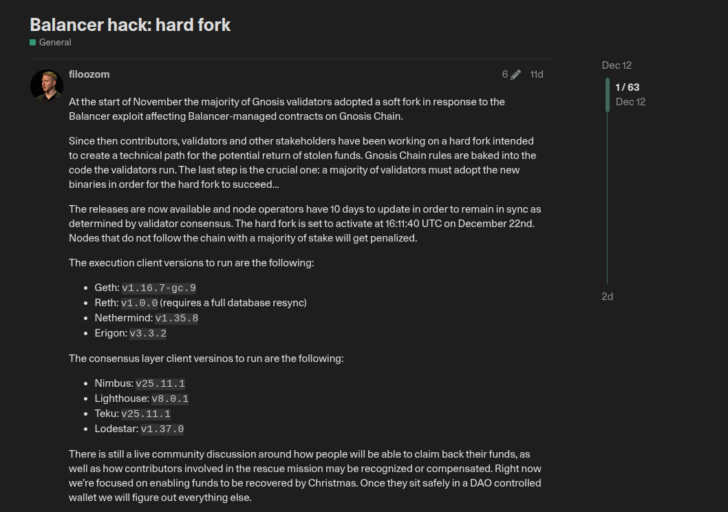
Gnosis Chain Warns of Validator Penalty Post Balancer Hack Recovery Hard Fork
Today's Crypto Market: NIGHT on Cardano Plummets, ZEC and XMR Also Decline

SEC Targets Crypto Frauds: An Unyielding Crusade
Trending news
MoreCrypto prices
More





