
News
Stay up to date on the latest crypto trends with our expert, in-depth coverage.


Massive $755M ETF Outflows Hit Bitcoin and Ethereum
Bitcoin and Ethereum ETFs saw combined outflows of $755M on October 13, sparking concerns over market sentiment.Investor Sentiment Appears to Be CoolingWhat Could Be Driving These Outflows?
Coinomedia·2025/10/14 06:39

Bitcoin Rallies After Negative Crowd Sentiment
Bitcoin often surges after days of extreme negative sentiment, proving crowd FUD is a strong contrarian indicator.Santiment Identifies Key Contrarian SignalsUnderstanding the Sentiment-Price Connection
Coinomedia·2025/10/14 06:39

BNB Hits New High Then Slides — Here’s Why Traders Should Be Cautious
BNB’s record high may be deceptive, as bearish signals and negative funding rates point to waning confidence and a potential pullback toward key support levels.
BeInCrypto·2025/10/14 06:30

Ethereum Price Breaks $4.200, Whale Accumulation Suggests Bullishness
Portalcripto·2025/10/14 06:27
Bitcoin Dominates Fund Flows With $2.67B Influx, But Still Trails 2024’s Peak
CryptoNewsNet·2025/10/14 06:27
India eyes CBDC, restates opposition against unbacked ‘crypto’
CryptoNewsNet·2025/10/14 06:27
DOGE Faces Rejection at $0.22 as Dogecoin Treasury Firm Eyes Public Listing
CryptoNewsNet·2025/10/14 06:27
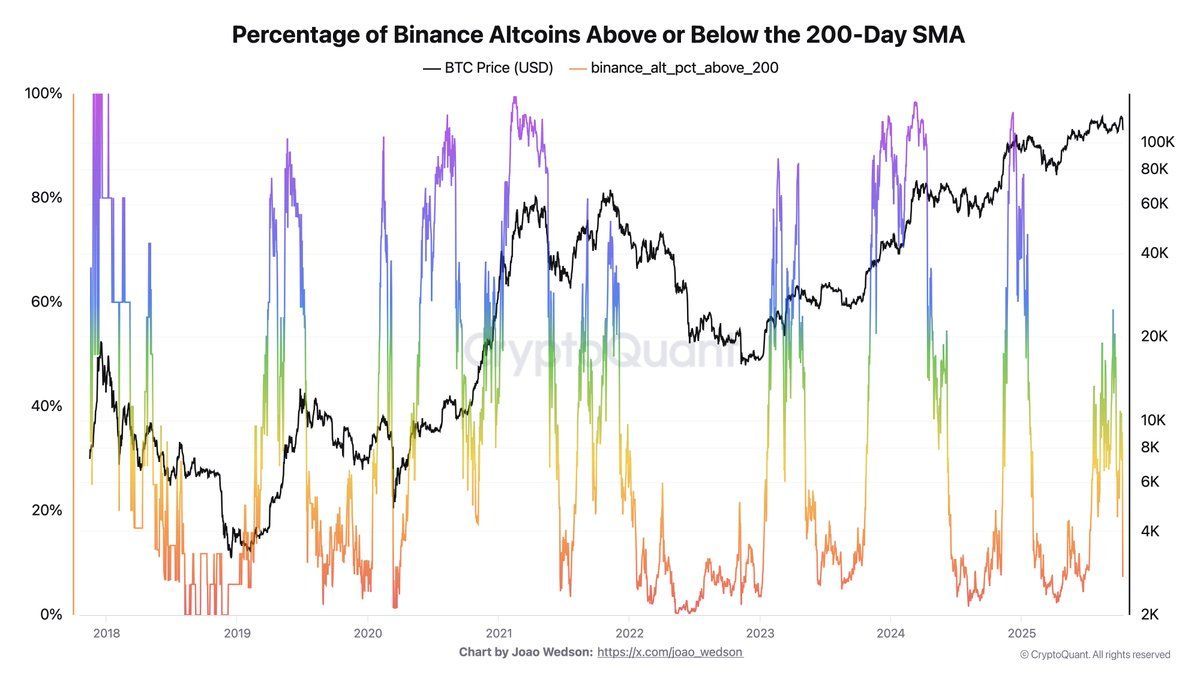
Why Analysts Say Now Could Be the Smartest Time to Buy Altcoins
CryptoNewsNet·2025/10/14 06:27
Wall Street Expands into Cryptocurrencies: Citi Makes Announcement
CryptoNewsNet·2025/10/14 06:27

Ethereum (ETH) Forms Key Bearish Setup — Could a Downside Move Follow?
CoinsProbe·2025/10/14 06:18
Flash
03:55
US Spot Ethereum ETF Sees $6 Million Net Outflow On June 6, according to monitoring data from Farside Investors, the US spot Ethereum ETF experienced a net outflow of $6 million yesterday.
03:32
Analyst: Market Digesting Fear, On-Chain Metrics Show Bitcoin Has Bottomed Structure ExpectationBlockBeats News, June 6th - On-chain analyst Murphy stated in a post that BTC broke below the $60,000 integer mark yesterday, but the market loss did not deteriorate in line with the sentiment indicators. Currently, the 3-day moving average of the adjusted on-chain realized loss (EARL) is $1.13 billion, nearly half of the value on February 5th. He believes that this does not mean BTC will not continue to decline in the future, but the fact that EARL has not increased further in a lower price environment is a typical structure that signals a "bottoming expectation."
If EARL represents the market's level of fear, STH-RUL (Short-Term Holder Relative Unrealized Loss) represents the psychological pressure faced by new investors. During the downtrend after entering a bear market, short-term holders usually experience a severe psychological limit pressure, and STH-RUL will exceed +5 standard deviations, corresponding to a systemic crisis. Subsequently, even if the price continues to decline, STH-RUL often does not surpass the previous peak, as the chips have completed turnover in the high loss range, new buyers have lower costs, and market pressure is being absorbed.
Murphy believes that EARL and STH-RUL are currently giving a consistent signal that market panic is being digested rather than spreading. Despite price setting new lows, the loss indicators have not simultaneously set new highs, which is not a sufficient condition for a bottom. However, in history, true bottoms almost always have this characteristic. Bottoming is a process of repeated pressure and digestion until the chips complete turnover in panic, new buyers have low enough costs, and the price gradually loses momentum to continue falling.
03:12
Cathie Wood: Market Misread Strong Non-Farm Payrolls, AI-Driven Productivity Gains to Dampen InflationBlockBeats News, June 6th, Cathie Wood, the founder of Ark Invest, stated in a post that the latest US jobs report showed strong performance, but the market misunderstood it. Non-farm payrolls increased by 172,000, higher than the market's expected 88,000. However, the market saw a sell-off afterward. She believes that the market is assuming that stronger-than-expected employment and growth will accelerate inflation, but historical experience does not support this view. The current productivity growth rate is close to 3%, and unit labor costs are around 0.5%, which is not indicative of inflationary prosperity but rather of healthy growth driven by productivity, which will ultimately reduce inflation in the long term.
Despite a year-over-year increase in oil prices of about 55% calculated on a three-month moving average basis, the yield curve continues to trend flat. She believes that the bond market is pricing in a more powerful force: the deflationary impact of technological innovation, especially AI, which is now beginning to boost productivity in several sectors of the economy. If the Iran tensions ease and oil prices fall, inflation may enter negative territory by the end of the year.
The Federal Reserve's significant rate hikes in 2022 when faced with a primarily supply-driven inflation shock would be a historic policy mistake, and the next generation of monetary policymakers may not be willing to repeat this error. If ARK's research proves correct, the next phase of this cycle may see a combination of accelerated growth, declining inflation, lower interest rates, and a stronger dollar, providing a favorable backdrop for innovation-driven stocks and technological advancements that will fuel the next wave of productivity prosperity.
News