
News
Stay up to date on the latest crypto trends with our expert, in-depth coverage.

- BlackRock's Bitcoin ETFs lost $523M in single-day outflows on Nov 17, marking fifth consecutive net redemptions totaling $2.96B for November. - Despite November's historical 41.22% Bitcoin price surge, ETF redemptions signal cooling institutional/retail demand with average investor cost basis at $89,600. - Michael Saylor's firm bought 8,178 BTC at $102k average price, while JPMorgan warned Bitcoin-heavy companies risk index delistings by 2026. - BlackRock's IBIT holds 3.1% of Bitcoin supply but NAV multi
- ECB President Lagarde reaffirmed Bitcoin's "worth nothing" stance, rejecting its inclusion in central bank reserves due to safety and regulatory risks. - Bitcoin fell below $90,000 (32% from October 2025 peak), mirroring April 2025's correction amid U.S. rate uncertainty and large holder sell-offs. - ECB prioritizes digital euro development, aiming for 2027 pilot and 2029 launch to enhance privacy and reduce reliance on foreign payment systems. - Despite short-term Bitcoin rebound (3.64% in 24 hours), an
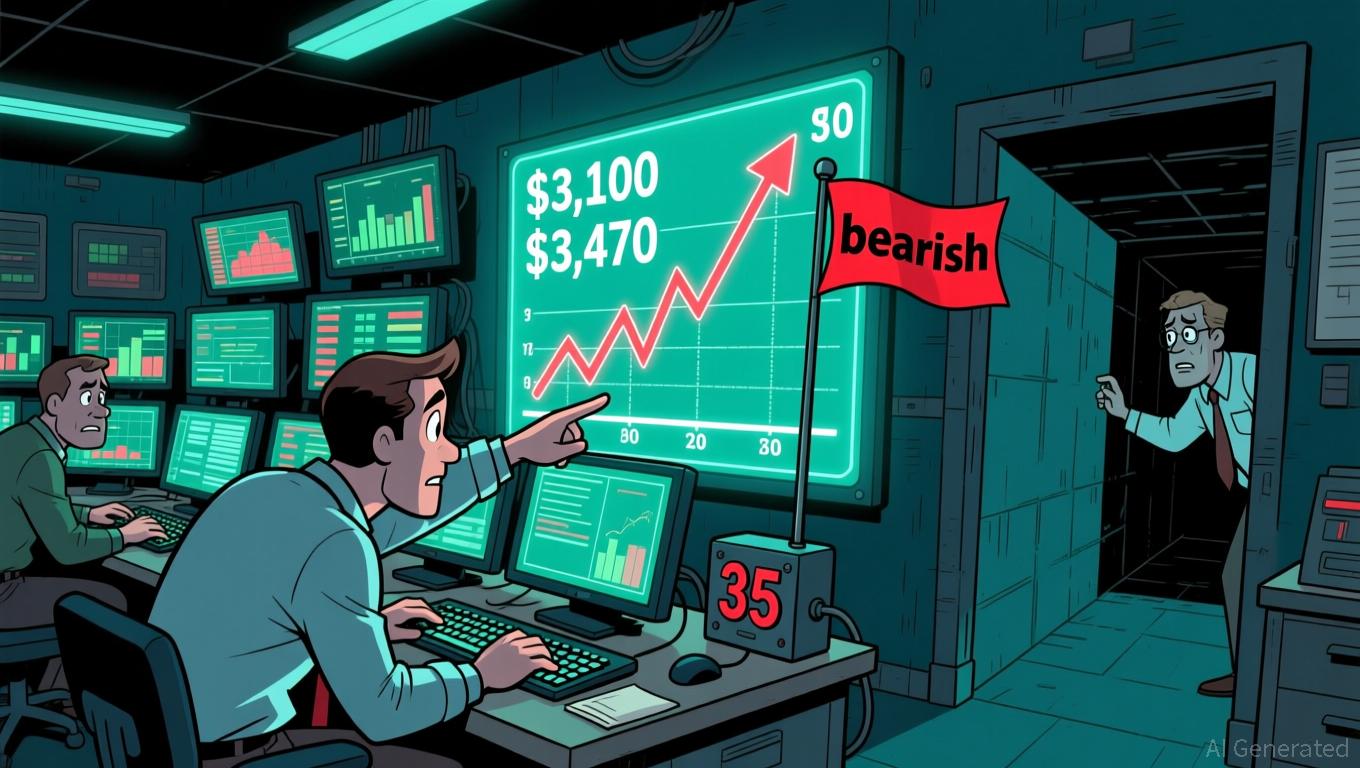
- Altcoins like ETH, XRP , and ICP trade near critical technical levels as institutional investors monitor potential inflection points ahead of a possible December market rebound or collapse. - Ethereum remains fragile below key moving averages with RSI near oversold territory, while XRP faces a $2.07–$2.10 support test that could trigger further declines if broken. - Smaller-cap tokens show speculative activity amid consolidation, with ICP's $4.97 resistance and Bitcoin's $88,000 support level serving as
- Fed's December rate cut odds dropped to 33% due to internal divisions and delayed labor market data. - October/November jobs reports delayed until post-Dec 9-10 meeting, removing key policy input. - 10-2 October voting split and cautious officials like Collins highlight policy uncertainty. - Bitcoin fell 20% while gold dipped below $4,000 as markets react to reduced cut expectations. - Analysts warn prolonged indecision risks volatility, with December outcome hinging on incoming data.

- ICP Caffeine AI-DFINITY introduces a "chain-of-chains" blockchain architecture enabling on-chain AI tasks like image processing and facial recognition. - The platform integrates Microsoft Azure and Google Cloud to reduce AI inference costs by 20-40%, targeting enterprise scalability while maintaining decentralization. - Despite a 56% ICP token price surge, dApp activity dropped 22.4% in Q3 2025, raising concerns about no-code workflow viability and SEC regulatory scrutiny. - Competitors like C3.ai and CU
- ICP's price surged over 6% in November 2025, supported by $4.70 and strategic partnerships with Tether and Parfin in Latin America. - Network upgrades like Caffeine and on-chain AI capabilities position ICP as a decentralized alternative to centralized cloud providers. - Institutional adoption, driven by Parfin's Argentina registration and $237B TVL, strengthens ICP's hybrid infrastructure and AI-native edge. - Analysts predict ICP could outperform altcoins in 2026, leveraging institutional trust and tec
- ICP's 30% price surge in late 2025 stems from AI tool Caffeine, cross-chain Chain Fusion upgrades, and institutional partnerships with Microsoft/Google Cloud. - Despite 1.2M active wallets and $237B TVL growth, dApp engagement fell 22.4%, revealing speculative TVL dominance over organic adoption. - Technical indicators show price volatility, with ICP consolidating between $4.30-$4.34 after breaking below $4.33 support in November 2025. - Long-term potential exists via 2.5x canister growth and AI/privacy
- ICP Network claims 10M active nodes in 2025 but lacks verified data, with 1.2M active wallets reported instead. - Q3 2025 saw 22.5% TVL growth ($1.14B) and 2,000 new developers, yet DApp usage fell 22.4% amid rising speculative trading. - Institutional partnerships (Microsoft, Google) and AI tools drive infrastructure growth, but regulatory risks and user engagement gaps threaten long-term viability.
- Zcash's 2025 halving cut block rewards by 50%, tightening ZEC supply and reshaping miner economics. - Historical price surges (500% in 2020, 92% in 2024) suggest deflationary narrative drives market demand. - Partial PoS transition and $137M Grayscale investment offset mining pressures while attracting institutional capital. - Privacy-focused adoption (28% shielded transactions) and inverse Bitcoin correlation position ZEC as a privacy-centric alternative. - Upcoming 2028 halving and regulatory risks hig