
News
Stay up to date on the latest crypto trends with our expert, in-depth coverage.


- Sui's SUI token consolidates near $2.02 support, with bullish analysts projecting potential $2.50-$20 moves following Mysticeti v2 upgrades and Beep Protocol liquidity injections. - Technical indicators show re-accumulation patterns between $1.6-$2, while partnerships with Crypto.com and Bluefin boost institutional exposure and network efficiency. - Risks include a $103M token unlock in 2026 and market volatility, though 35% improved network efficiency and growing developer activity strengthen long-term

- Circle plans to launch a native token on its Arc blockchain to boost network participation and decentralization, following a 66% revenue surge to $740M in Q3 2025. - The Arc Network, designed for stablecoin transactions with sub-second finality, has attracted 100+ participants including Goldman Sachs and Visa since its October testnet launch. - USDC circulation hit $73.7B (up 108% YoY), while analysts project its supply could triple by 2027, though regulatory challenges loom over tokenized governance mod
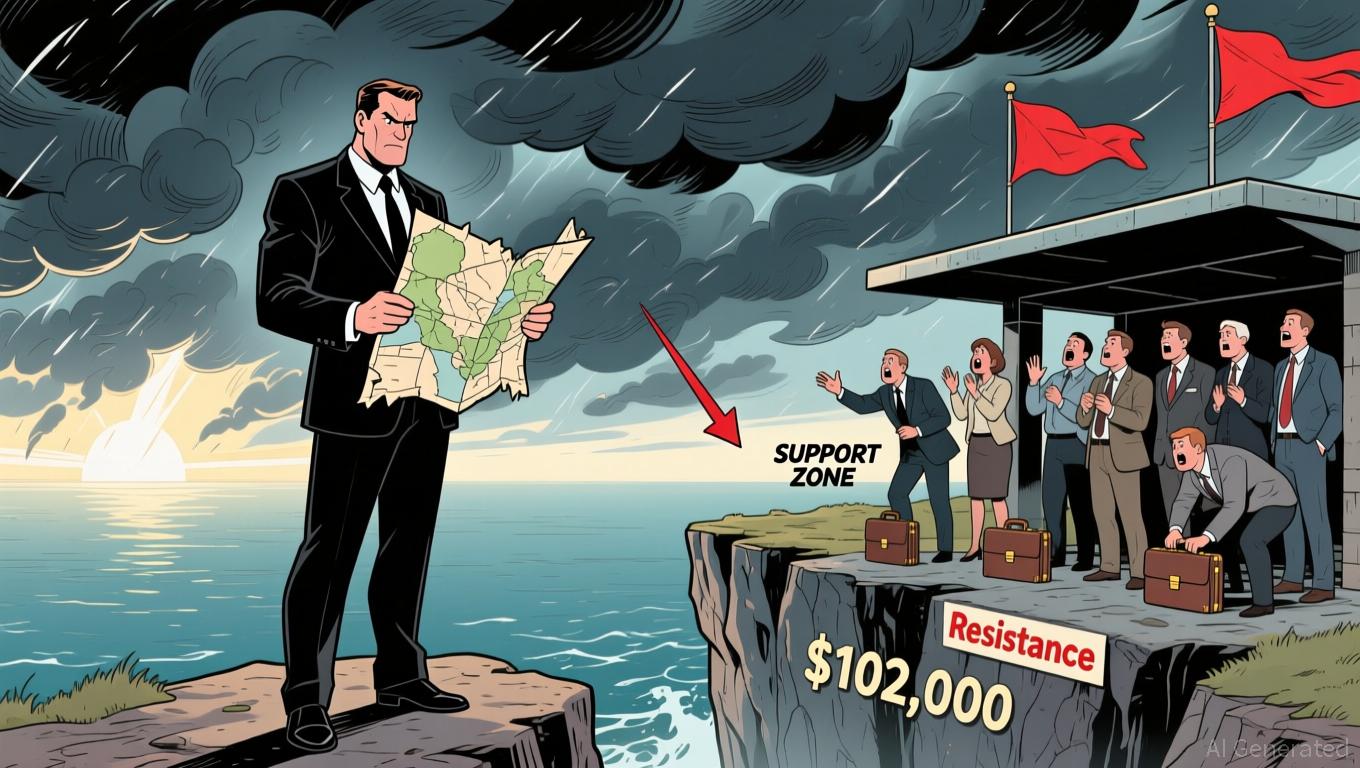
- Bitcoin fell 0.9% on Nov 11, 2025, testing $102,000 support amid heavy selling and lower highs. - ETF inflows ($524M) favored Bitcoin over Ethereum (-$107M), but weak post-shutdown inflows raised sustainability concerns. - On-chain data showed 23% higher spot volume and rising whale activity (EWR 0.55), suggesting accumulation. - Analysts debated $102,000's resilience, with potential targets at $107,400 or $100,500 depending on institutional buying.


- AllScale launches $120K Global Creator Program to boost digital innovation and attract creators. - Astar Network’s EVM compatibility and decentralized governance plans reflect industry trends toward democratizing platforms. - Mixed Q3 results across education and tech sectors highlight balancing profitability with innovation. - Challenges like Riskified’s revenue drop and Snail Inc.’s losses underscore market volatility, making AllScale’s incentives critical for stability.
- Ethereum's price fell 3.46% to $3,417.77 on Nov. 11, its largest drop since Nov. 4, with a 11.44% monthly decline despite a 2.18% year-to-date gain. - Institutional investors accumulated $1.37B worth of ETH during the $3,247–$3,515 pullback, but failed to reclaim $3,350 resistance, intensifying bearish concerns. - Technical indicators show deteriorating momentum below key EMAs, with $3,300–$3,200 as critical support levels and 138% above-average selling volume confirming institutional participation. - De

- Shodai Network raised $2.5M in seed funding led by ConsenSys to address crypto's "toxic capital" misalignment issues. - The platform aims to align incentives between developers and investors through open-source tools and community-driven structures. - Backed by Ethereum co-founder Joseph Lubin, Shodai faces regulatory risks but gains credibility through ConsenSys' technical expertise. - This initiative reflects growing institutional demand for sustainable crypto fundraising solutions amid intensified reg
- Ark Invest boosts Circle stake by 353,300 shares, signaling confidence in stablecoin growth amid market volatility and regulatory clarity. - Circle reports $740M Q3 revenue (66% YoY) and $73.7B USDC circulation, but faces margin pressures and a $482M net loss despite strong cash flow. - Ark shifts focus from Tesla to Circle and Alibaba , selling $30. 3M in Tesla shares amid China sales concerns and AI-driven tech bets. - Regulatory progress like the U.S. GENIUS Act and Circle's strategic partnerships (e.
- EigenCloud and LayerZero launch EigenZero, a decentralized cross-chain validation network using economic incentives and cryptographic constraints. - The "optimistic verification" model slashes staked ZRO tokens for malicious activity, aligning validator interests with network security. - By combining LayerZero's interoperability with EigenCloud's staking infrastructure, EigenZero reduces reliance on centralized bridges while maintaining trustless validation. - The solution enables scalable, cost-effectiv
- Japan's FSA and JPX are strengthening crypto regulations to prevent risks from hoarding and insecure management, balancing innovation with investor protection. - The FSA's proposed pre-approval system for crypto providers aims to address vulnerabilities exposed by the $312M DMM Bitcoin hack linked to Tokyo firm Ginco. - JPX plans to restrict listed companies from accumulating digital assets, following global trends as Japan hosts 14 listed Bitcoin buyers—the most in Asia. - Parallel stablecoin pilots wit