
News
Stay up to date on the latest crypto trends with our expert, in-depth coverage.


Key FedNow Contributor: Precise Method In Which Banks Can Use XRP for Payments
TimesTabloid·2026/05/04 17:03
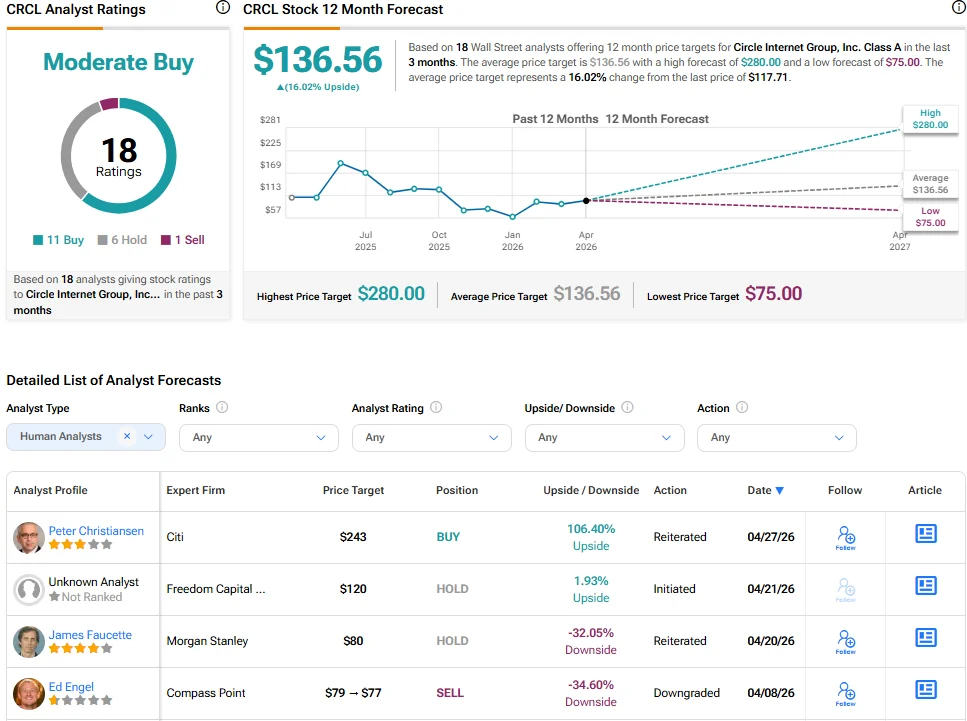
Why Circle (CRCL) Stock Is Surging 18% Today – May 4, 2026
Tipranks·2026/05/04 17:03

BlockDAG, Ethereum, PAX Gold, & Bitcoin Cash Are the Best Cryptos to Buy in May 2026
BlockchainReporter·2026/05/04 17:00
Applied Digital lines up $300M bridge loan to accelerate AI data center build
Crypto.News·2026/05/04 17:00
Silver’s rally may only be getting started
Mining.com·2026/05/04 16:57
White House Crypto Policy Chief To Close Hedera Conference, Revealing HBAR’s Next Phase
DailyCoin·2026/05/04 16:57
Prompt Injection Attack Drains $202K from Grok Wallet, Funds Partially Recovered
CoinEdition·2026/05/04 16:51
Are You Missing Palantir's $200B Tech Secret?
TradingView·2026/05/04 16:51
Nvidia: Triple Confluence?
TradingView·2026/05/04 16:48
Oracle: Has the Tide Turned?
TradingView·2026/05/04 16:48
Flash
01:59
Oil Price Retreats as Non-Inflation "Antidote": AI Investment and Domestic Demand Overheating Put the Fed in a Dilemma, Market Expects Two Interest Rate Hikes This YearBlockBeats News, June 26th. Following the U.S.-Iran ceasefire and the resumption of traffic through the Strait of Hormuz, oil prices quickly plummeted. While this may seem to alleviate inflationary pressures on the surface, the market's bet on the Fed's rate hikes has hardly loosened. This rare divergence is sparking deep discussions on Wall Street.
Reuters columnist Mike Dolan pointed out the core contradiction: even before the Iran conflict erupted, signs of overheating in the U.S. economy were already evident. From January to February this year, core inflation was already more than 1 percentage point above the Fed's 2% target. The fall in oil prices not only cannot eliminate inflation stickiness but may instead release consumer and investment demand previously suppressed by high oil prices, further raising price pressures. This situation puts the Fed in a double bind of "rising oil prices driving inflation and falling oil prices stimulating overheating."
Apollo Global Management's Chief Economist, Strock, stated that the traditional positive correlation between oil prices and the 2-year U.S. Treasury yield has broken down. The market's mainstream view has shifted to "the resumption of the Strait of Hormuz will further exacerbate U.S. economic overheating." The May PCE released on Thursday rose to 3.4% year-on-year, remaining above the policy target; both the June composite PMI readings also exceeded expectations, with upward pricing pressure from businesses still at elevated levels. Meanwhile, the AI capital expenditure boom continues to drive the stock market bull run, expanding household wealth, forming a self-reinforcing cycle of inflation.
JPMorgan Chase's mid-year outlook clearly states that the Fed's next move is highly likely to be a rate hike, but the timing may be delayed until 2027, creating a discrepancy with the futures market pricing in two rate hikes this year. The bank's strategy team warned that the probability of an economy in a "Goldilocks"-like scenario of low inflation and moderate growth continues to decline, raising the necessity of targeted rate hikes.
Furthermore, the policy communication reform spearheaded by Fed Chair Powell—substantially reducing forward guidance—further complicates market trading. Morgan Stanley believes this will significantly increase the market's sensitivity to economic data, causing the center of gravity for short-term fixed-income asset volatility to continually shift upward, leading to increased macro trading uncertainty.
01:55
BTC falls below $59,000, with nearly 80% of long positions liquidated—is the market bottoming out?BTC is currently trading near $59,278, down 2.40% in the past 24 hours and 5.68% over the past 7 days. The Fear & Greed Index has dropped to 13, indicating market sentiment remains in the extreme fear zone. In the past 24 hours, total liquidations across the market reached $3.05 billion, with long positions accounting for $2.41 billion, nearly 80% of the total. This shows that the current downturn mainly triggered a concentrated flush-out of leveraged longs, alleviating overheated sentiment to some extent. However, open interest remains elevated, meaning deleveraging is not yet complete. The market is now closer to a recovery phase after risk release, rather than having confirmed a bottom.From the price action, after BTC's sharp decline, significant buying has emerged in the $58,000 to $60,000 range, with spot orders concentrated around $58,000, $59,000, and $60,000, providing short-term support. At the same time, BTC perpetual contract funding rates have turned positive from negative, indicating some shorts have started to take profits, creating a technical rebound demand in the short term. However, the $60,000 to $60,200 zone remains a key resistance area; if it cannot be breached with strong volume, the price may revisit $58,000 or even $57,000, with the market likely to continue consolidating and forming a bottom.In terms of opportunities, after extreme fear and concentrated long liquidations, long-term investors may consider scaling in to BTC positions gradually to reduce volatility risk through position management. In the short term, it is advised to wait for a rebound to resistance levels before looking for trading opportunities based on volume and price structure. On the other hand, SOL is one of the few major coins experiencing a net capital inflow, and with continued accumulation by some whales, its short-term performance may continue to outperform the overall market. However, it is best to avoid chasing highs and consider buying on dips after pullbacks.Currently, the US dollar remains strong, and the macro environment continues to weigh on risk assets. If BTC breaks below the $58,000 support, further testing of the $57,000 to $55,000 range cannot be ruled out. Until a reversal trend is confirmed, it is recommended to focus mainly on spot allocation, control position size, and maintain low leverage in contract trading.
01:55
The US Federal Aviation Administration proposes to accelerate the certification process for new types of commercial aircraft.Glonghui, June 26 — The U.S. Federal Aviation Administration (FAA) on Thursday proposed a reform plan aimed at modernizing and accelerating the certification of new commercial aircraft types, as well as aligning relevant regulations with Europe. The FAA stated that by harmonizing certain requirements with the European Union Aviation Safety Agency (EASA), the reforms would benefit manufacturers by providing unified standards and reducing certification costs, time, and complexity. Both agencies have pledged to strengthen cooperation in safety and certification. The proposal is expected to boost the business of manufacturers such as Boeing, Airbus, Embraer, and Bombardier.