
10-Year U.S. Treasury Yield Nears 5%: Will U.S. Stocks Crash? Trading Opportunities in Gold and Equity Indices Amid Rate Hikes and Fiscal Deficits
U.S. inflation remains sticky. Alongside Federal Reserve interest-rate policy, widening fiscal deficits, and increased supply of long-term Treasury bonds, U.S. Treasury yields have once again become a major focus for global markets. As the 10-year U.S. Treasury yield approaches the psychological 5% threshold, investors naturally worry: Could higher interest rates trigger a broad sell-off in U.S. stocks? Can gold continue its safe-haven rally?
From a market perspective, the absolute level of yields is certainly important. However, the factors that truly influence risk assets are often the pace at which yields rise and whether the credit market deteriorates at the same time.
With the 10-Year Treasury Yield Nearing 5%, the Psychological Threshold Matters More Than the Number Itself
U.S. inflation remains above the Federal Reserve’s long-term 2% target, strengthening expectations that interest rates will remain elevated. When the 10-year Treasury yield approaches 5%, investors typically reassess the return differences between stocks, bonds, and cash.
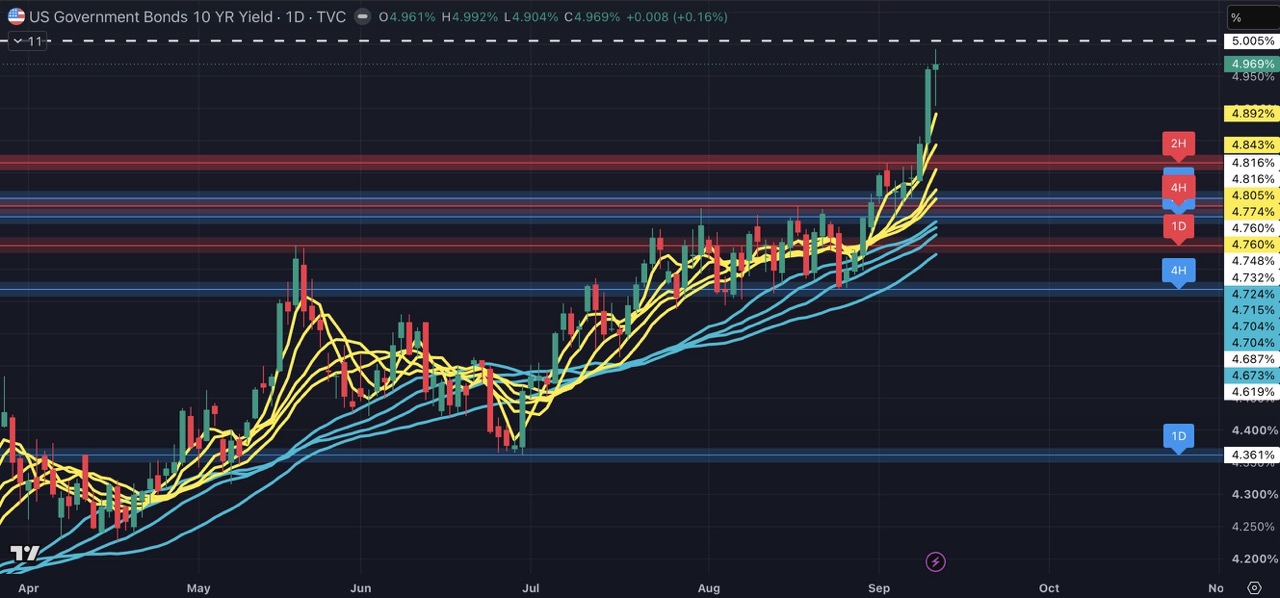
If the yield rises gradually from 4.85% to 5%, markets generally have time to digest the change, while companies and investors can gradually adjust their asset allocations. However, if yields surge by more than 10 basis points within a short period, discount rates may rise rapidly, putting pressure on high-price-to-earnings stocks.
Large technology companies, AI-related stocks, and businesses that depend heavily on future earnings growth are particularly sensitive to changes in interest rates. When the risk-free rate rises, investors may be willing to pay lower price-to-earnings multiples. As a result, stock prices may face valuation adjustments even if their fundamentals have not immediately deteriorated.
Therefore, a break above 5% in the 10-year Treasury yield does not necessarily mean that U.S. stocks will inevitably crash. However, if it is accompanied by a sharp rise in yields, widening credit spreads, and deteriorating corporate financing conditions, market volatility could increase significantly.
Fiscal Deficits and Long-Term Treasury Supply Are Key Drivers of Higher Yields
In addition to monetary policy, the U.S. government’s fiscal position is a core factor behind the rise in long-term Treasury yields.
As fiscal deficits continue to expand, the U.S. Treasury needs to issue more government debt to raise funds. If the pace of supply growth exceeds investor demand, bond prices may come under pressure, causing yields to rise accordingly.
This also explains why the market reaction may remain relatively muted even after the Treasury announces an expansion of its long-term Treasury buyback program. Buybacks can help improve liquidity in certain securities and provide marginal support for bond prices. However, compared with the overall size of the U.S. Treasury market, a single operation worth several billion dollars may not be enough to alter the long-term supply-and-demand structure.
More importantly, when the government actively introduces measures to try to lower long-term Treasury yields, the market may interpret the move as a sign that officials are concerned about pressure in the long-end bond market. In other words, while the policy may be intended to stabilize markets, it may also remind investors that the problems of fiscal deficits, debt levels, and interest expenses remain unresolved at a fundamental level.
Will U.S. Stocks Crash? Credit Spreads Are a More Important Indicator to Watch
Assessing whether U.S. stocks could experience a systemic decline requires more than simply watching whether the 10-year Treasury yield breaks through a round-number threshold. Investors also need to monitor whether the credit market is showing signs of stress.
Credit spreads represent the additional risk premium investors demand for corporate bonds compared with U.S. Treasuries. If spreads on investment-grade and non-investment-grade bonds remain stable, it generally suggests that the market is not yet broadly concerned about corporate defaults or a sharp deterioration in financial conditions.
Conversely, if credit spreads widen rapidly while yields are rising, it may indicate:
-
A significant increase in corporate financing costs
-
Selling pressure in the high-yield bond market
-
Lower risk appetite among banks and financial institutions
-
A slowdown in corporate investment and M&A activity
-
Simultaneous pressure on stock-market valuations and fundamentals
Under these conditions, a market decline may no longer be limited to valuation adjustments in technology stocks. It could spread further to financials, industrials, consumer stocks, and other sectors.
Investors should therefore assess the “pace of yield increases” together with “changes in credit spreads,” rather than using 5% alone as the sole signal for determining the market’s direction.
Higher Rates Could Lead to Greater Differentiation Across the Stock Market
Even if Treasury yields remain elevated, U.S. stocks do not necessarily have to decline across the board. In a high-interest-rate environment, the market is more likely to experience structural differentiation.
Companies with the following characteristics generally have relatively stronger resilience:
1. Stable cash flows and low debt levels
2. Pricing power that allows them to pass higher costs on to customers
3. Actual revenue from AI, cloud computing, or data-center businesses
4. Relatively strong supply chains and market positions
5. Low reliance on external financing
By contrast, companies that remain in a high-capital-expenditure phase, have yet to achieve mature profitability, or rely heavily on low-cost financing may face greater pressure.
This means that a high-yield environment does not necessarily eliminate opportunities across the entire stock market. However, investors need to place greater emphasis on earnings quality, cash flow, and balance sheets rather than simply chasing popular market themes.
If the U.S. Dollar Weakens, Gold’s Safe-Haven Appeal Could Increase
Rising Treasury yields may theoretically support the U.S. dollar. However, if markets begin to worry about the U.S. fiscal deficit, debt burden, or policy credibility, the dollar could also face medium- to long-term pressure.
When inflation remains elevated, fiscal deficits expand, and investors become concerned about monetary policy and fiscal discipline, gold’s role extends beyond that of a traditional safe-haven asset. It may also serve as a portfolio tool for diversifying exposure to the dollar and sovereign credit risk.
Gold prices are typically influenced by several factors, including:
-
Changes in real interest rates
-
The performance of the U.S. Dollar Index
-
Federal Reserve interest-rate policy
-
Geopolitical risks
-
Central-bank demand for gold
-
Safe-haven sentiment in global financial markets
It is important to remember that gold does not only move higher. If Treasury yields rise rapidly while the dollar strengthens at the same time, gold may still face short-term pressure. Gold traders should therefore monitor the dollar, real interest rates, and overall market risk sentiment together.
How Can CFD Traders Respond to Yield Changes and Market Volatility?
For CFD traders, changes in Treasury yields are not merely a bond-market issue. Through their impact on valuations, the U.S. dollar, and safe-haven demand, they can also influence price volatility in gold and equity indices.
The following market scenarios are worth monitoring:
Scenario 1: Yields Rise Gradually
If the 10-year Treasury yield rises gradually without a significant widening in credit spreads, the market may experience sector rotation. While high-valuation technology stocks come under pressure, financial, energy, or value-oriented equity indices may show relatively greater resilience.
Scenario 2: Yields Surge Rapidly
If long-term yields rise sharply within a short period, markets may see simultaneous declines in risk assets, a stronger U.S. dollar, and increased volatility in gold. In such circumstances, traders should avoid excessive leverage and monitor key support and resistance levels.
Scenario 3: Yields Rise While the Dollar Weakens
If the main reason for rising yields is fiscal concern rather than simply improving economic growth, the U.S. dollar may behave differently from traditional market expectations. If the dollar weakens while inflation expectations rise, gold may regain market favor.
Scenario 4: Credit Spreads Widen
If the credit market deteriorates at the same time, it may indicate that financial conditions are tightening rapidly. In this situation, volatility in equity indices will typically increase, and traders should prioritize risk management, position sizing, and stop-loss planning.
Conclusion: Focus on “How Yields Rise,” Not Just “How High They Go”
A 10-year Treasury yield approaching 5% could certainly increase pressure on stock valuations, but it does not necessarily mean that U.S. stocks will experience a broad crash. The key risks for markets are whether yields rise rapidly, whether credit spreads widen, and whether fiscal and monetary policies further weaken investor confidence.
Under these conditions, the market may become increasingly divided. Companies with stable cash flows and healthy financial structures may prove relatively resilient, while high-valuation companies, businesses with heavy capital-spending requirements, and those dependent on financing may face greater volatility. Meanwhile, if the dollar weakens, inflation remains sticky, and fiscal concerns persist, gold may continue to offer medium- to long-term portfolio diversification and safe-haven value.
Investors may benefit from analyzing Treasury yields, the U.S. dollar, credit spreads, and equity-market volatility within a single framework. Scenario planning, rather than making a one-directional market bet, can help improve the flexibility of trading decisions.
Capture Market Volatility with Bitget CFD: Trade Gold and Equity Indices
When Treasury yields, the U.S. dollar, and market risk sentiment change rapidly, gold and equity indices may present more trading opportunities. Through Bitget CFD, you can trade gold and major equity indices flexibly and participate in both rising and falling markets.
Visit Bitget today to explore CFD trading tools for gold and equity indices and build a market strategy that suits you.
All trading education provided by Bitget is for educational purposes only and should not be considered financial advice. The strategies and examples shared are for reference only and may not reflect actual market conditions. CFD trading involves significant risk, including the potential loss of capital. Past performance does not guarantee future results. Please conduct thorough research and ensure that you understand the risks involved. Bitget is not responsible for any trading decisions made by users.


- With the 10-Year Treasury Yield Nearing 5%, the Psychological Threshold Matters More Than the Number Itself
- Fiscal Deficits and Long-Term Treasury Supply Are Key Drivers of Higher Yields
- Will U.S. Stocks Crash? Credit Spreads Are a More Important Indicator to Watch
- Higher Rates Could Lead to Greater Differentiation Across the Stock Market
- If the U.S. Dollar Weakens, Gold’s Safe-Haven Appeal Could Increase
- How Can CFD Traders Respond to Yield Changes and Market Volatility?
- Conclusion: Focus on “How Yields Rise,” Not Just “How High They Go”

 Top Small-Cap Stocks to Watch2026-09-14 | 5m