
News
Stay up to date on the latest crypto trends with our expert, in-depth coverage.
1Bitget Daily Digest (Dec. 10)|13.8 billion LINEA tokens unlock today; Trump will begin the final round of interviews for the next Federal Reserve Chair this week2Bitcoin’s back above $94K: Is the BTC bull run back on?3BlackRock Enters Ethereum Staking With a First-of-Its-Kind ETF

Fed Meeting Outcome Today: FOMC Expectations and Forecast
Coinpedia·2025/12/10 19:27
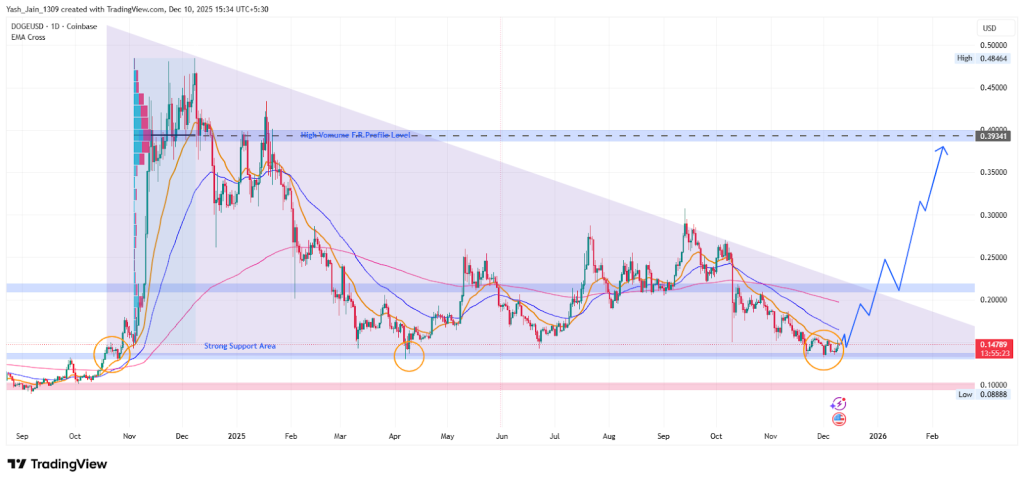
Dogecoin Price Prediction 2025, 2026 – 2030: Will DOGE Reach 1 Dollar?
Coinpedia·2025/12/10 19:27

Federal Reserve's Major Shift: From QT to RMP, How Will the Market Transform by 2026?
The essence of RMP, the mystery surrounding its scale, and its impact on risk assets.
Chaincatcher·2025/12/10 18:16
Questioning the Necessity of Gas Futures: Does the Ethereum Ecosystem Really Need Them?
ChainFeeds·2025/12/10 18:14

How did the Do Kwon trial trigger an 1.8 billion USD speculative frenzy?
Bitpush·2025/12/10 18:05
Crypto Game under Hawkish Rate Cuts: How FOMC Night Reshapes Asset Pricing Logic
Bitpush·2025/12/10 18:05

a16z "Big Ideas for 2026: Part One"
This article will share perspectives from the Infrastructure, Growth, Bio + Health, and Speedrun teams.
Block unicorn·2025/12/10 18:04

Bitcoin (BTC), Ethereum (ETH), and Solana (SOL) levels for the FOMC
market pulse·2025/12/10 17:39
Flash
- 19:32Dot plot interpretation: 1 person believes there should be 6 rate cuts in 2026, while 3 people believe there should be 1 rate hike.ChainCatcher news, according to Golden Ten Data, the median of the Federal Reserve's dot plot shows that the Fed will cut interest rates once in 2026, once in 2027, and keep rates unchanged in 2028. Looking at the specific points, 3 members believe that there should be one rate hike in 2026 (2 in September), 4 members believe rates should remain unchanged in 2026 (6 in September), 4 members believe there should be one rate cut in 2026 (2 in September), 4 members believe there should be two rate cuts in 2026 (4 in September), 2 members believe there should be three rate cuts in 2026 (3 in September), 1 member believes there should be four rate cuts in 2026 (2 in September), and 1 member believes there should be six rate cuts in 2026 (0 in September).
- 19:32FOMC raises GDP forecasts for 2025-2028, lowers PCE forecasts for 2025-2026According to ChainCatcher, citing Jinse Finance, the FOMC economic projections show that the median interest rate forecast is exactly the same as in September, while the GDP forecasts for 2025-2028 have been revised upward, and the PCE and core PCE forecasts for 2025-2026 have been revised downward.
- 19:24"Fed Mouthpiece": Three Rate Cuts Fail to Ease Internal Disputes, "Stagflation Risk" Requires VigilanceJinse Finance reported that "Fed mouthpiece" Nick Timiraos recently wrote that Federal Reserve officials have cut rates for the third consecutive meeting, but there is unusual disagreement within the Fed over whether inflation or the job market should be the bigger concern, so officials have indicated little willingness to continue cutting rates. Public comments from Fed officials in recent weeks show that the committee is deeply divided, to the extent that the final decision may depend on how Fed Chair Powell wishes to proceed. Powell's term will expire in May next year, meaning he will only preside over the next three rate-setting meetings. Persistent price pressures alongside a cooling labor market have presented the Fed with an unpleasant trade-off not seen in decades. During the so-called "stagflation" period of the 1970s, when officials faced a similar dilemma, the Fed's stop-and-go approach allowed high inflation to become entrenched. Jonathan Pingle, Chief U.S. Economist at UBS, said: "As rates approach neutral levels, with each rate cut, you lose the support of more participants, and you need data to motivate those participants to join the majority in order to achieve a rate cut."
News