
 Sizning tilingiz hozirda qo'llab-quvvatlanmaydi va siz avtomatik ravishda ingliz tilidagi maqolaga yo'naltirildingiz.
- Bitget

- Tadqiqot
- Bitget news
- Bitget Introduction to Institutional Loans(UTA)
Bitget Introduction to Institutional Loans(UTA)


2025/09/30
Bitget Institutional Lending is a borrowing service specifically for institutional clients. During the loan period, borrowers pay interest, while Bitget provides them with stable and cost-effective funding. The borrowed amount is credited directly to the funding account balance without the need to lock up collateral assets, thereby further enhancing capital utilization efficiency.
Product rules
Institutional Loans with 5x leverage for unified trading accounts
|
Product name
|
Institutional Loans with 5x leverage for unified trading accounts
|
|
Eligibility
|
Users of PRO1 and above with institutional identity verification (KYB)
|
|
Borrowable assets
|
USDT、USDC、BTC、ETH
|
|
Loan leverage
|
5x
|
|
Supported accounts
|
|
|
Collateral assets
|
Collateral amount refers to the total USDT value of all institutional lending collateral assets in your unified trading account,more details:Institutional Loan Supporting Collateral Assets
Note: When placing a spot order, if you convert collateral assets for your institutional loans into non-collateral assets or collateral assets with a lower haircut, your LTV may reach or exceed the liquidation threshold, causing the order to be immediately liquidated. Please manage your risk to avoid potential asset losses.
|
|
Loan term
|
1–12 months
|
|
Interest calculation
|
Daily interest accrual and monthly interest settlement
Daily interest accrued = outstanding loan principal x daily interest rate
|
|
Lending account
|
Dedicated unified trading sub-account in the risk unit
|
|
Repayment rules
|
Repayment date:
Repayment scenarios:
|
|
Interest repayment rules
|
|
|
Interest-free program
|
Institutional Loans offer the opportunity to secure 0% interest through an upon meeting monthly trading volume while otherwise adhering to Bitget Institutional loan interest costing. Please refer to Bitget Institutional Loan Interest-Free Program.
|
Risk Management
|
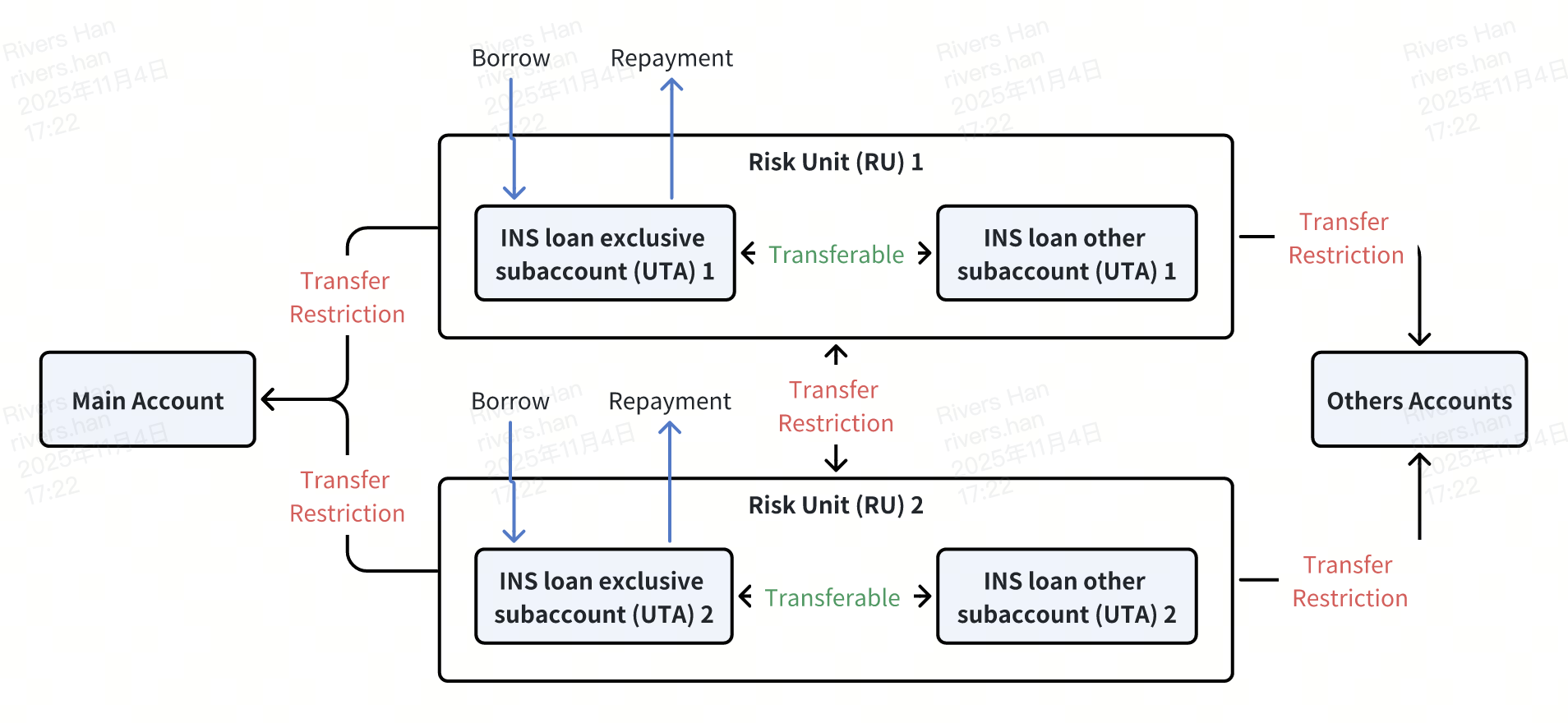
Risk unit rules
 |
|
LTV calculation formula
|
|
LTV trading restrictions
|
|
Liquidation (new process)
When the risk ratio reaches or exceeds 90%, the liquidation and repayment process will be triggered as follows:
1. Cancel open orders: Any open orders of spot, USDT-M and USDC-M perpetual futures, or Coin-M Futures in the UTA will be canceled.
2. No-loss payment: If the transferable assets in your UTA are sufficient for reducing the LTV to approximately 80%, the system will transfer available assets from your UTA for repayment to lower the LTV and end the liquidation.
When there is insufficient asset:
3. Transfer and convert balance for repayment: UTA balance in collateral coins of your institutional loan will be transferred and converted for repayment.
Example: A user has 3 BTC in their account and needs to repay 100,000 USDT for their institutional loan. Assuming the BTC-to-USDT exchange rate is 30,000 USDT (slippage included), the converted amount would be 90,000 USDT. After the repayment, the remaining debt amount would be 10,000 USDT.
4. Repay until 100% IMR: Transfer collateral coins with positive equity in your UTA until the initial margin rate (IMR) reaches 100% or above.
Example: A user needs to repay 100,000 USDT for their institutional loan and has 10,000 USDT in their UTA and 30,000 USDT in unrealized PnL. To reach a 100% IMR, a repayment of 20,000 USDT is required. 20,000 USDT will be transferred from the user's UTA for institutional loan repayment. The user's balance becomes −10,000 USDT, with an unrealized PnL of 30,000 USDT.
5. Repay until100% MMR: Transfer collateral coins with positive equity in your UTA until the maintenance margin rate (MMR) reaches 100% or above.
Example: A user needs to repay 100,000 USDT for their institutional loan and has 10,000 USDT in their UTA and 30,000 USDT in unrealized PnL. To reach a 100% MMR, a repayment of 20,000 USDT is required. 20,000 USDT will be transferred from the user's UTA for institutional loan repayment. The user's balance becomes –10,000 USDT, with an unrealized PnL of 30,000 USDT.
6. Address collateral shortfall: If all of the above steps are completed, but the collateral remains insufficient, trading and withdrawals of all user IDs in the risk unit will be restricted.
7.Liquidation settlement fee:
A settlement fee will be collected by the Loans Insurance Funds. Please monitor your risk level closely to avoid liquidation. Calculation formula:
Liquidation fee = liquidation asset × 2%.
8.Institutional loan liquidation and UTA liquidation
If a unified trading sub-account is already undergoing liquidation, it will be excluded from the liquidation triggered by an institutional loan.
|
Trading mode
|
Permissions
|
Main account (UTA)
|
Institutional loans dedicated sub-account (UTA)
|
Institutional loan sub-account (UTA)
|
|
Spot trading
|
Supported
|
Supported
|
Supported
|
|
Spot margin (UTA)
|
Supported
|
Supported
|
Supported
|
|
Futures trading
|
Supported
|
Not supported
|
Supported
|
|
Spot elite and copy trading
|
Not supported
|
Not supported
|
Not supported
|
|
Futures elite and copy trading
|
Not supported
|
Not supported
|
Not supported
|
|
Spot trading
Spot trading bot
|
Not supported
|
Not supported
|
Not supported
|
|
Futures trading
Futures trading bot
|
Not supported
|
Not supported
|
Not supported
|
|
Convert
|
Not supported
|
Not supported
|
Not supported
|
LTV Calculation Case
The case is as follows, the client's loan amount is 200000U:
Account assets within the risk unit
| UID | Coin | Coin equity of collateral assets | USD index price | Equity |
| 100001 | USDT | 150,000 | 1 | 150,000 |
| 100001 | USDC | 100,000 | 1 | 100,000 |
| 100001 | BTC | 2 | 60,000 | 120,000 |
| 100002 | USDT | 200,000 | 1 | 200,000 |
| 100002 | BTC | -3 | 60,000 | -180,000 |
| 100003 | USDT | 200,000 | 1 | 200,000 |
Currency assets
| Coin | Coin equity of collateral assets | USD index price | Equity |
| USDT | 550,000 | 1 | 550,000 |
| USDC | 100,000 | 1 | 100,000 |
| BTC | -1 | 60,000 | -60,000 |
Collateral Assets
| Coin | Collateral value ratio | Maximum collateral value(USDT) |
| USDT | 100% | 1,000,000 |
| USDC | 95% | 1,000,000 |
| BTC | 95% | 1,000,000 |
Step 1: Calculate the unified account collateral assets
Converted assets=550,000 × 100%+100,000 × 95% -60000=585,000 U
Step 2: Calculate LTV
LTV=(remaining unpaid principal + remaining unpaid interest)÷ risk unit asset value (in USDT)=200,000/585,000=34.1%
FAQ
1.How do I apply for an institutional loan?
-
You must be PRO1 or above and have completed institutional identity verification (KYB). If you are an institution or a high-volume trader seeking greater flexibility, we will also assess your request.
-
Contact your relationship manager or send your inquiry to institution@bitget.com, and a dedicated BD will contact you.
2.What are the advantages of Institutional Loans?
-
Supports a wide range of collateral asset types.
-
Improves fund utilization by supporting up to 5x leverage for loan proceeds that are credited directly to the borrower's account, with no over-collateralization requirement.
-
Offers competitive interest rates and flexible borrowing amounts, and borrowers who reach certain trading thresholds may qualify for an interest exemption.
3.Can Institutional loans be transferred out of Bitget?
No. Our Institutional Loan offers “low-collateral, high-leverage ”financing to boost your trading scale and efficiency on Bitget. Unlike standard Credit Line, the funds are locked in a Risk Unit for internal trading only and are non-withdrawable
4.Supported trading pairs and collateral assets
-
Supported trading pairs:Ins Loan API
-
Supported collateral assets:Institutional Loan collateral assets and haircut
5.Risk Unit Rule Explanation:
-
Risk Unit refers to a designated grouping of sub-accounts (UIDs). All sub-accounts within a single set must belong to the same master-sub account hierarchy.
-
Master accounts are not eligible to bind in Risk Unit, each sub-account UID can be linked to only one Risk Unit.
-
Each risk unit must designate one sub-account as the Dedicated Loan Sub-account.
-
A sub-account UID can only be unbound from the risk unit after all outstanding loans have been repaid, or its balance is zero.
-
Binding /Unbinding sub-account UIDs to a risk unit via OpenAPI is supported. For more details, please refer to :Institutional Loan API.
6.Are there any trading restrictions on the Dedicated Loan Sub-account?
Yes. The dedicated loan sub-account does not support contract trading. We recommend using a sub-account that is not used for day-to-day trading to serve as the settlement account within the Risk Unit.
7.What are the prerequisites for binding a sub-account?
-
When joining a Risk Unit, all sub-accounts must ensure that the leverage of any existing contract positions does not exceed the leverage limit set for that Risk Unit.
-
Risk Unit derivatives leverage limits can be queried via the Institutional Loan API.
8.How is interest calculated?
Interest accrues on a daily basis starting from the date the loan funds are credited. The accrued interest is included in your Risk Unit liabilities. The system automatically charges interest on the 1st of each month; if you are eligible for an interest-free benefit, the interest rate will be automatically adjusted to 0% at the time of charging and settled accordingly.
9.What is the loan-to-value (LTV) ratio?
Risk management of the risk unit is based on the loan-to-value ratio (LTV), which is calculated as follows: LTV = (remaining unpaid principal + remaining unpaid interest)÷ risk unit asset value (in USDT).
You can manage your LTV ratio by transferring assets to/from your unified trading sub-account risk unit.
You can query the LTV ratio through OpenAPI. Refer to:Institutional Loan API.
10.Can margin be deposited into a custodial account for institutional loans (e.g., Cooper, Fireblocks custodial wallets)?
For risk control reasons, assets held in third-party custodial wallets or mirrored to a Bitget account cannot be used as collateral for institutional loans. Collateral for institutional loans must be locked within the Risk Unit.
Join Bitget, the World's Leading Crypto Exchange and Web3 Company